Cushion cuts look simple at first glance. But issues typically arise when the cushion style, proportions, and intended setting are not aligned early in the design process. Inconsistent sparkle, unexpected center darkness, or a finished piece that performs differently under everyday lighting are common challenges.
In other cases, a cut that seemed right on paper fails to align with the intended setting or overall design direction.
Much of this stems from treating cushion cut as a single category rather than a family of distinct styles. Antique, brilliant, and modified cushions differ meaningfully in faceting, light behavior, and setting compatibility. Understanding these differences early helps prevent design compromises, mismatched visual outcomes, and avoidable rework down the line.
Why Cushion Cuts Matter?
Cushion cuts occupy a unique position in diamond cutting. They balance softness with geometry, offering rounded corners without the rigidity of a round brilliant or the severity of a princess cut. That flexibility appeals to diverse design requirements and aesthetic preferences.
The cushion category is deceptively broad. Small changes in facet arrangement produce dramatic shifts in how a diamond performs under different lighting. A stone cut one way throws bold flashes across a room. Another glows softly with scattered pinpoints of light. Both are technically cushions, but they deliver completely different visual experiences.
Cushion specifications often lack clarity in sourcing requests. A generic "cushion cut" requirement spans these three lab-grown styles from Solitaire Lab Diamond, where we specialize in affordable, IGI-certified options for wholesalers. Accurate identification prevents mismatches and supports bulk orders across sizes and grades.
If you are evaluating different diamond shapes and their performance characteristics, understanding cushion variations becomes even more critical.
Comparison of Cushion Cuts at a Glance
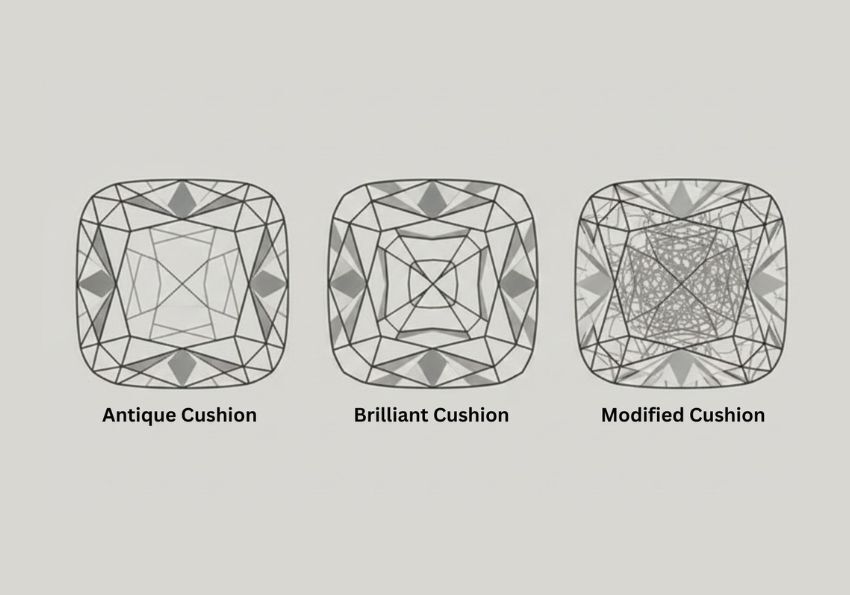
Cushion cuts fall into three main categories, which are antique cushion, cushion brilliant, and cushion modified brilliant. Each reflects a different cutting and approach to managing light.
|
Aspect |
Antique Cushion |
Brilliant Cushion |
Modified Cushion |
|
Light behavior |
Large, slow-moving flashes that change noticeably with movement |
Organized, repeating sparkle with a balanced rhythm |
Many small reflections that blend into a soft, shimmering glow |
|
Overall sparkle style |
Bold and deliberate rather than continuously brilliant |
Structured and intentional brilliance |
Diffused sparkle that feels gentle and blended |
|
Face-up appearance |
May display a darker or softer-looking center depending on culet size, pavilion facet alignment, and overall optical symmetry |
Bright and evenly lit with clear light and dark contrast |
Generally uniform brightness, though with less contrast and punch |
|
Visual personality |
Strong, character-driven, and distinctive |
Clean, balanced, and refined |
Soft, romantic, and understated |
|
Setting compatibility |
Best suited to vintage-inspired designs, halos, bezels, and ornate metalwork |
Versatile. Works well in solitaires, classic designs, and modern settings |
Works best in romantic, decorative designs rather than minimalist settings |
|
Best for buyers who |
Appreciate historical cuts and visible craftsmanship |
Want a traditional diamond look with consistent brilliance |
Prefer subtle sparkle and a softer overall glow |
|
Overall approach |
Expressive and architectural |
Controlled and symmetrical |
Fluid and blended |
The sections explore each type in detail, explaining what they are and how they look.
Antique Cushion - Old Mine Style
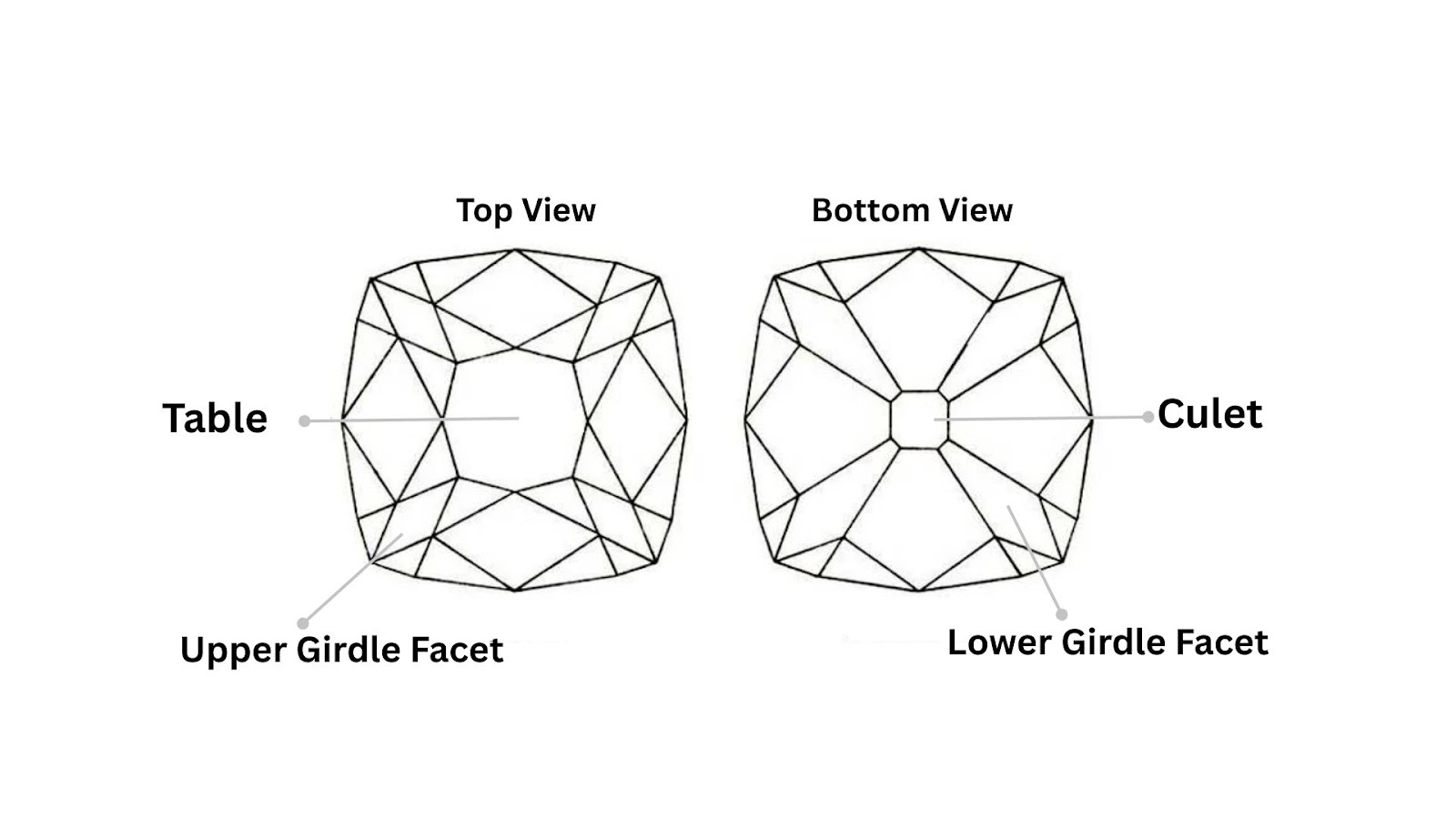
Antique cushions trace their lineage to old mine cuts, which predate modern precision cutting. These stones were shaped by hand, often with a focus on preserving carat weight rather than optimizing light return. The result is a cut with a high crown, a small table, and a culet that's sometimes visible to the naked eye.
The faceting on an antique cushion is simple and direct. Large facets create bold, distinct flashes of light rather than continuous brilliance. When light enters the stone, it reflects in chunky patterns that feel deliberate and structured. This is not a diamond that tries to disappear into sparkle. It announces itself with broad, confident flashes that shift as the stone moves.
Color tends to show more readily in antique cushions because of their proportions. The deeper pavilion and higher crown concentrate color toward the center of the stone. For warmer diamonds, this can work in your favor. The vintage character feels enhanced rather than hindered by a slight tint. For colorless stones, higher color grades become necessary compared to brilliant cuts of equivalent face-up appearance.
Antique cushions work naturally in designs that embrace their historical roots. Halo settings, bezel frames, and ornate metalwork complement the cut's bold presence. They're less suited to ultra-modern or minimalist settings, where their chunky facet pattern might feel out of place.
Cushion Brilliant - Modern Style
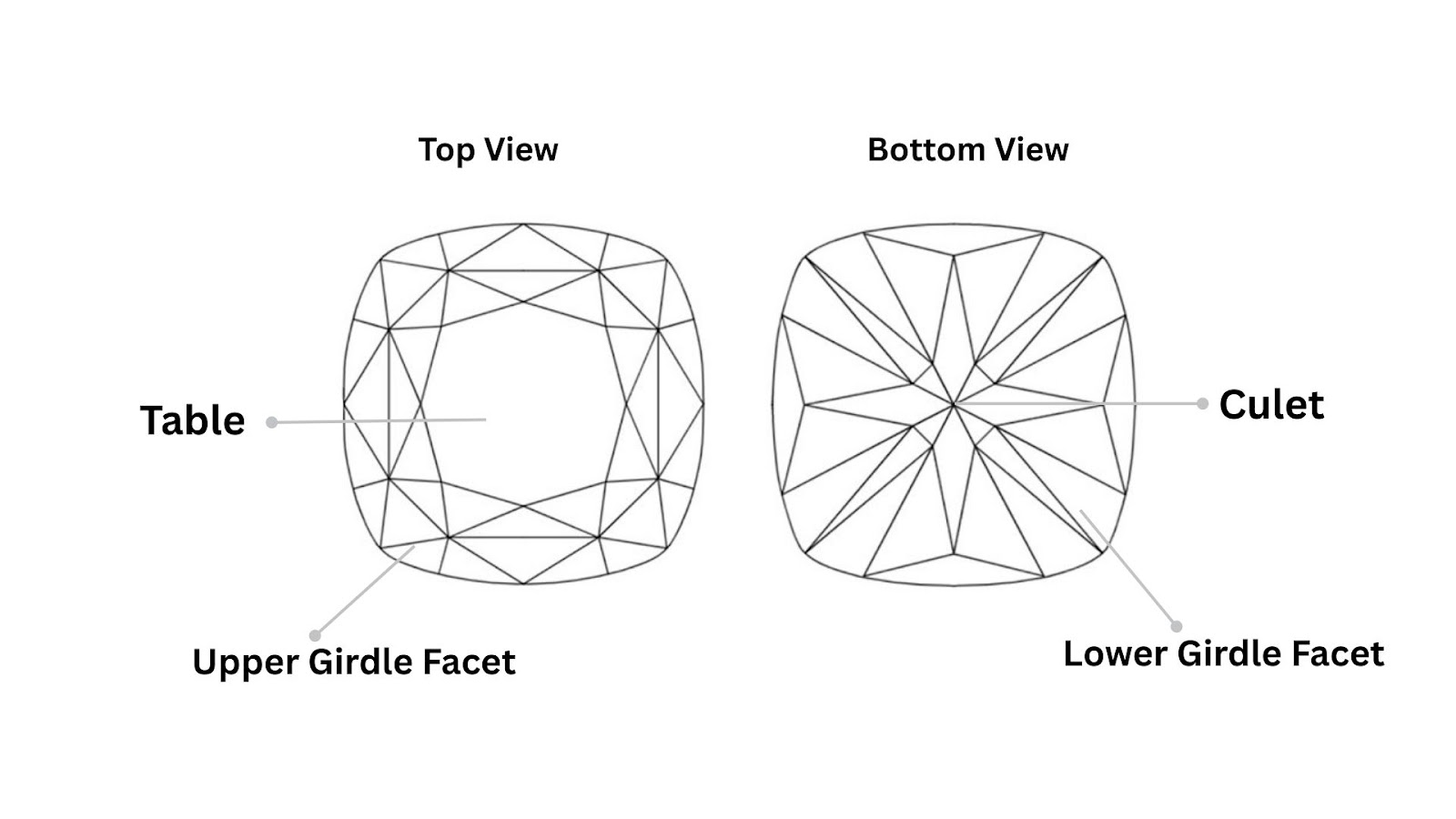
Cushion brilliants represent the modern interpretation of the cushion shape. They're cut to contemporary standards with a focus on brightness, symmetry, and contrast. The pavilion follows a brilliant-style facet arrangement adapted specifically to a cushion outline, with variations in main facet structure and symmetry depending on the cutter.
The result is a diamond with crisp, organized sparkle. Facets form an organized, repeating pattern that produces clear contrast between light and dark areas. Light moves through the stone in a controlled way, producing alternating areas of brightness and shadow that give the diamond definition and depth.
Well-proportioned cushion brilliants typically face up whiter than antique cushions due to more efficient light return and reduced light absorption. They also maintain more consistent appearance across different lighting conditions. Under bright lights, they show clear contrast. Under softer ambient light, they maintain a clean, structured glow.
This cut offers the widest design versatility. It works in solitaires, three-stone settings, halos, and contemporary designs. This flexibility makes it a reliable choice when the setting style hasn't been finalized or when working with designs that may shift during development.
The consistent performance and broad compatibility make cushion brilliants the most straightforward cushion style to work with across different applications.
Cushion Modified Brilliant - Crushed Ice Style
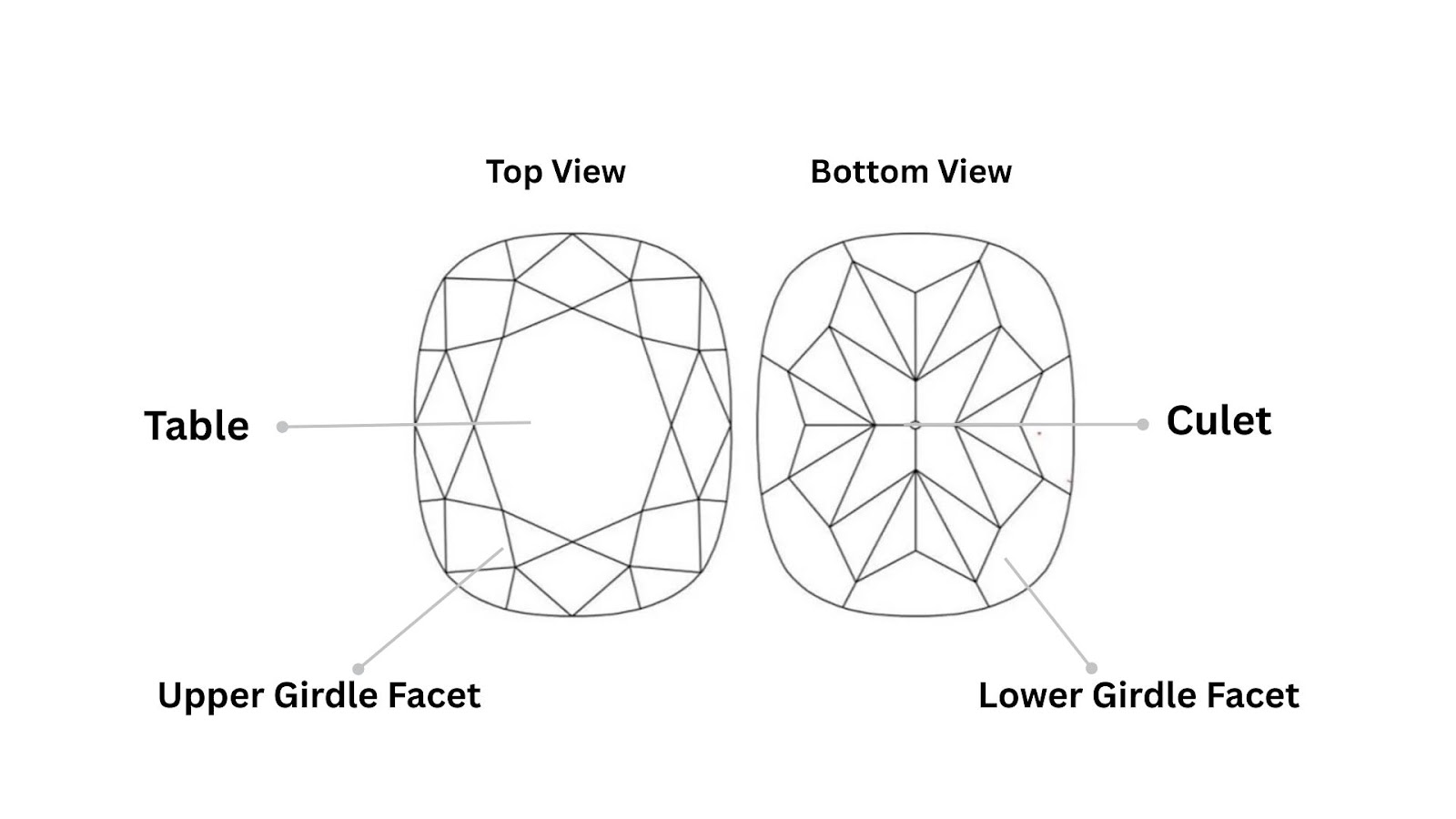
Cushion modified brilliants add extra rows of facets to the pavilion by introducing additional or split pavilion facets that break light into smaller reflections. This additional faceting breaks light into smaller fragments, creating a dispersed sparkle pattern rather than distinct flashes or organized brilliance.
The visual result varies significantly by execution. Some modified cushions retain partial structure while showing increased fragmentation. Others commit fully to the crushed ice appearance, where individual facets become nearly impossible to distinguish, and the stone presents as a field of tiny sparks. This inconsistency creates sourcing challenges because "modified cushion" doesn't guarantee a specific look.
The cut generates polarized reactions. Some find the dispersed pattern appealing. Others consider it lacks definition. You can't predict which response you'll get, which makes clear specification critical before sourcing.
Modified cushions offer advantages in certain scenarios. The fragmented sparkle pattern can reduce the visual prominence of certain inclusions, though visibility ultimately depends on inclusion type and placement. This makes modified cushions particularly valuable for budget-conscious sourcing where size matters more than technical perfection.
Depending on depth and overall proportions, some modified cushions may present a broader face-up appearance, though the spread varies significantly by execution.
These diamonds work naturally in designs emphasizing softness and delicate details. Pavé bands and smaller halo settings complement the gentle sparkle. They struggle in designs requiring bold contrast or clean geometric lines, where the dispersed pattern reads as weak rather than refined.
Choosing the Right Cushion Cut
The right cushion cut depends on what the diamond needs to do, how it should perform in its intended setting, and which sparkle pattern aligns with the design specifications.
Direct comparison under consistent lighting conditions reveals performance differences. The goal is matching the cut's character with the design requirements, not defaulting to a single style for every application.
Solitaire Lab Diamond supplies lab-grown cushion cuts across all three styles, curated to meet specific cut, proportion, and optical requirements. We provide antique, brilliant, and modified cushions in different sizes, color grades, and clarity specifications.
Our dual-facility operation provides supply chain flexibility and consistent quality control across orders. We handle IGI (the most commonly used standard for lab-grown cushion cuts) and GCAL certifications, accommodate specific proportion requests, and maintain reliable turnaround times.
Contact us to discuss your sourcing requirements or explore our collection to order samples across different cushion cutting styles.