Not every diamond is cut to dazzle from across the room. Some are cut to reward the people who look closely. Asscher cut diamonds are exactly that kind of stone.
For jewelry retailers, designers, and trade buyers sourcing fine diamond inventory, the Asscher cut sits in a category of its own. It is geometric, architectural, and quietly commanding. From Elizabeth Taylor's 33-carat Krupp diamond to Pippa Middleton's engagement ring, the cut carries genuine Art Deco heritage that translates into retail story value. But it is also one of the most technically demanding shapes to source well.
Get the specifications right, and you have a stone that commands a strong retail price and holds its position in any fine jewelry collection.
This blog covers what buyers in the trade need to know: the anatomy of the cut, the specifications that matter, clarity, and color standards.
What Is an Asscher Cut Diamond?
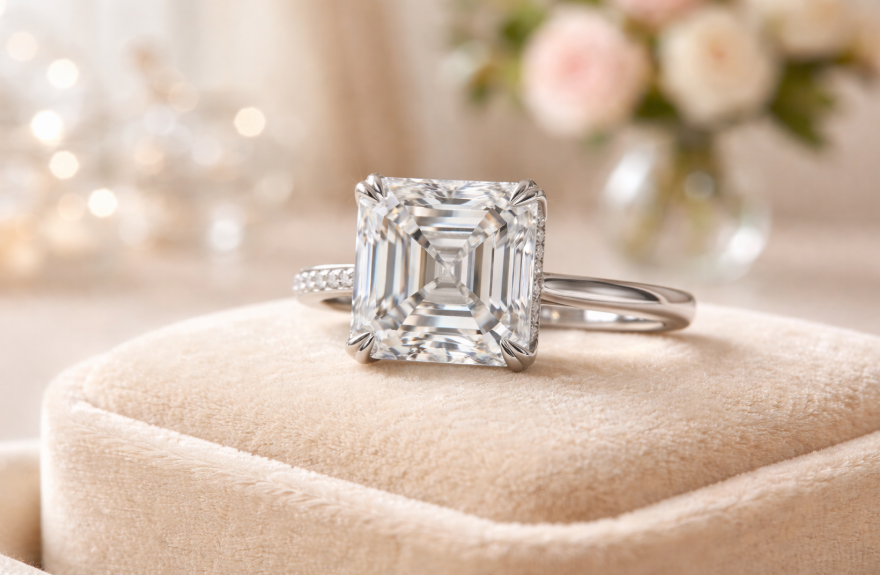
An Asscher cut diamond is a square step-cut stone with cropped corners, giving it a distinctive octagonal outline when viewed from above.
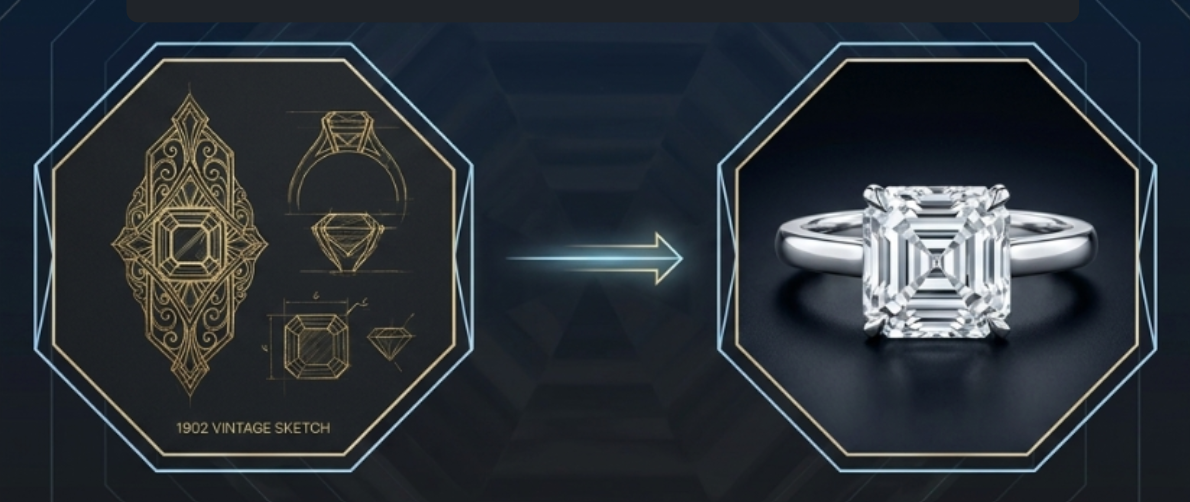
Unlike brilliant cuts that are designed to maximise sparkle through light refraction, the Asscher produces what is known as the "hall of mirrors" effect, deep, concentric reflections that draw the eye into the stone rather than off its surface.
Joseph Asscher created this cut in 1902 in Amsterdam. It became the signature stone of the Art Deco era and has seen consistent demand in vintage-inspired and fine jewelry collections since. It is also one of the few diamond cuts with a genuine heritage story, which adds value at the retail level.
Standard Asscher vs. Royal Asscher
These two cuts differ in structure, not just quality level, so pricing and positioning must reflect that. Always confirm which version you are quoting, as sourcing and margins vary significantly.
|
Feature |
Standard Asscher |
Royal Asscher |
|
Facet Count |
58 |
74 |
|
Table Size |
Broader |
Smaller |
|
Depth |
Shallower |
Deeper pavilion |
|
Visual Effect |
Softer step pattern |
Strong hall-of-mirrors effect |
|
Cut Type |
Traditional Asscher |
Patented variation |
|
Sourcing |
Widely available |
Licensed cutters only |
|
Price Position |
Lower |
Premium |
|
Product Nature |
Standard cut |
Distinct, non-interchangeable cut |
Key Specifications of Asscher Cut Diamonds
These parameters define whether a stone performs well visually and commercially. Ignoring them often leads to poor inventory decisions and slower sales.
1. Length-to-Width Ratio
The ideal range is 1.00 to 1.05. Anything outside this window causes the stone to appear off-square, and the Asscher's defining geometry falls apart. Stones with ratios beyond 1.05 are harder to place in retail settings and are typically priced lower for that reason.
2. Depth and Table Percentage
- Recommended depth: 61% to 67%
- Recommended table: 60% to 65%
Depth drives the hall-of-mirrors effect. Cut too shallow, and the reflections collapse. Cut too deep, and the stone carries weight in the pavilion that does not show face-up, meaning you are paying for carat weight the buyer cannot see.
Since GIA does not assign an official cut grade to fancy shapes, these two numbers are your primary indicators of cutting quality.
3. Symmetry and Polish
The Asscher's windmill pattern, the X-shaped reflection visible through the table, only appears when facet alignment is precise. Any deviation in the lobes or crown disrupts it entirely. There is no scattered light to compensate for a poor execution, unlike with round or cushion cuts.
For retail-grade inventory, only Excellent or Very Good grades on both symmetry and polish are worth considering.
4. Girdle and Culet
A medium to slightly thick girdle is preferred for durability in finished jewelry settings. The culet should be none too pointed. These are often overlooked in sourcing, but they affect how the stone behaves in prong and bezel settings.
Why Clarity Standards Are Stricter for Asscher Cut Diamonds
The step-cut structure makes inclusions easier to detect. Higher clarity is required to maintain a clean, premium appearance.
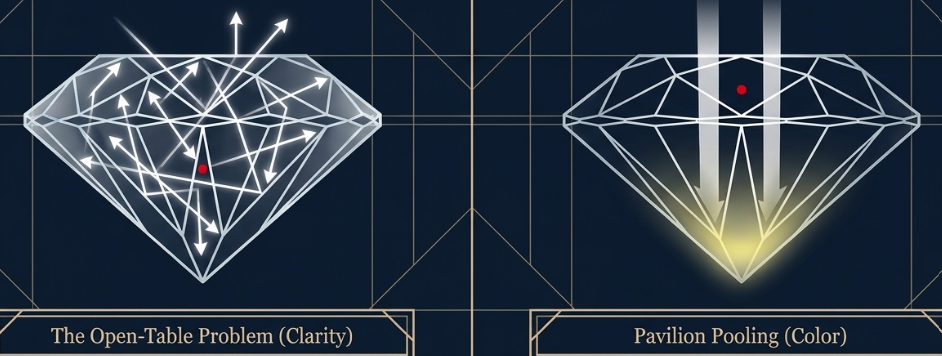
1. Open-Table Problem
Step-cut facets do not scatter or fragment light. They reflect it in broad, unbroken planes. This means any inclusion sitting under the table or near the center of the stone is directly visible to the naked eye, with no sparkle masking it. What is in the stone is what the buyer sees.
2. Clarity Benchmarks for Trade Sourcing
- VS2 minimum for standard inventory
- VS1 or better for stones 1.5ct and above
- SI1 is only acceptable if the inclusion is positioned at the edge and completely outside the table area
Do not rely on grade alone; use GIA or IGI clarity plotting maps to confirm inclusion placement before committing to a stone.
Color Grading in Asscher Cut Lab Diamonds
Open facets pool body color rather than break it up. The pavilion depth then concentrates any yellow tint toward the center of the stone, where it is most visible. G color is the practical minimum for trade-grade Asscher inventory. D to F is appropriate for high-end or bespoke collections.
Lab-grown production yields a significantly higher proportion of D to F color stones compared to natural rough. HPHT growth tends to produce Type IIa colorless stones more consistently; CVD output is more variable and worth factoring into your sourcing decisions.
IGI color certification is the accepted standard for lab-grown step-cut diamonds in the trade.
Pros and Cons of Asscher Cut Diamonds
For trade buyers building a balanced inventory, the Asscher cut offers clear advantages but also specific risks that need managing.
Pros
- Strong Niche Market Appeal: Art Deco and vintage-inspired segments are growing, and the Asscher is the natural fit.
- Price Advantage: In lab-grown versus natural at equivalent specifications.
- Distinctive Appearance: It differentiates a collection from round-heavy inventories.
- Durable Design: Cropped corners reduce the chipping risk associated with sharp-cornered cuts like princess cuts.
Cons
- Strict Clarity Requirements: Limit the viable price tiers in your inventory.
- Color Sensitivity: It means you cannot go below G without affecting the stone's retail appeal.
- Lower Demand Volume: Compared to round brilliants, this is a specialty shape, not a core mover.
- Size Perception Gap: Asschers carry depth, weight, and appear smaller face-up than other shapes of equal carat weight, which requires careful client communication.
- Sourcing Difficulty: Well-cut stones with Excellent symmetry and VS+ clarity in a proper 1.00 to 1.05 ratio are not easy to find in high volume.
Quick Reference: Asscher Cut Sourcing Specifications
|
Parameter |
Recommended Range |
|
L/W Ratio |
1.00 – 1.05 |
|
Depth |
61% – 67% |
|
Table |
60% – 65% |
|
Clarity |
VS2 min (VS1+ for 1.5ct+) |
|
Color |
G min (D–F for premium) |
|
Symmetry |
Excellent / Very Good |
|
Polish |
Excellent / Very Good |
|
Certification |
IGI or GIA |
FAQs
Are Asscher cut lab-grown diamonds certified the same way as natural ones?
Yes. Asscher cut lab-grown diamonds are certified by IGI and GIA using the same grading criteria applied to natural stones, 4Cs, symmetry, polish, and plotting map.
Why is there no official cut grade for Asscher cut diamonds from GIA?
GIA does not assign official cut grades to Asscher cuts because that grade is reserved for round brilliants only. For fancy shapes like the Asscher, symmetry and polish grades on the certificate serve as the closest proxies for cut quality.
What is the difference between an Asscher cut and an emerald cut?
Both the Asscher and emerald cut are step cuts. The emerald cut is rectangular; the Asscher is square with cropped corners. The Asscher also tends to have a higher crown and deeper pavilion, which produces a more pronounced hall-of-mirrors effect.
What carat range moves best for the Asscher cut in retail?
The 1.00ct to 2.00ct range sees the strongest retail demand for Asscher cuts. Below 1ct, the step-cut detail becomes less visible. Above 2ct, the price point narrows the buyer pool significantly.
How does Asscher cut pricing compare to round brilliant for trade buyers?
Asscher cut diamonds are generally priced lower per carat than round brilliants at equivalent 4C specifications. In lab-grown, this gap can be meaningful, which gives trade buyers room to work on margin.
Final Thoughts!
The Asscher cut is not the easiest shape to source well, and that is precisely what makes it worth understanding. The clarity floor is strict, color sensitivity is real, and symmetry is non-negotiable.
But when you source within the right specification window (VS2 or better, G or above, Excellent symmetry, 1.00–1.05 ratio), you have a stone with a clear retail identity and a story that sells itself.
Lab-grown production makes meeting those standards more consistent and cost-effective than ever before. The supply side is in your favor; the work is in selecting the right stones.
If you are building or refreshing an inventory of certified Asscher cut diamonds, Solitaire Lab Diamond carries IGI-certified stones across a range of specifications built for retail and bespoke supply.