
Retailers and jewelry designers order baguette cut diamonds more consistently than almost any other accent shape. Yet sourcing them without a clear framework leads to mismatched sets, color problems, and setting failures that cost time and client trust.
If you're looking for certified lab-grown baguette diamonds with consistent calibration, this is the right starting point.
In this guide, we'll cover what baguettes are, how straight and tapered varieties differ, and the specifications that actually matter when you're placing an order.
What Is a Baguette Cut Diamond?
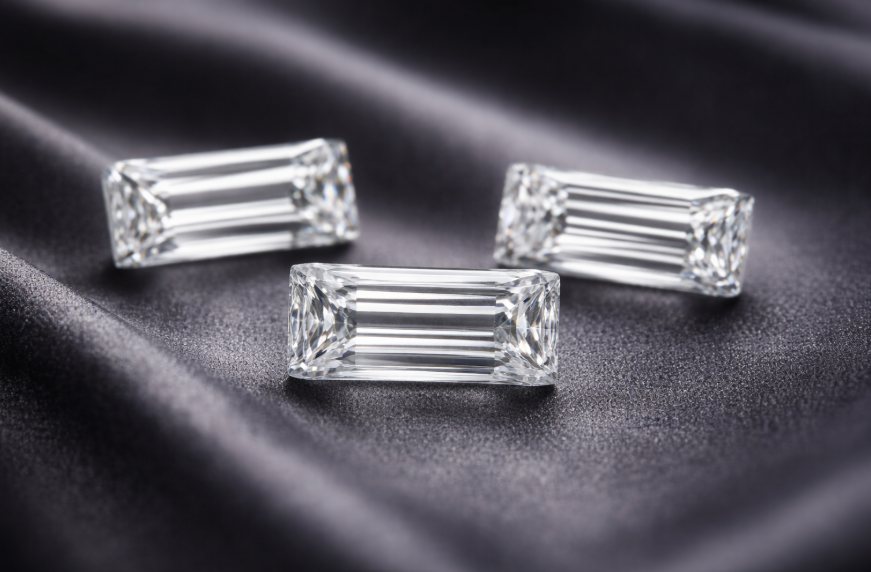
A baguette cut diamond is a rectangular step-cut stone with 14 facets and perfectly square, unbeveled corners. It belongs to the step-cut family alongside emerald and Asscher cuts. But unlike the emerald cut, baguettes have no clipped corners. That sharp-cornered geometry is the quickest way to tell them apart.
The facet structure creates what jewelers call a "hall of mirrors" effect. Light moves through the stone in long, clean reflections rather than the scattered sparkle of a brilliant cut. It's a subtler look, and that's exactly why baguettes work so well as accent stones. They frame the center diamond without competing with it.
Typical length-to-width ratios run from 1.5:1 up to 5:1. Cartier popularized this cut around 1912, and it became a defining shape of the Art Deco period. Today, it remains one of the most ordered side stone shapes in engagement and bridal jewelry.
Straight Baguette vs. Tapered Baguette: What's the Difference
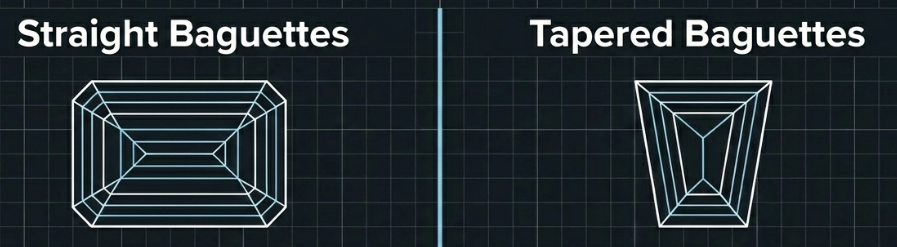
Straight baguettes deliver clean, linear symmetry that works best in structured designs, while tapered baguettes guide the eye inward, making them ideal for framing a center stone. The decision depends on whether you want uniformity across the piece or a natural visual flow toward a focal point.
|
Feature |
Straight Baguette |
Tapered Baguette |
French Baguette |
|---|---|---|---|
|
Shape |
Parallel sides; rectangular |
Trapezoidal; one narrow end |
Rectangular; step-cut crown |
|
Visual Effect |
Clean, continuous line |
Directs focus to center |
High sparkle and light return |
|
Best For |
Channel sets and eternity bands |
Engagement ring side stones |
Designers wanting more "fire" |
|
Ordering Key |
Length and width (0.1mm) |
Wide end, narrow end, and length |
Specific facet pattern |
|
Pro Tip |
Match dimensions over weight |
Usually sourced as matched pairs |
Combines step and brilliant cuts |
Key Sourcing Specifications for Baguette Cut Diamonds
This is where the sourcing decisions actually happen. Getting these right protects your margins and reduces returns.
1. Dimensions Over Carat Weight
Order baguettes by millimeter size, not carat weight. In a multi-stone setting, surface area consistency is what creates a clean, matched look. Two baguettes can share the same carat weight but look mismatched if their dimensions differ.
For straight baguettes, specify L x W. For tapered, specify wide-end width, narrow-end width, and length, all to 0.1mm tolerance.
2. Color Grade Considerations
Step cuts reveal body color more readily than brilliant cuts. Fewer facets and a shallow pavilion mean there's less brilliance to mask warmth in the stone.
When placing baguettes next to a round brilliant center, the baguette will read warmer at the same color grade. Compensate by going one grade higher on the baguette. For most commercial designs, G to H works well.
If your center stone is D to F, source baguettes at F to G minimum. Color consistency across the matched set matters as much as the grade itself.
3. Clarity Grade Considerations
With fewer facets, inclusions are easier to spot. VS1 and above is the standard for side stones that will be clearly visible. VS2 to SI1 can work in smaller melee sizes, but detail-conscious retail clients will reject stones that show inclusions under normal viewing conditions.
Avoid stones with inclusions near the edges or corners. Those areas are already structurally vulnerable in a step-cut; an inclusion there is both a durability risk and a visual problem.
4. Symmetry and Cut Precision
In a multi-stone setting, any deviation from parallel facets is immediately visible. Asymmetrical baguettes don't just look off; they make the whole piece look poorly made.
For matched sets, hold dimensional tolerance to within 0.1mm across the group. Symmetry grade matters more in baguettes than in brilliant cuts, where sparkle can mask slight irregularities.
Best Jewelry Applications for Baguette Side Stones
Once you understand the sourcing specs, the application decisions follow naturally.
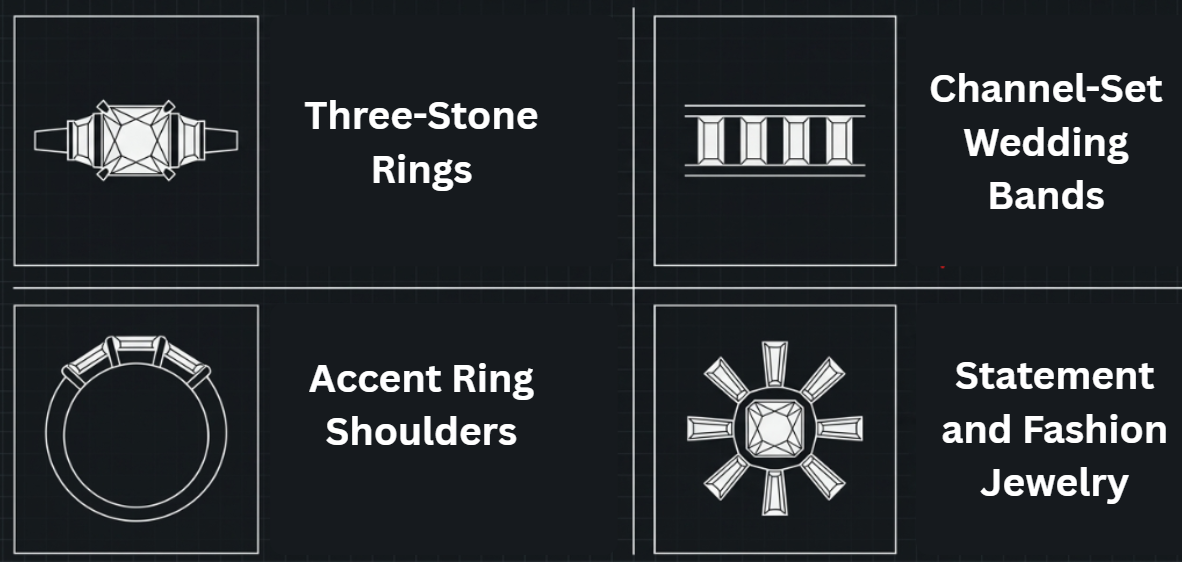
1. Three-Stone Engagement Rings
Tapered baguettes flanking a center stone is the classic three-stone configuration. The step-on-step pairing of an emerald cut center with tapered baguette sides is a consistent seller; both cuts share the same visual language of clean lines and geometric precision. Radiant and round brilliant centers also work well.
2. Channel-Set Wedding Bands and Eternity Rings
Straight baguettes are the preferred choice here. Their rectangular shape sits flush without gaps, making them more space-efficient than rounds in a channel setting. Bar and bezel settings provide structural protection for the straight edges, which are more vulnerable to chipping than beveled corners.
3. Accent Rows in Ring Shoulders
Both straight and tapered baguettes appear in shoulder accents. Channel or bezel settings are preferable to prong settings for longevity. The corners of a baguette are the first point of contact if the stone shifts, and an exposed corner chips easily.
4. Statement and Fashion Jewelry
Ballerina halo rings, where tapered baguettes are set radially around a center stone, pointing outward, are a strong Art Deco-revival design that continues to perform at retail. Baguette eternity bands in modern minimalist settings are also trending across multiple price points.
Baguette Cut Lab-Grown vs. Natural Diamonds
Lab-grown diamonds offer better consistency and margins, while natural stones carry traditional appeal and established demand. The decision usually comes down to pricing strategy, supply reliability, and the customer segment you serve.
|
Factor |
Natural Baguette Diamonds |
Lab-Grown Baguette Diamonds |
|
Price per Carat |
Higher; market-driven pricing |
Significantly lower; better cost control |
|
Supply Consistency |
Variable; harder to match at scale |
More consistent; better calibrated sizing |
|
Dimensional Matching |
Requires more sourcing effort for matched sets |
Easier to source in uniform calibrated sizes |
|
Certification |
GIA, IGI, and other labs |
IGI and GIA certified |
|
Retailer Margin |
Moderate |
Higher margin potential |
|
Consumer Demand |
Established; strong in traditional bridal |
Growing; especially in accent and fashion jewelry |
|
Color Consistency |
Can vary batch to batch |
More uniform across production batches |
|
Availability in Small Sizes |
Generally available but inconsistent |
Readily available in melee and accent sizes |
|
Design Cohesion |
Mixed with lab-grown centers requires justification |
Preferred pairing with lab-grown center stones |
|
Ethical Sourcing Narrative |
Requires traceability documentation |
Inherently traceable origin story |
Frequently Asked Questions
What's the difference between a baguette and an emerald cut diamond?
Both are rectangular step cuts. The key difference between a baguette and an emerald cut diamond is the corners. Emerald cuts have diagonally clipped corners, while baguettes have perfectly square, sharp corners. Baguettes also have fewer facets and are rarely used as center stones.
How do I specify tapered baguettes for matched pairs?
To specify tapered baguettes for matched pairs, provide the wide-end width, narrow-end width, and length to 0.1mm precision. Pairs are typically specified by total weight, but dimensional accuracy is what determines whether they'll set cleanly.
What color grade works best next to a round brilliant center?
For the best color match next to a round brilliant center, go one grade higher on the baguette. A G-color baguette next to an H-color brilliant will read as a closer match than stones with the same grade.
Are lab-grown baguettes GIA or IGI certified?
Yes. Lab-grown baguettes are certified by both labs. IGI is more commonly used for lab-grown accent stones in the trade.
What's the standard clarity grade for baguette accent stones?
VS1 is the standard clarity grade for visible baguette accent stones. VS2 works in smaller sizes but carries more risk for discerning buyers.
Quick Recap!
We started with a straightforward problem: baguette cut diamonds are one of the most consistently ordered accent shapes in fine jewelry, yet most buyers source them without a clear framework. Hopefully, this blog narrows that gap.
The sourcing checklist is short. Order by dimensions, not carat weight; compensate for color grade when pairing with brilliant cuts. Hold clarity at VS1 or above for visible stones, and hold matched sets to 0.1mm dimensional tolerance.
Get those four right, and baguettes become one of the easiest accent shapes to source reliably.
Lab-grown baguettes make the most sense for most trade applications, better calibration, better margins, and consistent supply across sizes. As demand for lab-grown bridal and fashion jewelry continues to grow, having a reliable source for matched accent stones is a genuine advantage.
Ready to source certified lab-grown baguette cut diamonds with consistent calibration? Browse Solitaire Lab Diamond's inventory.