The heart shaped diamond is one of the most recognizable fancy cuts in fine jewelry. Its distinctive silhouette makes it an immediate statement, but beneath that shape sits a technically demanding cut that requires precise symmetry, balanced lobes, and a well-defined cleft to perform at its best.
While the shape is closely associated with romance and sentiment, the decision to choose one should be grounded in the same quality criteria that apply to any serious diamond purchase. Cut precision, length-to-width ratio, and clarity all play a significant role in how a heart shaped diamond looks face-up.
This guide covers the anatomy of the cut, how to evaluate one accurately, what settings work best, and the key benchmarks that separate a well-executed heart shaped diamond from a poorly cut one.
What Is a Heart Shaped Diamond?
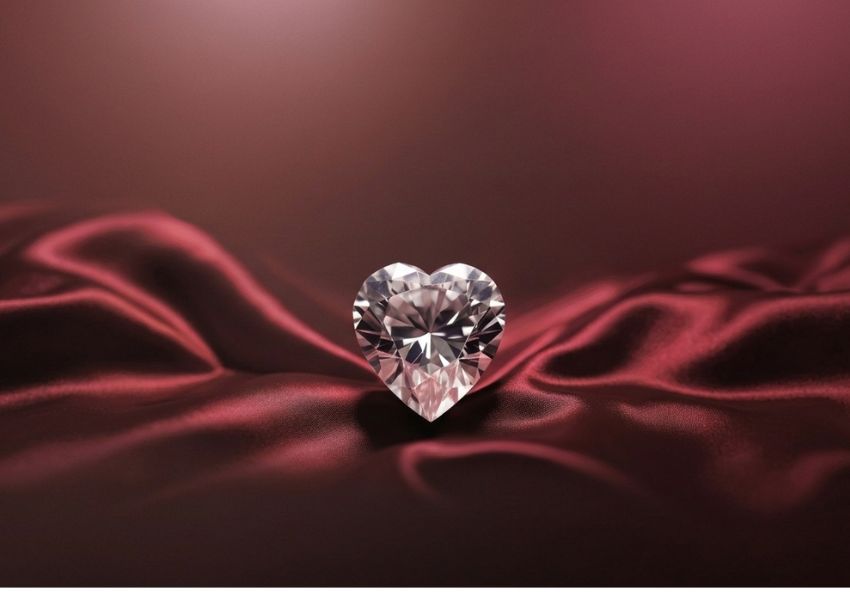
A heart-shaped diamond is a fancy-cut diamond with two symmetrical, rounded lobes, a defined cleft at the top, and a single point at the base. It typically features 56 to 58 facets and is classified as a modified brilliant cut, designed to maximize light return across one of the most structurally complex outlines in diamond cutting.
Structurally, the heart shaped diamond is defined by several critical parts:
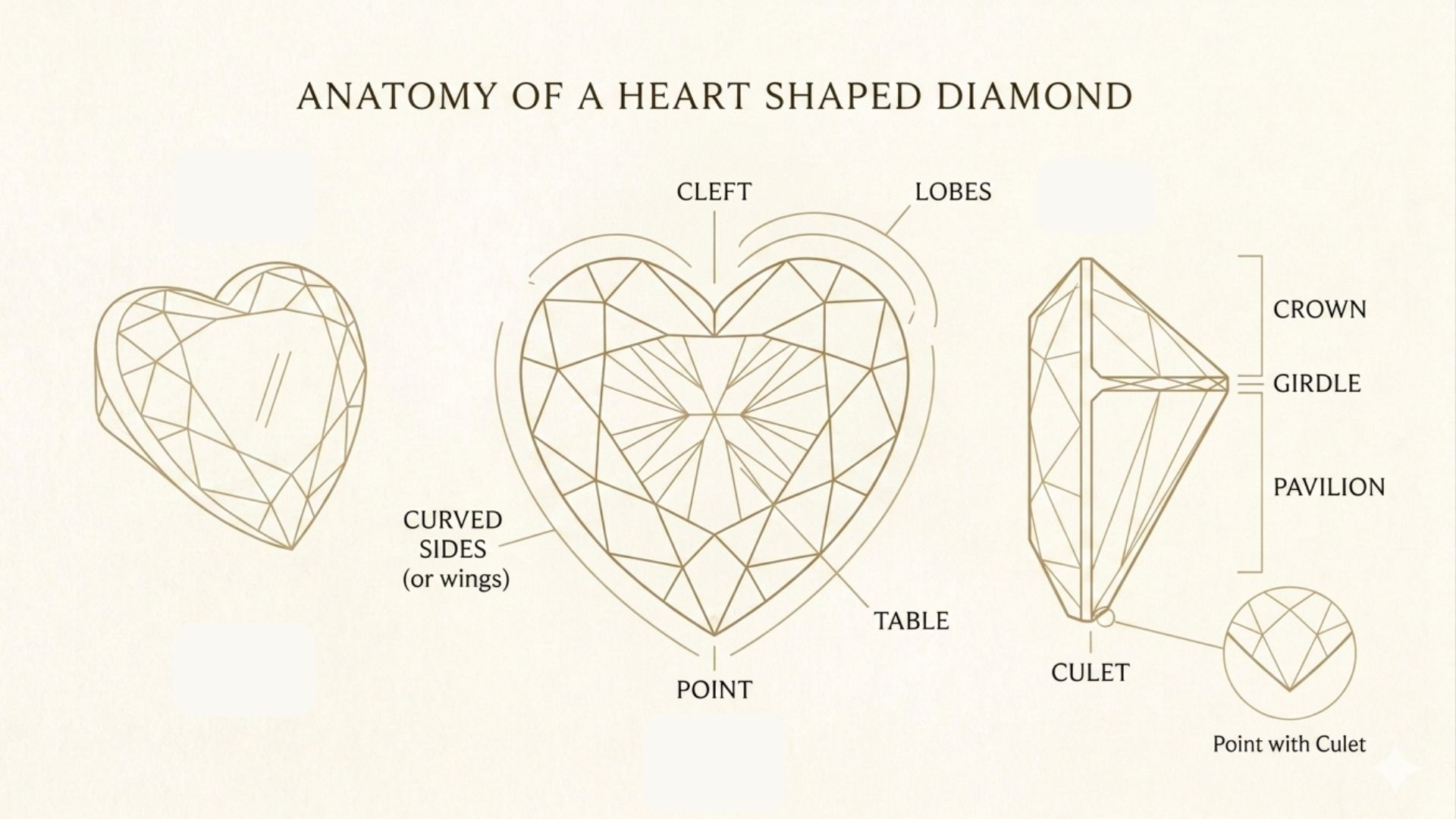
1. Cleft
The inward notch at the top center that defines the heart shape. Must be sharp, deep, and perfectly centered.
2. Lobes
The two rounded upper sections on either side of the cleft. They must be identical in shape and size for visual symmetry.
3. Curved sides or wings
The outer flowing curves extend from the lobes to the point. Any asymmetry here is highly visible face-up.
4. Point
The bottom tip is structurally the weakest area and most prone to chipping during setting and wear. Requires protective prong placement.
5. Table
The large top facet significantly impacts brightness and face-up appearance.
Each part must be precisely executed. Any imbalance between the lobes is immediately visible face-up, and a shallow or poorly defined cleft significantly weakens the overall outline.
What makes the heart shape particularly demanding is its unforgiving silhouette. Even minor deviations in symmetry or outline are highly visible and difficult to hide, resulting in higher rejection rates during quality control and lower production yield compared to more forgiving fancy cuts.
What is the ideal length to width ratio for heart shaped diamond?
Heart shaped diamonds are one of the most unforgiving fancy cuts. The outline is the very first thing people notice. If the proportions are off, the diamond immediately looks chubby, skinny, or lopsided, regardless of its color or clarity.
1. Ideal Length-to-Width (L/W) Ratio
The best range for a balanced, symmetrical heart shaped diamond is 0.95 – 1.05.
The widely accepted good range is 0.90 – 1.10.
- Below 0.90: The diamond looks too wide, stubby, and loses the classic heart definition.
- Above 1.10: The diamond appears elongated, skinny, and stretched.
A ratio closest to 1.00 delivers the most visually pleasing and symmetrical heart shape with even lobes and a well-defined cleft.
2. Symmetry
Symmetry is critical for heart shaped diamonds. The two lobes must be perfect mirrors of each other, with a sharp, deep, and perfectly centered cleft and smooth, even curves on both sides. Poor symmetry is glaringly obvious to the naked eye and significantly reduces light performance and sparkle.
3. Depth and Table Percentage
- Depth: 58% – 64% (ideal for good brilliance and fire)
- Table: 54% – 62%
These percentages are helpful guidelines, but overall cut geometry, excellent symmetry, and face-up appearance matter more than hitting any single number perfectly.
Key Quality Factors in Heart Shaped Diamonds
The 4Cs carry the same weight here as with any diamond, but each interacts with the heart shape in specific ways worth understanding before making a decision.
Cut quality
Determines overall light return. Heart shapes are harder to cut due to symmetry, cleft, and facet alignment. Poor cuts create a visible bow-tie effect with dark patches.
Clarity
An SI1 grade or better is suggested to ensure the diamond is "eye-clean," as inclusions can show up easily in this cut.
Color
Heart diamonds tend to retain body color near the pointed tip. G color or better is recommended for a white appearance. Stones over 1.5 carats may require an F or better rating.
Carat weight
Below 0.50 ct, the shape becomes unclear. Hearts also appear smaller face-up than rounds of the same carat.
Poor performance in any one of these four areas will be immediately visible in a shape this distinctive. There is nowhere for a weak cut or poor clarity to hide.
Pricing and Value of Heart Shaped Diamonds
Heart shaped diamonds are typically priced lower per carat than round brilliants of comparable quality, largely because market demand is smaller. That pricing gap creates a genuine opportunity for those who prioritize the shape itself.
Key pricing considerations:
- Lab-grown options cost 70 to 80 percent less than mined equivalents at comparable quality, making them a practical entry point for this cut.
- Manufacturing cost is higher due to cutting complexity, but this rarely translates into a retail premium.
- Resale value is weaker than that of round brilliants, given the thinner secondary market.
For those buying primarily for the piece rather than long-term value retention, the pricing advantage at purchase usually offsets the resale consideration.
FAQs
What is a heart-shaped diamond called?
A heart-shaped diamond is commonly called a heart cut diamond or simply a heart diamond. It is a fancy cut featuring two rounded lobes, a central cleft at the top, and a pointed bottom, symbolizing love and romance.
Why are heart-shaped diamonds rare?
Heart-shaped diamonds are relatively rare because they are extremely difficult to cut. Achieving perfect symmetry between the two lobes, a sharp, centered cleft, and an even point requires exceptional skill, resulting in more waste from the rough stone and limited supply.
What metal colors look best with heart shaped diamonds?
Platinum and white gold pair best with heart-shaped diamonds, creating crisp contrast that enhances the stone’s brilliance and makes it appear more colorless. Yellow gold and rose gold add warmth and a romantic glow, especially with slightly warmer color grades.
How big does a 0.5ct, 1ct, 1.5ct, or 2ct heart shaped diamond appear on a finger?
On an average finger, a 0.5ct heart shaped diamond measures about 5.2–5.5 mm and looks delicate, while a 1ct appears around 6.4–6.7 mm and is noticeable. A 1.5 ct reaches 7.5–7.9 mm (prominent), and a 2ct spans 8.5–9 mm, looking bold and eye-catching. Hearts appear slightly smaller than round brilliant diamonds of the same carat weight due to their shape.
How to choose the perfect heart shaped diamond for an engagement ring?
Prioritize excellent symmetry with a balanced 0.95–1.05 length-to-width ratio, sharp cleft, and even lobes. Aim for a good cut, eye-clean clarity (VS2+), near-colorless grade (G–I), and at least 0.90–1.00ct so the heart shape shows clearly. View in person or with high-quality images.
Final Thoughts!
The heart shaped diamond is one of the most demanding fancy cuts available, and also one of the most immediately recognizable. When cut well, it delivers genuine brilliance across a complex silhouette that no other shape replicates.
Getting it right requires symmetry, proportion, clarity, and cut precision in equal measure. A grading report is the starting point, not the finish line. Visual verification, performance imaging, and careful vendor selection are what separate a well-chosen heart shaped diamond from a costly mistake.
Lab grown heart shaped diamond follow the same cutting standards and grading criteria as mined stones, offering identical visual performance with greater pricing transparency and accessibility.
For those who want a diamond where the shape itself does the talking, no other cut makes that statement as directly or as unmistakably.
Browse certified lab grown heart shaped diamonds at Solitaire Lab Diamond.