

The term "Hearts and Arrows diamonds" is used across supplier catalogs and retail descriptions, but the label alone does not guarantee a high level of optical precision.
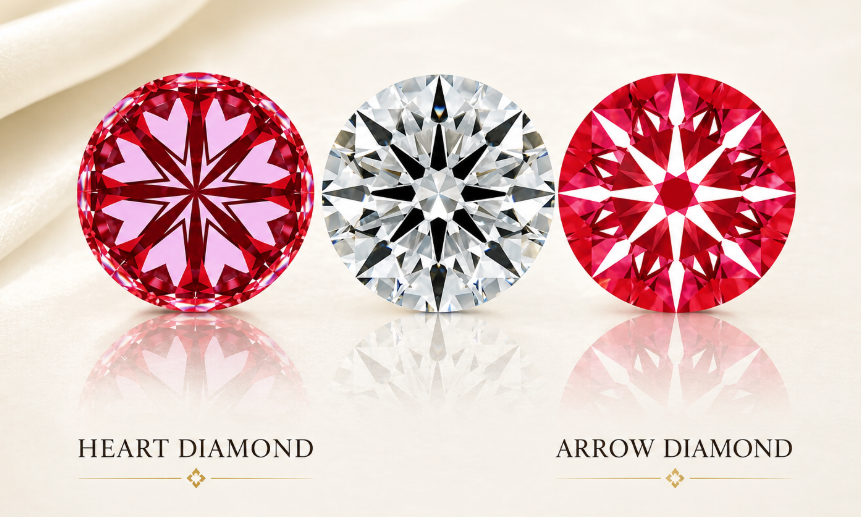
A Hearts and Arrows (H&A) diamond is a round brilliant cut with precise facet alignment. It creates eight heart-shaped reflections from the pavilion and eight arrow-shaped reflections from the crown when viewed through a specialized viewer.
An Excellent symmetry grade is useful supporting information, but it does not establish the quality of the H&A pattern.
This guide is written for jewelers, retailers, designers, and trade buyers evaluating precision-cut round brilliant diamonds for inventory or custom design work.
What is a Hearts and Arrows diamond?
A Hearts and Arrows diamond is a round brilliant diamond with a highly precise facet arrangement that produces a recognizable eight-heart and eight-arrow pattern. The pattern shows eight symmetrical hearts when the stone is viewed from the pavilion and eight symmetrical arrows when viewed from the crown.
A Hearts and Arrows diamond is not a separate diamond shape. It is a precision-cut round brilliant identified by its optical pattern. GIA does not issue a standard Hearts and Arrows designation, while IGI offers a dedicated Hearts & Arrows report for qualifying diamonds.
Every Hearts and Arrows diamond is a round brilliant, but not every round brilliant qualifies as Hearts and Arrows. The pattern depends on extremely precise relationships among the diamond's angles, facet dimensions, alignment, and azimuth, with small variations capable of disrupting the pattern. For diamond cutters, achieving this level of precision requires careful control of facet placement and alignment throughout the cutting process.
The Hearts and Arrows concept emerged in Japan during the 1980s. Cutters and gemologists developed techniques and viewing instruments to evaluate highly precise round brilliant cuts.
How to verify a Hearts and Arrows diamond
Not every diamond marketed as Hearts and Arrows meets the same level of optical precision. Because H&A criteria can vary between laboratories, brands, and suppliers, buyers should verify the actual pattern rather than relying on the label alone.
Here are four steps to evaluate the H&A optical precision of a diamond before adding the stone to inventory.
Step 1: Check the diamond with a Hearts and Arrows viewer
A Hearts and Arrows scope is the most direct verification tool available for evaluating optical symmetry. A high-quality H&A pattern should show eight well-defined, balanced hearts and eight clearly defined arrows with minimal distortion.
Viewed face-up through a Hearts and Arrows viewer, the diamond should display eight well-defined arrow reflections with consistent shafts and arrowheads. A consistent eight-heart and eight-arrow pattern indicates a high degree of optical precision and symmetry.
While the term ‘perfect symmetry’ is sometimes used in marketing, buyers should focus on the actual pattern and its consistency rather than a label.
Step 2: Request stone-specific Hearts and Arrows images
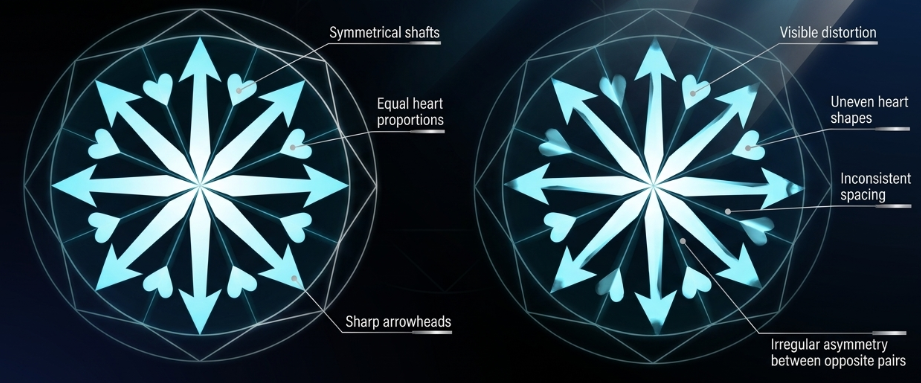
Always request stone-specific images of the diamond you are sourcing, not generic marketing examples from the supplier's catalog. A strong hearts pattern should show eight well-defined, balanced hearts with consistent shapes and minimal distortion.
Visible distortion, uneven heart shapes, or inconsistent spacing can indicate lower levels of optical precision and should prompt closer evaluation.
Step 3: Review the grading report
Laboratory documentation varies by origin and laboratory. Traditional GIA reports for natural round brilliants include cut, polish, and symmetry information, while current GIA colorless-to-near-colorless lab-grown diamonds receive Premium or Standard Quality Assessments. IGI offers grading reports and a dedicated Hearts & Arrows Report.
Step 4: Evaluate light performance
ASET® maps or other appropriate light-performance imagery can provide additional information about brightness, contrast, optical efficiency, and potential light leakage. A stone can display a clean heart pattern and still have light leakage issues that affect face-up brightness and overall light performance.
Use these images alongside the H&A viewer evaluation rather than treating either tool as a standalone verification method.
Key specifications of Hearts and Arrows diamonds
The hearts and arrows pattern is a direct result of how precisely the diamond's facets are cut and aligned. These four factors have the greatest influence on H&A precision.
1. Proportions
Crown angle, pavilion angle, table percentage, and total depth all influence the appearance and optical performance of round diamonds, particularly precision-cut round brilliants.
Crown angle, pavilion angle, table percentage, and total depth should be evaluated together rather than against a single H&A proportion recipe. Proper proportions help support the desired optical performance but should not be judged in isolation.
2. Optical symmetry
High three-dimensional optical precision is characteristic of purpose-cut Hearts and Arrows diamonds. This three-dimensional alignment involves precise relationships among the diamond's facets and contributes to the optical symmetry seen in a well-defined H&A pattern.
While some well-cut round brilliants may also display partial H&A patterning, purpose-cut stones are generally produced with tighter alignment tolerances.
3. Polish
Polish quality is an important consideration when evaluating a precision-cut Hearts and Arrows diamond because the quality of the facet surfaces contributes to the stone's overall appearance. Excellent polish is commonly preferred for high-precision H&A stones. However, evaluate it alongside symmetry, proportions, and the actual H&A pattern.
4. Light performance
Brightness, fire, and scintillation all contribute to a diamond's overall light performance. H&A patterning is evidence of optical precision, but it is not by itself a guarantee of superior light performance. Consider brightness, contrast, scintillation, and potential light leakage alongside H&A images when assessing the stone's overall appearance.
Evaluating the 4Cs in Hearts and Arrows diamonds
The 4Cs still apply to Hearts and Arrows diamonds, but the cut deserves particular attention because the H&A pattern depends on precise facet alignment, proportions, and optical symmetry.
1. Cut
For trade buyers, the cut grade should be treated as one data point rather than the complete picture. Review the report alongside proportions, symmetry, H&A images, and light-performance imaging.
For natural D-to-Z round brilliant diamonds, GIA's overall cut grade provides useful information about cut quality. For laboratory-grown diamonds submitted under GIA's current system, GIA uses a Premium or Standard Quality Assessment, which incorporates cut-related criteria for round brilliants.
2. Color
Color selection should follow your target market, metal mix, price point, and inventory strategy. H&A precision does not inherently require a particular color grade. The appropriate color range ultimately depends on the retailer's target customer, metal choice, and price point. For example, higher color grades may be preferred for premium collections or settings where a bright, colorless appearance is a priority.
3. Clarity
Eye-clean is a visual assessment rather than an official laboratory grade, and inclusion visibility depends on the stone's size, inclusion type, position, relief, and viewing conditions. Higher clarity grades may make sense for premium collections or larger diamonds where inclusions may be more noticeable face-up. Clarity is assessed on each stone, so review the grading report and actual diamond images rather than the clarity grade alone.
4. Pricing and cutting yield
Added cutting precision, potential rough loss, and additional labor can contribute to a price premium over comparable Excellent-cut rounds. The premium varies by supplier, quality, and market.
Settings that showcase a precision-cut Round diamond
The setting should complement the precision of a Hearts and Arrows diamond without unnecessarily obscuring the center stone. Because H&A diamonds are precision-cut round brilliant diamonds, settings that provide good visibility of the center stone while balancing security and design are often well suited.
1. Classic 4-prong solitaire
A classic 4-prong solitaire keeps the center diamond as the main focus and leaves much of the stone visible. Its minimal design is a straightforward choice for engagement rings where the goal is to showcase the center diamond.
2. Open gallery or basket setting
An open gallery or basket setting can provide support while leaving more of the lower portion of the diamond exposed than a more enclosed design. This makes it a practical option when the setting needs to balance security, visibility, and a lighter overall appearance.
3. Slim halo or hidden halo
A slim or hidden halo can add visual presence while keeping the precision-cut center stone as the main focal point. The surrounding diamonds frame the round brilliant while the center stone remains the primary focal point.
4. Platinum or white gold head
Platinum and white gold can be useful choices for the prongs or head when the goal is to keep the setting visually neutral around a colorless or near-colorless center diamond. The metal choice can influence the overall appearance of the ring, so it should be considered alongside the diamond's color grade and the design of the setting.
Hearts and Arrows lab-grown vs natural diamonds
Both options are available, but they serve different inventory strategies and come with meaningfully different sourcing considerations.
|
Feature |
Lab-grown Hearts & Arrows |
Natural Hearts & Arrows |
|
Optical precision |
Depends on cutting and individual stone |
Depends on cutting and individual stone |
|
Availability |
May offer deeper repeatable inventory depending on supplier |
Availability varies by size and specification |
|
Price |
Generally lower acquisition cost |
Generally higher acquisition cost |
|
Documentation |
Depends on laboratory and supplier |
Depends on laboratory and supplier |
|
H&A verification |
Stone-specific viewer images/report recommended |
Stone-specific viewer images/report recommended |
Natural and lab-grown diamonds can both be precision-cut to produce a Hearts and Arrows pattern. Lab-grown diamonds may offer greater sourcing availability for businesses building larger inventories, but the origin of the diamond does not guarantee optical precision. Each stone still needs to be evaluated for its facet alignment, proportions, symmetry, and actual H&A pattern.
Conclusion
A Hearts and Arrows diamond represents exceptional optical precision in round brilliant manufacturing, not a separate diamond category or a marketing label that can be taken at face value. The pattern results from precise proportions, accurate facet alignment, and meticulous craftsmanship. It requires stone-specific verification rather than relying on a grading report or quality assessment alone.
These verification steps can help distinguish a diamond with strong H&A optical precision from one that is simply marketed as Hearts and Arrows. Confirm the pattern with a viewer, request actual stone images, and review the grading report and ASET images before placing an order.
Lab-grown Hearts and Arrows diamonds can give wholesalers and retailers another option for expanding precision-cut inventory, with potentially greater sourcing availability and competitive pricing. As with natural diamonds, however, each stone should be evaluated individually for its optical symmetry, proportions, light performance, and H&A pattern.
If you are sourcing precision-cut lab-grown diamonds for your inventory, browse Solitaire Lab Diamond's round cut diamond collection.
Frequently asked questions
1. Does a GIA or IGI grading report confirm a Hearts and Arrows diamond?
No, a standard GIA or IGI grading report does not by itself confirm a Hearts and Arrows pattern. GIA does not issue a standard H&A grading designation, while IGI offers a separate Hearts & Arrows report that includes stone-specific H&A imagery and assessment. When a dedicated H&A report is not available, verification should include stone-specific H&A images or scope evaluation alongside the grading report.
2. Why are Hearts and Arrows diamonds more expensive?
Achieving the facet precision required for a genuine Hearts and Arrows pattern can take longer and result in greater rough loss than standard round brilliant cutting. That combination of meticulous craftsmanship and additional rough sacrifice is what drives the price premium.
3. Can lab-grown diamonds achieve true Hearts and Arrows precision?
Yes. The hearts and arrows pattern depends entirely on how the diamond is cut, not on its origin.
4. Can fancy-shaped diamonds display a Hearts and Arrows pattern?
The classic eight-heart and eight-arrow pattern is associated with the round brilliant cut and its specific facet arrangement. Other diamond shapes can display different forms of optical symmetry, but they do not produce the classic H&A pattern found in round brilliant diamonds.
Resources: