
In the contemporary jewelry market, the "sparkle" of a stone is no longer enough to guarantee its identity. We have seen a rapid increase in synthetic diamond technology over the past decade, which has led to legitimate concerns regarding identification. Knowing how to tell if a diamond is real, one must distinguish between three distinct categories: natural diamonds (formed by the earth), laboratory-grown diamonds (man-made duplicates), and diamond simulants (look-alikes made of different materials).
This comprehensive guide delves into the science of diamond formation, the technical nuances of verification, and the legal standards of disclosure to ensure you can confidently identify what you are holding.
Method 1# The Origin Story: Nature vs. The Lab
At its core, a diamond is a mineral consisting of essentially pure carbon crystallized in the isometric cubic system. While they appear identical to the naked eye, their origins and growth histories are worlds apart.
Natural Diamonds
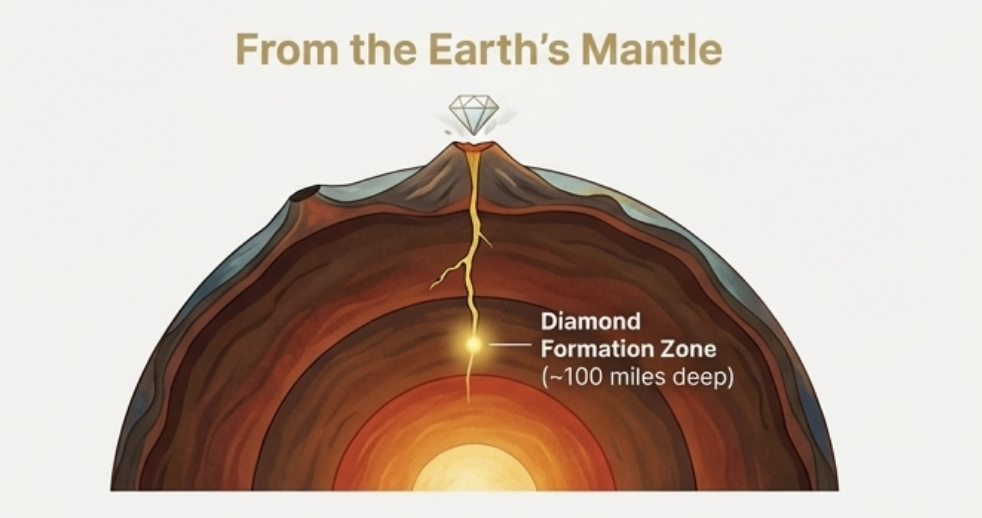
Natural diamonds are a "wonder of science," formed approximately 100 miles (160 kilometers) below the Earth’s surface in the upper mantle. Under conditions of extreme pressure and high temperature, carbon atoms reside for millions, sometimes billions of years before being transported to the surface via volcanic eruptions of kimberlite magma.
Because of this chaotic, natural process, they often incorporate small inclusions of other minerals, which geoscientists use to calculate the diamond's age. For a deeper look at the environmental context and origins of these stones, you can explore How Are Diamonds Mined or Where Does Diamond Come From.
Laboratory-Grown Diamonds
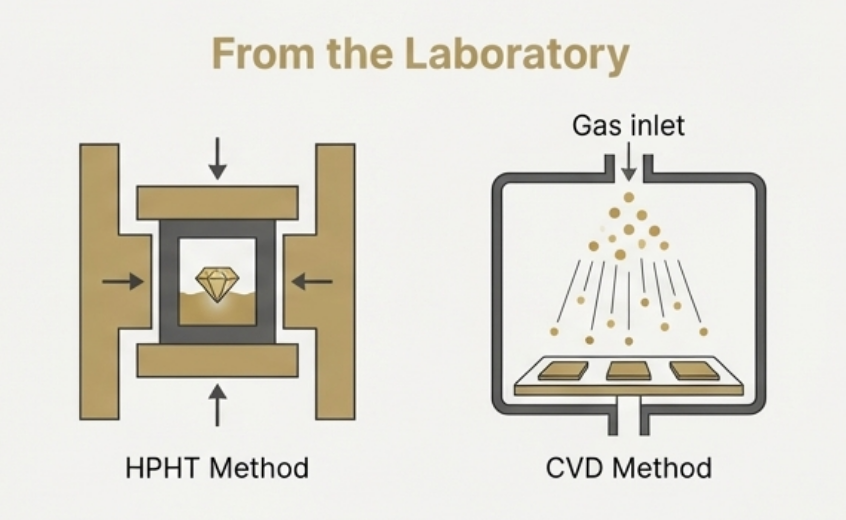
Lab-grown diamonds are not "fake"; they possess essentially the same chemical, physical, and optical properties as natural stones. However, instead of eons, they are grown in roughly two to three weeks using one of two methods:
- HPHT (High Pressure/High Temperature): This process mimics the earth’s conditions using a molten metal flux and a diamond seed to initiate crystal formation. These crystals often have a distinctive shape featuring a combination of octahedral and cube faces with a flat base.
- CVD (Chemical Vapor Deposition): This method uses low pressure and high temperature in a vacuum chamber. Carbon-rich gas (like methane) is introduced, and the carbon atoms "rain" down onto flat diamond seed plates, resulting in a square-shaped, tabular crystal.
If you are weighing the benefits of these modern stones, see our article on Are Lab-Grown Diamonds Actually Worth It or learn Why Do People Choose Lab-Grown Diamonds.
Method 2# Identifying the Diamond Simulants
Unlike lab-grown stones, simulants differ completely in chemical composition. They are merely intended to "mimic" the appearance of a diamond.
- Cubic Zirconia (CZ): The most common simulant, CZ is a lab-created material that is much less dense than an authentic diamond, meaning it will weigh significantly more than a diamond of the same size. It also does not conduct heat well.
- Moissanite: Made of silicon carbide, moissanite is a popular alternative because it is durable and brilliant. However, it is doubly refractive, often causing a "doubling" of facets when viewed under magnification, whereas diamonds are singly refractive.
- White Sapphire: While durable, it has a lower refractive index, meaning it lacks the intense "fire" and sparkle of a real diamond.
Method 3# At-Home Verification
While "at-home" tests are not foolproof, they serve as excellent initial "filters" for separating diamonds from lower-quality simulants.
- The Fog Test: Diamonds are exceptional heat conductors. If you breathe on a diamond, the fog should clear almost instantly. If the fog lingers for several seconds, it is likely an imitation like cubic zirconia.
- The Water Test: Due to high density, a loose natural or lab-grown diamond will sink immediately in a glass of water. If the stone floats or stays suspended, it is likely a fake.
- The Newspaper (Dot) Test: Because of a diamond's high refractive index, it bends light sharply. If you place a loose stone flat-side down over printed text or a small dot, you should not be able to read the letters or see the dot clearly.
- The Flashlight Test: Shine a light directly through the stone. A real diamond will reflect bright white light (brilliance) accompanied by subtle rainbows (fire). Excessive rainbow reflections often indicate a simulant like CZ or glass.
Method 4# Professional Gemological Analysis
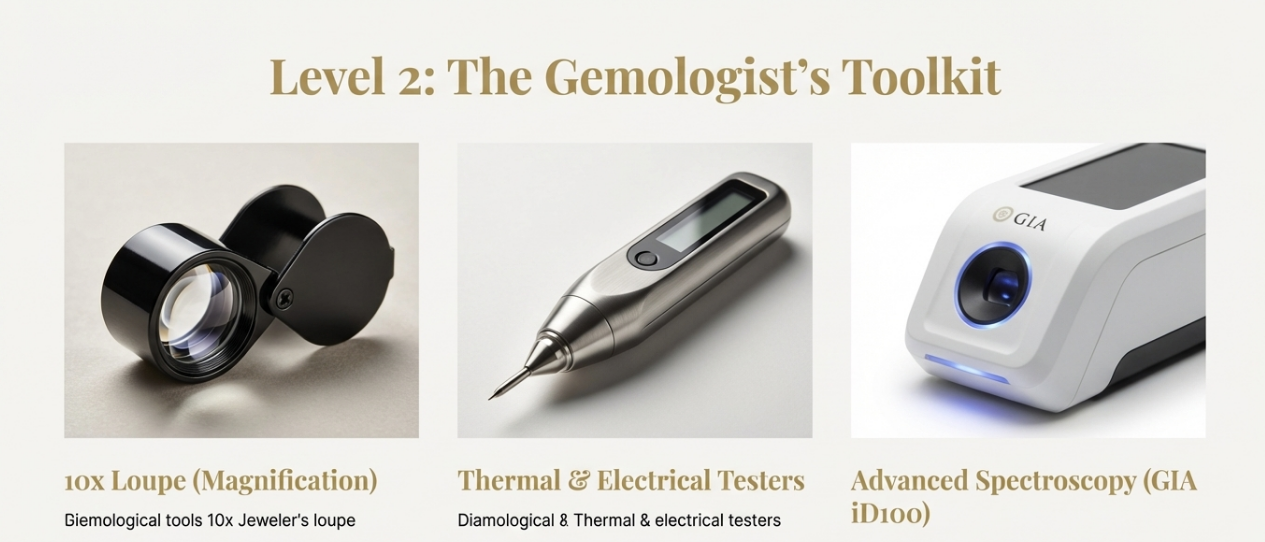
For a definitive determination, especially when distinguishing natural stones from lab-grown stones, professional tools are mandatory.
1. Magnification (10x Loupe)
A trained gemologist uses a 10x magnification loupe to look for "diagnostic features". Natural diamonds often contain natural inclusions (crystals, feathers, or clouds). Conversely, lab-grown stones may display dark metallic inclusions from the HPHT growth flux or unique strain patterns visible under cross-polarized light.
2. Thermal and Electrical Conductivity Testers
Standard "diamond testers" typically measure thermal conductivity. Because diamonds transfer heat rapidly, they are easily separated from glass or CZ. However, moissanite can "trick" thermal testers. Professionals must use electrical conductivity testers to identify moissanite, as it conducts electricity differently than diamonds.
3. Advanced Spectroscopy (GIA iD100)
The current "gold standard" for retailers is the GIA iD100. This device uses fluorescence spectroscopy to detect trace lattice defects in diamonds. It can distinguish natural diamonds from lab-grown (HPHT and CVD) and simulants in under two seconds with pinpoint accuracy, even for stones as small as 0.9mm.
Method 5# Evaluating Raw (Rough) Diamonds
If you encounter a diamond in its natural, uncut state, the verification criteria shift toward geological markers.
- Crystal Form: Raw diamonds typically appear in specific structures, such as octahedral (two pyramids base-to-base), dodecahedral (twelve faces), or cubic.
- Surface Texture: Unlike the glassy surface of a simulant like quartz, rough diamonds have a rough, unpolished exterior directly from the earth.
- The Scratch Test: On the Mohs scale, a diamond is a 10. You can test a raw stone against corundum (ruby or sapphire); if the suspected diamond scratches the corundum, it is likely a genuine diamond. Note: Exercise caution as this can damage the stones.
Method 6# Legal Standards and Consumer Protection
If you find a stone out in the wild, it won’t look like the one in a wedding band. Rough diamonds have a specific "crystal form". They usually look like two pyramids joined at the base (octahedral) or have twelve faces (dodecahedral).
They often have a skin that looks unpolished, oily, or even cloudy. A quick check for a raw stone is a scratch test. Diamonds can scratch almost anything, including sapphire or ruby (corundum). But be careful, doing this can actually damage the stone you’re testing.
Method 7# The Diamond Grading Report

If you are spending a significant amount of money, do not rely on a flashlight or a bowl of water. You need a GIA Diamond Grading Report (or a similar one from AGS or IGI).
A real GIA report is a "report card" for the stone. It covers the 4Cs:
- Carat Weight: The exact weight to the nearest hundredth.
- Color Grade: Measured on a D-to-Z scale.
- Clarity Grade: Based on those tiny inclusions I mentioned earlier.
- Cut Grade: How well the stone was shaped to reflect light.
GIA now marks their reports for lab-grown stones very clearly so they won't be confused with natural ones. They even use different terms for the grades to make sure there's no "shady" business.
Making Authentication Standard Practice
When investing in a diamond, remember that authenticity is a hierarchy. At-home tests like the fog and water tests are your first screening tools, while handheld testers provide the second layer of security. However, for a stone of significant value, there is no substitute for a professional laboratory certification.
Identifying a diamond is like verifying a high-value currency note. You can feel the paper (at-home tests) and look for a watermark (loupe inspection), but the only way to be 100% certain of its value and origin is to use a high-tech scanner (spectroscopy) and verify its serial number against a central bank registry (Diamond Grading Report).
Never compromise on Full Disclosure; ensure your jeweler provides the "biometric" proof of your stone's identity.
If authenticity, traceability, and verified quality matter to your operations, explore Solitaire Lab Diamond's collection of certified lab-grown diamonds. Every stone comes with complete gemological certification from recognized laboratories.
Connect with our team to discuss verification standards, certification requirements, and sourcing protocols.
Because in diamonds, documentation matters more than assumptions.