Round brilliants diamond still dominate the market, but the edges are moving. The vintage engagement ring market is growing at a steady pace, and Old European Cut diamonds are one of the shapes driving that shift.
The warm light, the broad facets, the hand-cut character, none of it can be replicated in a modern stone. That is what makes it worth stocking.
This guide is for jewelers, retailers, and trade buyers deciding what to carry, how to evaluate it, and how to price it.
What is an old European cut diamond?
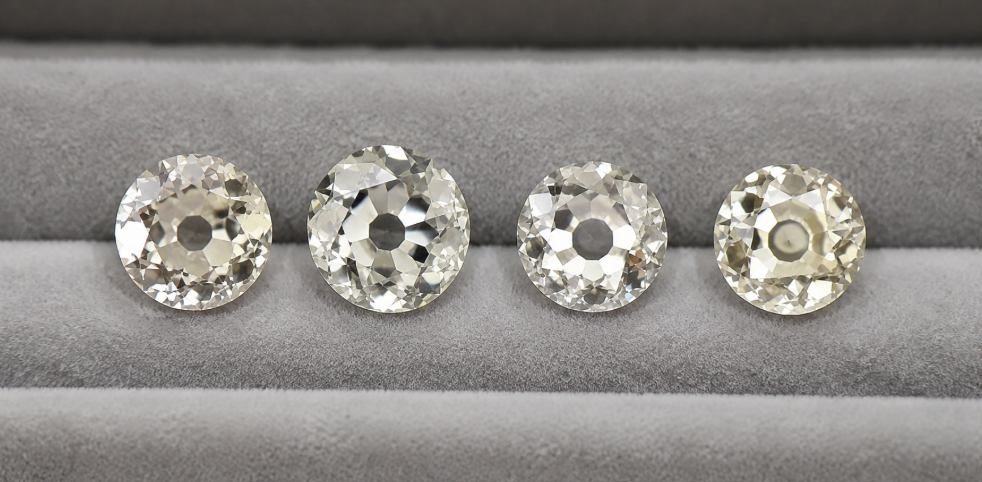
An Old European Cut diamond (OEC) is a round-outline stone with 58 facets, cut primarily between the late 1800s and early 1900s. It evolved from the old mine cut and directly preceded the modern round brilliant.
The structural profile is distinct. Table size typically runs 45–53% of the diamond's diameter, with a high crown, deep pavilion, and an open culet visible from above. These proportions were designed for candlelight, producing broad, warm flashes rather than the sharp, high-contrast brilliance of modern cuts.
That warmth is not a quality issue. It is the reason buyers ask for it by name.
Why old European cut diamonds are gaining ground in modern jewelry design
If your inventory stops at round brilliants, you are missing a buyer who has already made up their mind about what they want. Demand for vintage and heirloom-style rings has grown steadily, and the OEC is one of the shapes driving it.
The appeal spans style categories. It works in Victorian revival pieces, Art Deco settings, and clean modern bespoke designs where the center stone is meant to feel considered, not mass-produced. The OEC buyer usually comes in knowing what they want. Your job is to have it ready.
Lab-grown OEC makes this practical for retailers. Consistent supply, reliable certification, and competitive price points mean you can stock it without the unpredictability that comes with sourcing antique stones.
Key specifications of old European cut diamond
Sourcing an OEC well starts with knowing exactly what you are looking at. These are the four specification areas that separate a strong inventory pick from one that creates problems at the retail counter.
1. Key proportions
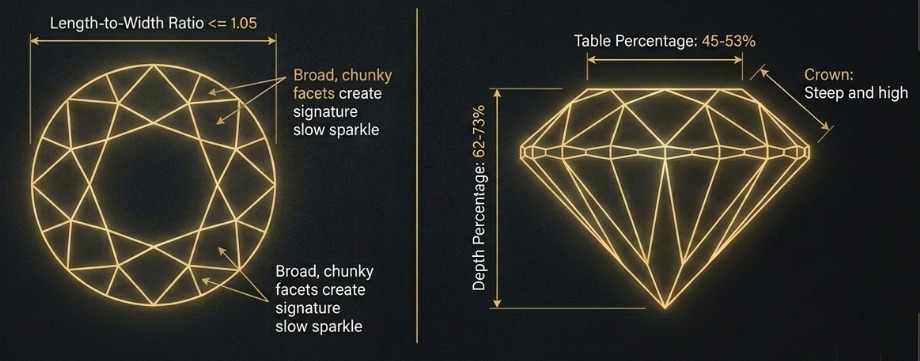
Old European cut diamonds usually have a deeper profile than modern round brilliant diamonds. Their depth often falls between 62% and 73%, while the table is typically smaller, around 45% to 53%. This combination is what creates the taller crown, the softer sparkle, and the look that buyers associate with vintage stones.
For shape, the length-to-width ratio is important. A ratio of 1.05 or lower will look nicely rounded. Once it goes above 1.10, the diamond may start to look slightly oval or uneven, especially to someone familiar with antique cuts.
2. Facet geometry and culet
The facets are broader and chunkier than modern cuts, which creates that characteristic slow sparkle. The open culet is the easiest visual identifier. Seen from above, it appears as a small circle or dark dot at the center of the stone.
Culet size varies. Larger culets affect light return and are more visible in certain settings. It is worth factoring this into your selection criteria, especially for solitaire settings where the center stone has nowhere to hide.
3. Grading and certification
GIA does not assign a cut grade to Old European Cut diamonds. This is the first thing to communicate to any retailer buying from you for the first time. Symmetry and polish grades become the primary quality proxies. For lab-grown OEC, target Very Good or Excellent in both. Do not accept Fair symmetry in newly produced stones. That standard belongs to antique inventory, not modern production.
4. Market and valuation
OEC price per carat runs below round brilliants in the lab-grown segment. That gap creates margin room without requiring you to sacrifice on quality grade. The deeper profile also means the stone can face up slightly smaller than a round brilliant of equivalent carat weight, which is a conversation worth having with your retail clients upfront.
Evaluating the 4Cs in old European cut diamonds
The 4Cs apply to OEC diamonds, but not in the same way they apply to round brilliants. A few key differences in how color, clarity, and cut behave in this shape will change how you source and price it.
1. Cut
There is no GIA cut grade for this shape. Use symmetry and polish as your evaluation framework. For lab-grown production stones, Excellent or Very Good in both is the floor, not the target.
2. Color
Antique OEC stones skew warm, often falling in the I–L range. Lab-grown OEC gives you control. G–H is the practical sourcing range for most retail inventory. The OEC's warm light behavior means H–I color reads differently than it would in a round brilliant. Slight warmth can actually complement the cut's character rather than detract from it.
3. Clarity
VS2–SI1 is the sweet spot for retail margin. The open culet demands extra attention here. Inclusions near the center of the stone are more visible through the table than they would be in a modern cut. Eye-clean evaluation matters more than the certificate grade alone.
4. Carat weight
OEC faces up slightly smaller than a round brilliant at the same carat weight due to its depth. Factor this into your pricing conversations with retail partners. The lower price per carat in lab-grown OEC offsets this well, but the expectation needs to be set before the sale.
Best settings for old European cut diamonds
The OEC's taller crown and deeper profile make setting selection more deliberate than it is for modern cuts.
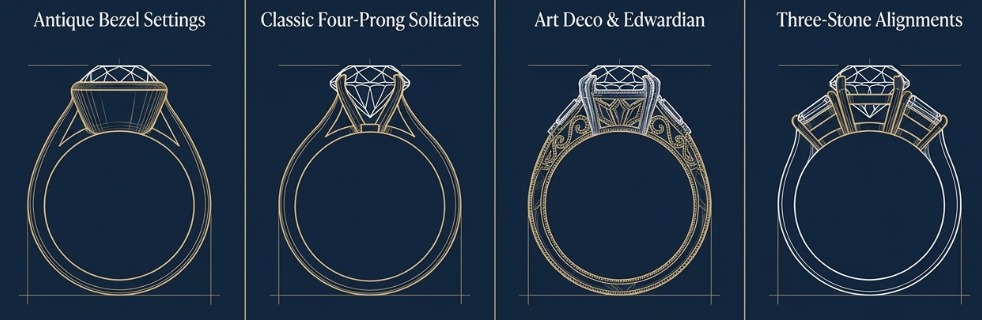
1. Antique bezel settings
A full bezel suits the OEC's round outline and protects the girdle. It also softens the overall profile, which pairs well with the cut's warm character.
2. Classic four-prong solitaires
A high-profile four-prong solitaire complements the OEC's taller crown naturally. It keeps the stone elevated and visible without competing with it visually.
3. Art deco or edwardian settings
Milgrain edges, filigree details, and geometric side work reinforce the OEC's era. These settings sell the story of the cut, which is part of what retailers are paying for when they stock this shape.
4. Three-stone rings
OEC center with tapered baguettes or shield cuts references the Art Deco period directly. Side stone proportions need to account for the OEC's higher profile to keep the design balanced.
Old European cut: Lab-grown vs. antique natural
Both options have a market, but they serve different retail strategies. Here is how the two compare across the factors that actually matter when you are making an inventory decision.
|
Factor |
Antique OEC |
Lab-Grown OEC |
|
Supply consistency |
Limited, irregular |
Consistent, scalable |
|
Price per carat |
Variable, often premium |
Competitive, predictable |
|
Certification |
Variable |
GIA / IGI certified |
|
Symmetry |
Varies widely |
Controlled in production |
|
Color range |
Typically warm (I–L) |
Full range available |
|
Margin potential |
Lower (supply risk) |
Higher (predictable cost) |
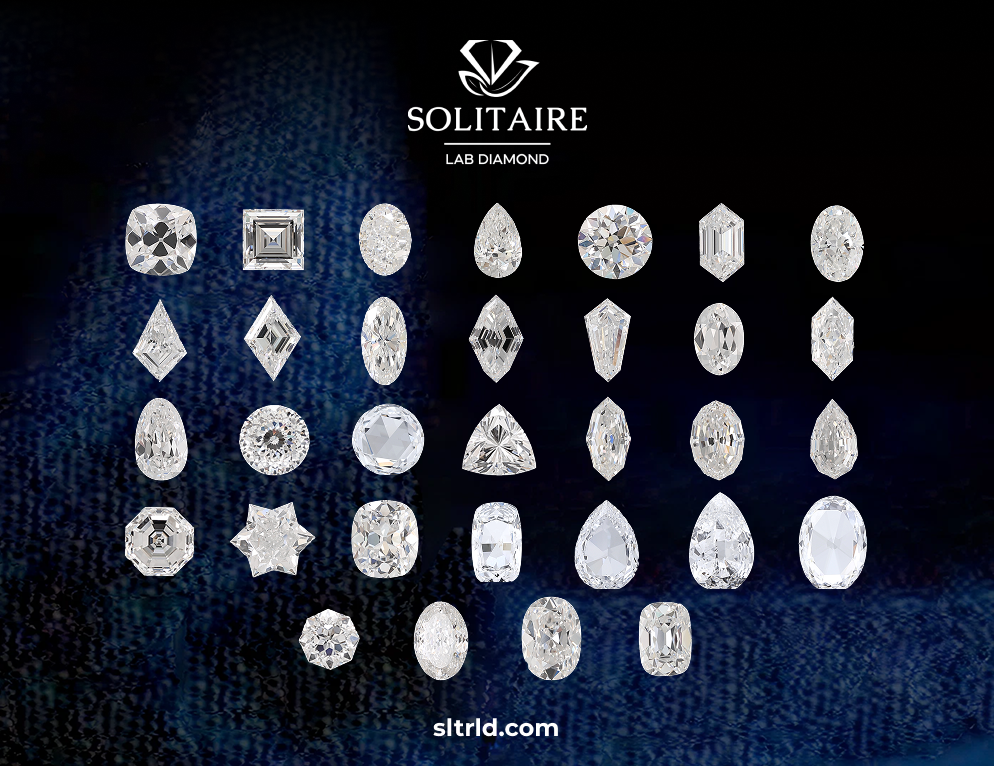
Antique OEC has its place, especially for collectors and estate buyers. But if you are building a repeatable retail offer, lab-grown is the more practical foundation. Before you finalize your inventory mix, the diamond shapes chart gives you a quick way to see how OEC sits relative to other shapes you may already carry.
Frequently asked questions
Does GIA issue a cut grade for old European cut diamonds?
No. GIA does not assign an overall cut grade to this shape. It grades OEC stones for symmetry and polish.
How do I evaluate an OEC without a cut grade on the certificate?
To evaluate an OEC without a cut grade, focus on symmetry and polish grades. Visually inspect for a circular outline, centered culet, and even facet alignment. Video viewing is also important for remote sourcing.
Are lab-grown OEC diamonds graded the same way as natural OEC stones?
Yes. GIA and IGI apply the same grading criteria in lab-grown OEC diamonds regardless of their origin.
What color grade should I source for OEC lab-grown inventory?
For OEC lab-grown inventory, source G–H for most retail applications. Move to F–G for high-end bespoke collections where clients are paying attention to color on the certificate.
How does OEC face-up size compare to a round brilliant of the same carat weight?
OEC faces up slightly smaller due to deeper proportions. Budget for this in your client conversations.
Conclusion
Old European cut diamonds offer retailers something most shapes cannot: a product with a distinct visual identity, a compelling story, and margin room built into the price structure. Let’s look at the sourcing checklist:
- Prioritize symmetry and polish grades first
- Evaluate clarity eye-clean, not by certificate alone
- Source G–H color for standard retail inventory
- Match settings to the taller crown profile
The demand for vintage-style jewelry is not a passing trend. Buyers are actively looking for something that feels considered, not mass-produced. OEC is one of the few cuts that delivers that feeling without requiring a custom manufacturing process.
Lab-grown OEC solves the one problem that has historically kept this shape out of standard retail inventory: consistent supply. You get the aesthetic of an antique cut with the reliability of a modern production stone.
If you are building out your OEC inventory or want to evaluate specific stones before committing, browse Solitaire Lab Diamond's certified lab-grown Old European Cut selection or request a memo here.
The round brilliant will always have a market. But the retailers who diversify early into shapes like OEC are the ones having a different conversation with their customers, and winning more of those sales.