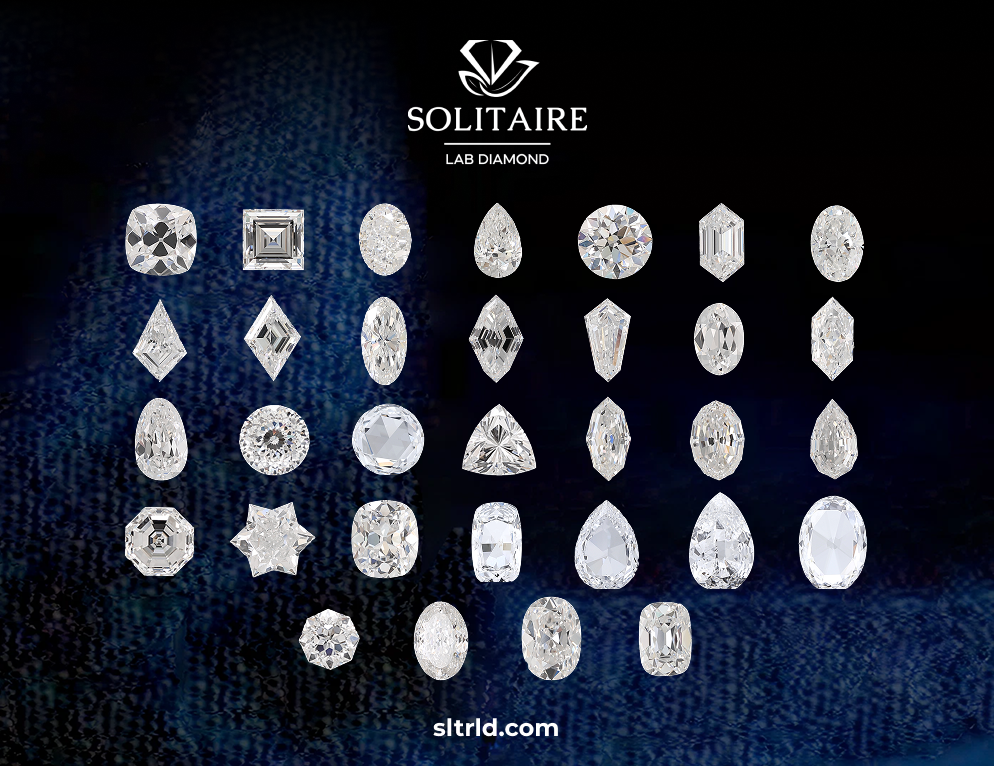


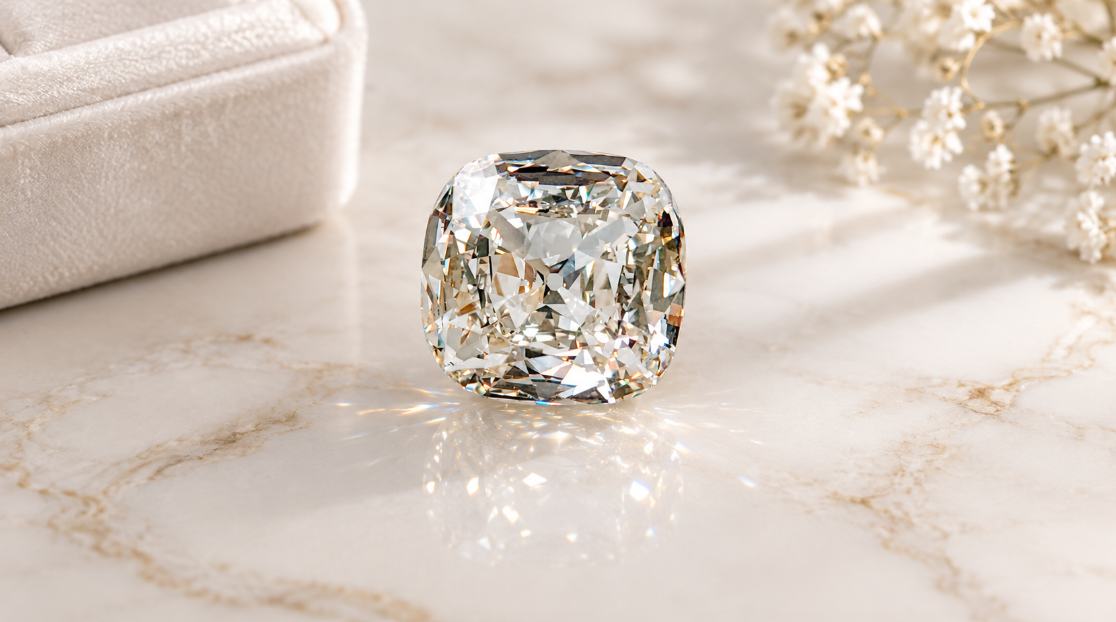
Old Mine cut diamonds are among the earliest brilliant-style diamond cuts and appeal to buyers seeking antique character. Taylor Swift's engagement ring, confirmed to feature an old mine brilliant-cut diamond, brought renewed mainstream attention to this antique cutting style.
This guide is written for jewelers, retailers, designers, and trade buyers who want a practical understanding of Old Mine cut diamonds (OMC) before sourcing them. If you want to compare it with a later antique cutting style, our Old European cut diamonds (OEC) guide covers the round brilliant-style cut that became prominent as diamond-cutting technology advanced in the late 19th century.
What is an Old Mine cut diamond?
Old Mine cut diamonds are typically squarish or cushion-like, often with rounded corners, high crowns, small tables, deep pavilions, and relatively large culets. Their proportions and facet arrangements can vary considerably from stone to stone. The style became widely used during the 18th and 19th centuries.
It is an important predecessor in the development of later antique and modern brilliant-style cuts and remains relevant to the history of antique jewelry, particularly pieces from the Victorian era.
Antique Old Mine cuts were fashioned largely by hand, so their proportions and outlines can vary considerably from stone to stone. Modern Old Mine-style diamonds can be newly cut to reproduce characteristic features of the antique style with greater consistency.
For genuine antique stones, this variation is part of the character that attracts buyers, collectors, and jewelry enthusiasts seeking an individual, historically cut diamond.
Why the Old Mine cut is gaining ground in retail
Old Mine cut diamonds appeal to buyers looking for an antique-inspired look with distinctive proportions and a less uniform appearance than modern brilliant cuts. Their chunkier facets, high crown, and visible culet can contribute to broad, softer flashes of light that look different from the finer scintillation of many modern diamonds, including modern round brilliants.
Modern lab-grown Old Mine-style diamonds can also make this antique-inspired look easier to source repeatedly than comparable genuine antique diamonds. For retailers, this can provide an additional way to offer the style without relying solely on the limited supply of antique natural diamonds.
Old Mine cut vs Old European cut
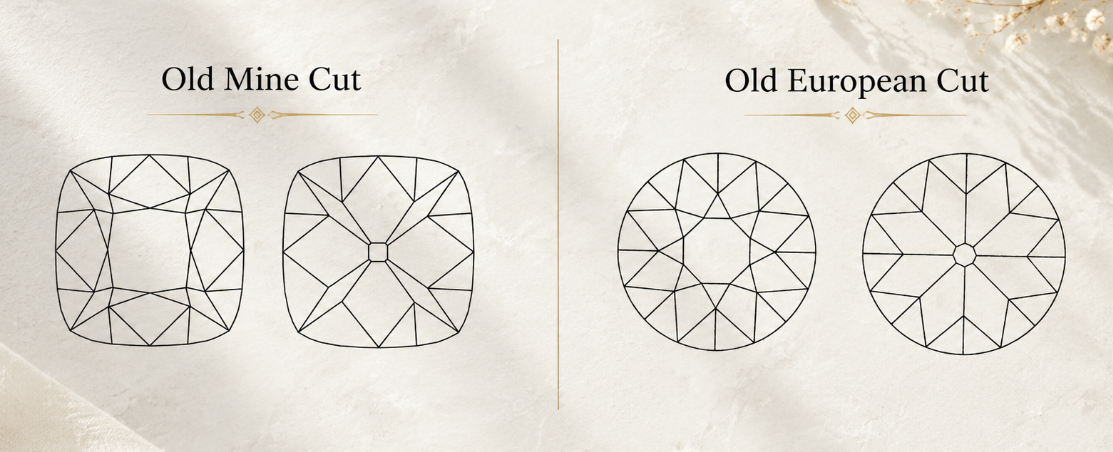
Both are antique cutting styles with distinctive light patterns and historical hand-cut origins, but they differ in outline, proportions, facet arrangement, and overall appearance.
|
Factor |
Old Mine cut |
Old European cut |
|
Typical outline |
Squarish or cushion-like |
Round |
|
Historical period |
Primarily 18th to late 19th century |
Primarily late 19th to early 20th century |
|
Culet |
Often relatively large and visible |
Often visible, generally smaller |
|
Crown |
Typically high |
Typically high |
|
Table |
Typically small |
Typically small |
|
Facet character |
Broad, antique-style facets |
Round antique-brilliant facet arrangement |
|
Overall appearance |
Squarish, individual, softer antique character |
Round, antique-brilliant character |
Buyers who want an antique look without the round outline of an OEC may prefer an OMC for its squarish shape, cushion-like outline, and often more pronounced culet visibility.
Key specifications of Old Mine cut diamonds
Antique Old Mine cuts do not have a standardized proportion range. So evaluating an individual stone requires visual inspection and review of its measurements and laboratory documentation rather than relying on a report alone.
1. Table and crown
Antique Old Mine cuts typically have relatively small tables paired with high crowns. These proportions contribute to the distinctive profile of the style and, together with the facet arrangement, can contribute to the broad, softer flashes associated with antique cutting.
2. Culet and pavilion
A relatively large, open culet is one of the most distinctive visible characteristics of many antique Old Mine cuts. Viewed face-up through the table, the large culet can appear as a visible facet or dark area near the center of the stone.
The combination of a high crown, deeper pavilion, small table, short lower-half facets, and larger facet pattern contributes to the broad flashes associated with the Old Mine style.
3. Facet geometry
Old mine cut diamonds have larger, chunkier facets than modern brilliant cuts, which produce broader, softer flashes of light rather than the sharp scintillation of a round brilliant. The lower half facets are shorter than in modern cuts. The overall facet geometry of antique Old Mine cuts reflects the hand-cutting techniques available before mechanized cutting tools became standard.
The larger facets and antique-style proportions contribute to broad, slower flashes of light that look distinctly different from the finer scintillation of many modern brilliant cuts.
4. Outline and symmetry
The squarish outline of an Old Mine cut is one of its defining characteristics. Antique Old Mine cuts often show outline and symmetry variations associated with historical hand-cutting methods. Newly cut Old Mine-style diamonds may be produced with greater symmetry and consistency.
Buyers who prioritize tighter outline consistency and more standardized modern faceting may prefer a contemporary cushion cut or radiant cut.
5. Grading and laboratory documentation
GIA does not assign a cut grade to old mine cut diamonds. Symmetry and polish grades appear on GIA reports, but they are the secondary evaluation framework rather than the primary sourcing proxy.
IGI offers cut grading for eligible fancy-shaped diamonds as part of its reporting options, using a methodology that considers finish, proportions, shape-specific craftsmanship, and light return.
Visual inspection, video review, and direct assessment of culet size, crown height, and facet character are more useful for sourcing decisions than the grading report or quality assessment alone.
Evaluating the 4Cs in Old Mine cut diamonds
The 4Cs apply to old mine cut diamonds, whether you are evaluating a loose stone or a finished piece of jewelry, but they require some adjustment in how they are interpreted compared to modern brilliant cuts.
1. Cut
Because GIA does not assign an overall cut grade to Old Mine cuts, direct visual evaluation becomes especially important when comparing stones. Use symmetry and polish grades as supporting data, but prioritize direct visual evaluation of the culet, crown height, and facet character. If your sourcing standards require minimum polish or symmetry grades, apply those requirements consistently across your inventory.
2. Color
Old Mine cuts can show body color differently from modern brilliant cuts, so color is best evaluated alongside the stone's proportions, face-up appearance, and setting. Near-colorless grades can offer a balance of appearance and value, while the preferred range ultimately depends on the metal color and the buyer's preferences.
3. Clarity
Because facet size and pattern vary, the visibility of inclusions can differ from stone to stone, so clarity is best evaluated visually rather than by clarity grade alone. Pay additional attention to inclusions near the culet or other visually prominent areas. Their importance depends on type, size, relief, position, and whether they affect durability or face-up appearance.
4. Carat weight
Because Old Mine cuts often have deeper proportions, some may appear smaller face-up than a modern round brilliant of the same carat weight.
This is worth communicating clearly to retail clients who are comparing carat weight across cut styles. For retailers, lab-grown OMCs can provide a more consistent supply option than sourcing comparable antique natural stones
Popular settings for Old Mine cut diamonds
Old Mine cuts work in both vintage-inspired and contemporary fine jewelry settings. The setting should accommodate the individual diamond's outline, girdle, crown height, and dimensions while providing appropriate security.
Antique Old Mine cuts may have thin or uneven girdles, so genuine antique stones should be inspected before setting and handled by a jeweler experienced with antique diamonds.
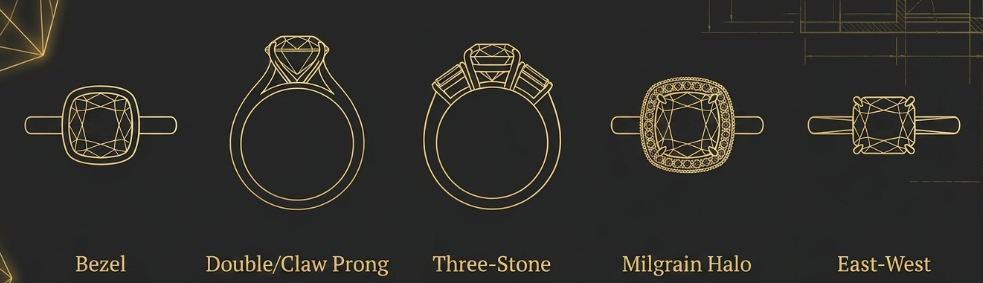
1. Bezel setting
A bezel setting complements the OMC's squarish outline while protecting the girdle and works naturally with vintage-inspired settings. It also works well with the cut's vintage character in yellow or rose gold.
2. Double-prong or claw-prong solitaire
Double or claw prongs can complement the OMC's higher crown while keeping the center stone visually prominent. This is a strong choice for vintage-inspired solitaire designs.
3. Three-stone setting
An OMC center paired with tapered baguettes or smaller OMC side stones can create a vintage-inspired three-stone design. Side-stone proportions should complement the center stone's higher profile.
4. Halo setting
A milgrain halo reinforces the antique aesthetic and adds visual weight around the center stone. It can also work well with OMCs that have slight outline asymmetry.
5. East-west setting
An east-west OMC offers a more contemporary interpretation of the antique cut. The horizontal orientation creates a modern look while retaining the stone's vintage character.
Old Mine cut: Lab-grown vs antique natural
Both options have a place in the market, but they serve different retail strategies and come with very different sourcing realities.
|
Factor |
Antique Natural OMC |
Modern Lab-Grown OMC-Style |
|
Age/origin |
Historic natural diamond |
Newly grown and newly cut |
|
Outline and proportions |
Often highly individual |
Can be cut to more repeatable specifications |
|
Availability |
Limited by existing antique supply |
May be easier to source repeatedly |
|
Optical character |
Depends on the individual stone |
Depends on the cutter and individual stone |
|
Price |
Varies with quality, rarity, history, and market |
Generally lower, but varies by specification and supplier |
|
Documentation |
Depends on the stone and laboratory |
Depends on the laboratory and supplier |
|
Matching/repeat orders |
Can be difficult |
May be easier with a consistent supplier |
Genuine antique Old Mine cuts can command premiums based on rarity, quality, condition, historical significance, and documented provenance when available.
For retailers who need repeatable inventory, modern lab-grown Old Mine-style diamonds can reduce some of the sourcing challenges associated with finding comparable antique natural stones. Modern cutters can reproduce the characteristic squarish outline, high crown, chunky facets, and open culet associated with the old mine style.
Conclusion
The Old Mine cut diamond stands apart for its antique character, distinctive proportions, and broad flashes of light.
The sourcing checklist is very short:
- Verify culet size and crown height directly rather than relying on the certificate.
- Do not over-index on symmetry grades for a hand-cut stone.
- Match color and clarity to the intended market, setting, and price point, and communicate face-up dimensions before purchase.
Old Mine cuts are part of the broader history of cushion-shaped and brilliant-style diamond cutting. The Old European Cut developed along a separate path toward the modern round brilliant. Buyers who want it are not comparing it to a round brilliant. They are making a deliberate choice for a cut with history, character, and a distinctive antique light pattern.
Modern lab-grown Old Mine-style diamonds can make the style easier to source repeatedly, with laboratory documentation and pricing that varies by specification and supplier. You get the culet, high crown, and chunkier facets associated with the Old Mine style while avoiding some of the sourcing challenges associated with genuine antique stones.
If you are ready to expand your Old Mine cut inventory, browse Solitaire Lab Diamond's inventory.
Frequently asked questions
1. Does GIA assign a cut grade to Old Mine Cut diamonds?
No. GIA's standard overall cut grade applies to eligible standard round brilliant diamonds, not Old Mine-style fancy cuts. For natural Old Mine diamonds, measurements, polish, symmetry, proportions, and direct visual inspection are more useful for evaluating the individual stone.
2. Why does an Old Mine Cut face up smaller than a round brilliant of the same carat weight?
The deep pavilion and high crown of an Old Mine Cut push carat weight into the stone's depth rather than its face-up surface area. Some 1-carat OMCs can appear smaller face-up than a 1-carat modern round brilliant because more of the weight may be carried in the stone's depth.
3. What is the difference between old mine cut and modern cut diamonds?
Old mine cut diamonds have a squarish outline, high crown, large open culet, and chunky facets associated with antique cutting styles. Their light pattern differs noticeably from that of a modern round brilliant. Modern round brilliants are precision-cut with standardized proportions engineered to maximize light performance under contemporary lighting conditions.
Resources: