Oval diamonds occupy a rare position in the market. They deliver the brilliance of a round diamond with a silhouette that appears larger face-up for the same carat weight. Their elongated outline creates a slimming effect on the finger, making them one of the most flattering fancy shapes in engagement jewelry.
First developed by Lazare Kaplan in 1957, the oval cut diamond gained widespread recognition through iconic rings worn by Jacqueline Kennedy and Princess Diana.
Today, celebrities such as Blake Lively, Hailey Bieber, and Kourtney Kardashian have chosen oval diamonds for their engagement rings, bringing the shape back to the center of fine jewelry. Choosing wisely starts with knowing what to look for.
What Is an Oval Diamond?
An oval diamond is a modified brilliant cut diamond with an elongated, rounded shape that delivers the same level of brilliance as a round diamond in a more distinctive silhouette.
Oval diamonds are typically cut with 57 or 58 facets, a structure specifically designed to maximize light return and produce continuous sparkle across the stone's entire surface.
The elongated shape gives oval diamonds a larger face-up appearance relative to their carat weight, meaning they tend to look bigger than round diamonds of the same size. This outline also creates a natural slimming effect on the finger, making the hand appear longer and more elegant.
What are the Popular Types of Oval Diamonds?
Oval diamonds are not a single category. They differ in silhouette proportions and facet structure, and each variation performs differently on the hand and under light.
1. Classic Oval (1.30–1.40)
This widely preferred ratio offers a balanced, elegant silhouette that flatters most finger shapes and usually shows a moderate bow‑tie when well cut.
2. Elongated Oval (1.40–1.50+)
A slender outline that maximizes finger coverage and creates the illusion of greater size, though it carries a higher risk of a visible bow‑tie effect if the proportions or angles are not optimized.
3. Rounded Oval (1.20–1.30)
A fuller, plumper shape that sits closer to a cushion cut in appearance, often appearing slightly wider on the finger.
4. Brilliant Cut Oval
Features large, traditional facets that produce bold, high‑contrast flashes of light, giving the stone a more “classic sparkle” look.
5. Crushed Ice Oval
Uses a modified facet structure that scatters light into continuous, fine shimmer across the stone, creating a more blended, icy sparkle pattern.
Understanding which type suits your preference is the most important decision before comparing individual stones.
How to Evaluate an Oval Diamond?
Because GIA does not assign a cut grade to oval diamonds, the quality of the stone cannot be determined from a certificate alone. Every oval must be evaluated visually against a set of specific benchmarks.
- Check the length-to-width ratio first. Target between 1.30 and 1.50. Below 1.30 reads as plump and loses the oval's elongating effect. Above 1.50, the outline stretches and increases the risk of light leakage at the tips.
- Evaluate the bow-tie before anything else. Tilt the diamond under diffused lighting. A mild shadow that shifts with movement is acceptable. A dark, static shadow covering more than 25 to 30 percent of the center is a cut problem that no setting can fix.
- Verify depth percentage. Stay between 58 and 62 percent. Above 63 percent, carat weight hides in the pavilion, and the diamond faces up smaller than its weight suggests.
- Set a color floor of H or above. Oval diamonds concentrate body color at the tips. Anything below color H becomes visible in white metal settings, particularly on larger stones.
- Inspect symmetry face-up. Both ends must curve evenly with a centered culet. Pinched tips or an off-center culet distort the outline and affect how light travels through the stone.
A certificate confirms what is measurable, but does not confirm what is visible. Always evaluate an oval diamond in person or through high-resolution video before making a sourcing decision.
Choosing the Right Setting for Oval Diamond
The right setting defines how an oval diamond sits on the hand, how much light it captures, and how long it lasts in daily wear. These are the options worth knowing.
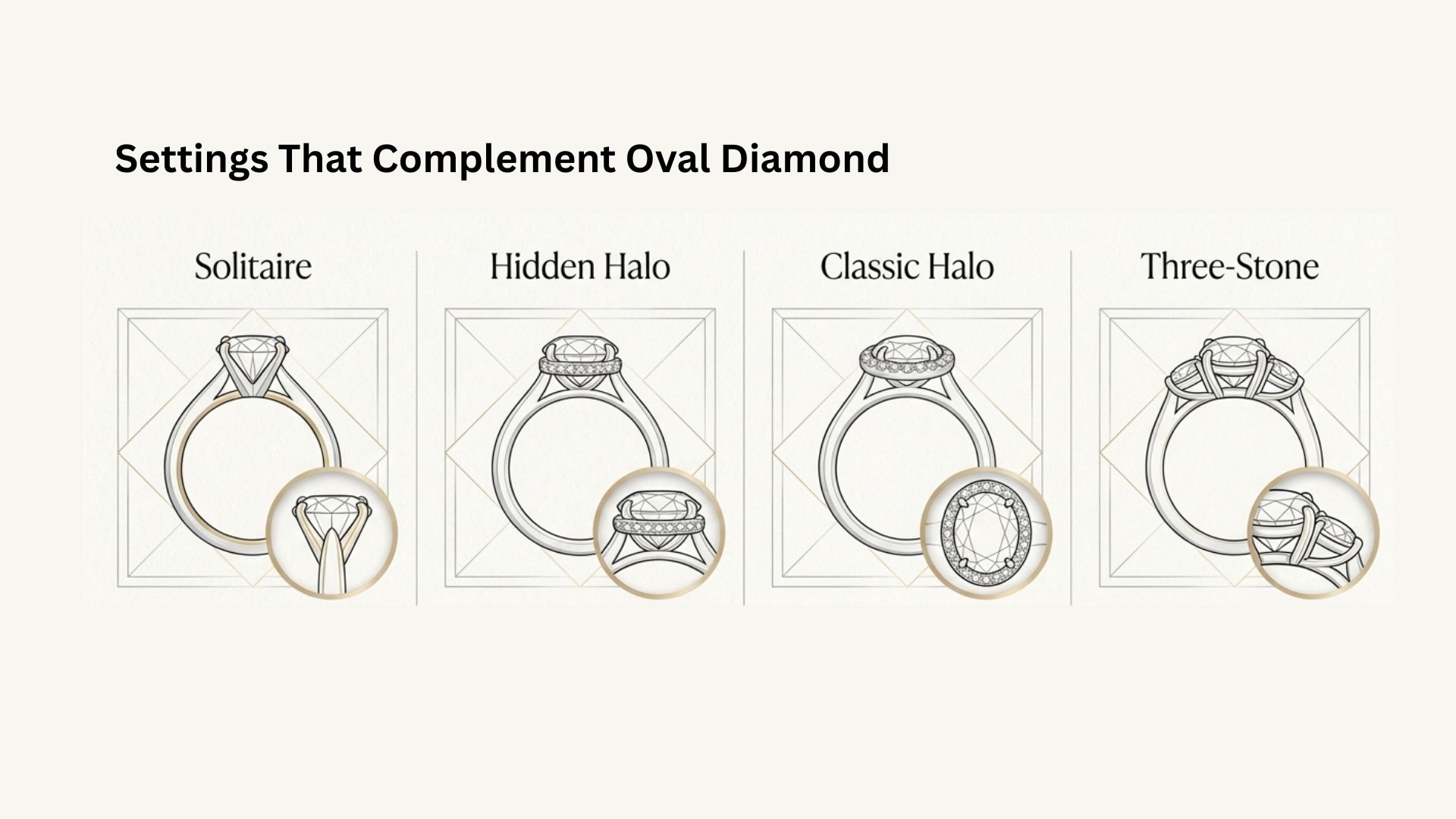
- Solitaire: A clean, timeless choice that keeps the oval as the sole focal point. Ideal for showcasing cut quality and proportions without distraction.
- Hidden halo: A row of diamonds set beneath the center stone, mostly invisible from the top but visible from the side. Adds brilliance and perceived size while maintaining a minimal profile.
- Classic halo: Diamonds surrounding the center stone increase the overall face‑up size and add sparkle, though they can visually soften the oval’s silhouette.
- Three‑stone: Flanking stones add volume and symbolic weight without competing with the center diamond, keeping the oval the dominant feature.
Orientation matters as much as the setting itself.
- North–south placement follows the finger vertically, emphasizing length and creating a slimming effect.
- East–west placement sets the stone horizontally for a bold, architectural look that sits lower on the hand.
A poorly chosen setting can diminish even a well‑cut oval. The proportion between the stone size and band width is the detail most buyers overlook.
How to Spot the Oval Diamond Bow-Tie Effect?
The bow-tie effect is a dark shadow across the center of an oval diamond, caused by the stone’s facet geometry returning light unevenly. It is usually not called out on grading reports.
A mild bow-tie can be acceptable if it is not overly dark and the stone still brightens as it moves. A strong bow-tie that stays prominent from multiple angles usually suggests weaker cut performance.
To evaluate it, tilt the diamond slowly under diffused lighting. A well-cut oval should show the shadow shifting and softening with movement, rather than remaining flat and dark at every angle.
How to Choose an Oval Diamond for an Engagement Ring?
The right oval diamond depends on three things: the ratio, the hand, and the setting.
1. Short or wide Fingers
A 1.35 to 1.40 length-to-width ratio is the most universally flattering starting point. It balances elegance and proportion across most finger shapes without the bow-tie risk that comes with more elongated stones.
2. Match the ratio to the hand
Short or wide fingers benefit from a more elongated oval between 1.40 and 1.50, which creates a lengthening effect. Long or slender fingers suit a rounded oval closer to 1.20 to 1.30, adding width without looking out of scale.
3. Pick a Setting That Suits the Shape
A solitaire or hidden halo preserves the oval's natural silhouette. A classic halo adds perceived size but softens the outline. North-south orientation emphasizes length while east-west creates a bolder, architectural look.
Prioritize cut quality and personal fit for an oval diamond you will love for decades.
Pricing and Value of Oval Diamonds
Oval diamonds often offer strong value compared with round brilliants because they typically cost less per carat and can look larger face-up for their weight.
Their elongated shape can create a larger visual spread than a round diamond of the same carat weight, which makes them appealing to buyers who want a bigger look without moving up to the next full-carat price tier.
Lab grown oval diamonds usually offer the lowest entry price, allowing buyers to choose a larger or higher-quality stone within a fixed budget.
FAQs
Are oval diamonds outdated?
No. Oval diamonds are one of the most popular choices for engagement rings today. Their elongated shape creates a finger-lengthening effect while delivering brilliance comparable to a round diamond.
Why not buy an oval diamond?
Oval diamonds are beautiful, but they can show a bow-tie shadow, reveal color more easily, and vary in sparkle from one stone to another. Because they do not have a standardized overall cut grade, buyers need to pay close attention to proportions and light performance.
Is 4 carats too big for an engagement ring?
For most people, yes. A 4-carat oval can feel bulky for daily wear, though finger size, lifestyle, and personal preference ultimately determine what works.
Do oval diamonds have the same brilliance as round diamonds?
Nearly. Oval diamonds are brilliant-cut and highly sparkly, but round diamonds produce slightly more intense, evenly distributed light return due to their perfectly symmetrical facet layout.
How do I minimize the bow-tie effect in an oval diamond?
Minimize the bow‑tie by choosing a well‑cut oval with balanced depth and crown angles. Avoid extremely shallow or elongated ratios and always verify the shadow brightens under movement before committing.
Are Oval Cut Diamonds Worth the Investment?
For most people, yes. The oval cut offers more face-up size per carat than any other brilliant cut, a finger-lengthening effect, and light performance that rivals round diamonds, all at a lower price point.
The key factor is evaluation. A poorly proportioned oval with a visible bow-tie effect is not worth any price. However, a well-cut oval, chosen carefully, is one of the most versatile and beautiful diamonds available.
Browse Solitaire Lab Diamond's certified collection of lab-grown oval diamonds and find the cut that meets the standard.