

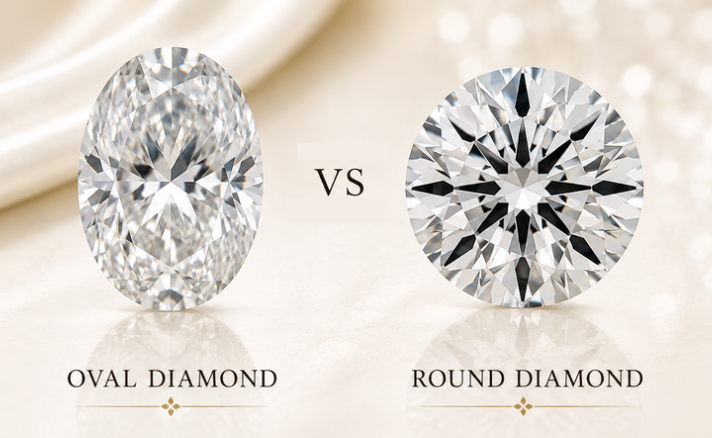
Round and oval are two of the most widely sold diamond shapes, with round remaining a leading choice and oval now nearly as popular among engagement-ring buyers.
The oval vs round diamond decision often comes down to customer demand, inventory strategy, and how much individual stone evaluation they are prepared to undertake. A well-sourced oval can offer a differentiated inventory option when you evaluate its proportions and bow-tie visibility carefully.
This diamond shape comparison is written for jewelers, designers, and trade buyers who need a specification-level understanding of both shapes before making inventory or design decisions. If you want to see where both shapes sit across the full range, the diamond shapes chart is a useful reference to keep alongside this guide.
How popular are oval and round diamonds?
Round diamonds have historically been the most popular diamond shape for engagement rings, but oval diamonds are now nearly as popular. According to Southern Jewelry News, citing The Knot's study, round diamonds were chosen by 26% of couples, compared with 25% for oval diamonds in engagement rings.
This narrow gap shows how close oval has come to round in engagement-ring preferences, making both shapes important considerations for retail inventory.
Oval diamond
Most modern oval diamonds use brilliant-style faceting, although facet arrangements can vary considerably from stone to stone. The oval shape also gives buyers more flexibility in length-to-width ratio, outline, and overall face-up appearance.
Like other fancy-shaped diamonds, ovals do not receive an overall GIA cut grade. As a result, proportions, symmetry, polish, outline, and overall face-up appearance become important when evaluating individual stones.
Round diamond
The standard round brilliant diamond has 57 or 58 facets, depending on whether the culet is faceted. Its standardized facet arrangement is one reason GIA can apply an overall cut grade to round brilliant diamonds.
Today, GIA's cut-grading system gives round-brilliant diamonds a standardized framework for comparing cut quality.
Oval diamond vs. Round diamond
Both round and oval diamonds share a brilliant faceting structure, but they differ in grading, proportions, and retail positioning. Here is how they compare across the factors that matter most at the sourcing level.
|
Factor |
Oval diamond |
Round brilliant |
|
GIA overall cut grade for natural D-to-Z diamonds |
Not assigned |
Assigned |
|
IGI cut grading |
Available for fancy shapes |
Available |
|
GIA lab-grown assessment |
Premium/Standard system |
Premium/Standard system |
|
Faceting |
Varies by cutting style |
Standardized 57/58-facet arrangement |
|
L/W ratio |
Important appearance variable |
Not normally a styling variable |
|
Bow-tie |
May be visible; evaluate individually |
Not characteristic of standard rounds |
|
Face-up spread |
Often larger-looking for comparable carat weight |
More standardized outline |
|
Clarity |
Evaluate inclusions individually |
Evaluate inclusions individually |
|
Color |
Consider grade, metal, neighboring stones |
Same |
|
Remote sourcing |
Dynamic imagery especially useful |
Grading framework provides more standardized comparison |
1. Facet structure and light behavior
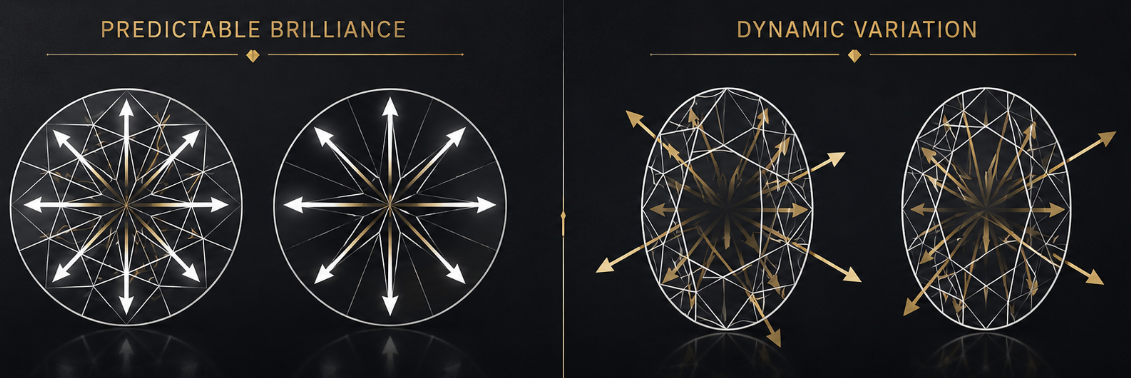
Round diamonds reflect light more uniformly than oval diamonds because their facet arrangement is more standardized. Oval diamonds can vary considerably in faceting, proportions, and face-up appearance from stone to stone.
The bow-tie effect is a darker area of contrast across the center of many oval diamonds. Its visibility depends on the stone's faceting, proportions, and viewing conditions. It is not a defect in the traditional sense, but it is a legitimate sourcing filter that affects how the stone reads face-up in different lighting conditions.
The practical sourcing rule is simple: When sourcing remotely, request video or other dynamic imagery rather than relying only on still photographs.
For natural diamonds, GIA assigns an overall cut grade to standard round brilliant diamonds but not to oval diamonds. For colorless to near-colorless laboratory-grown diamonds, GIA's current system uses Premium and Standard quality assessments.
2. Shape, outline, and proportions
Length-to-width ratio is not normally a styling variable for a standard round brilliant, while it plays a major role in the appearance of an oval. The standardized round-brilliant cut grading system gives retailers a more consistent framework for comparing cut quality.
The oval's length-to-width ratio is an important sourcing variable, but it should be evaluated alongside outline, symmetry, faceting, and bow-tie visibility. A ratio below 1.30 generally creates a shorter, fuller oval appearance, while higher ratios produce a more elongated shape. A 1.30 to 1.50 ratio is a useful starting range for many retail applications, but the preferred ratio ultimately depends on the desired outline and setting.
At the same carat weight, a well-proportioned oval often provides more visible face-up spread than a comparable round, contributing to a larger appearance, although actual dimensions vary from stone to stone.
Decide in advance which length-to-width ratios you want to stock rather than relying only on what is available from the cutter.
3. Clarity and color grading considerations
The round brilliant's facet pattern is forgiving on clarity. SI1 and SI2 stones can appear eye-clean depending on the type and placement of inclusions. This gives retailers more flexibility when sourcing across clarity grades. G to H can offer a practical balance of appearance and cost for many round-diamond assortments.
Clarity should be assessed stone by stone. Depending on the inclusion type, location, and overall appearance, an eye-clean SI1 may offer better value than a higher-clarity stone with a more noticeable inclusion.
Because ovals lack an overall GIA cut grade, individual stone evaluation becomes especially important when building inventory.
Which diamond is easier to stock: Oval or Round?
Round diamonds generally offer a more standardized starting point because GIA provides an overall cut grade for round brilliant diamonds. This makes it easier to compare stones using a consistent grading framework, although individual visual assessment is still important.
Oval diamonds require more stone-by-stone evaluation because GIA does not assign an overall cut grade to fancy shapes. Retailers should pay particular attention to length-to-width ratio, outline, symmetry, proportions, and bow-tie visibility when selecting inventory.
For buyers and retailers, the practical choice often comes down to inventory goals. Round diamonds provide a familiar shape with an established grading framework, while ovals offer more variation in outline and appearance. A balanced inventory can include both, depending on customer demand and the styles you sell.
Final thoughts
The oval vs round diamond comparison is not really about which shape is better. They are solving different problems on the sales floor. Round remains a familiar choice for engagement rings, with the classic round diamond continuing to serve as a reliable core inventory option. Oval offers more variation in shape and faceting, but requires closer stone-by-stone evaluation.
Before placing any oval order, confirm the length-to-width ratio fits your intended retail application, and evaluate the bow-tie by video rather than a laboratory report alone. For round diamonds, the GIA cut grade provides a useful starting point for evaluating cut quality. Individual stones should still be visually assessed.
Lab-grown diamonds give retailers access to both shapes across a broad range of sizes and specifications. As with natural diamonds, however, individual stones should still be evaluated for proportions, clarity, color, symmetry, polish, and overall visual appearance.
If you are ready to build out your oval or round lab-grown inventory with graded stones, browse Solitaire Lab Diamond's oval and round cut diamond collection.
FAQs
1. Does GIA assign a cut grade to oval diamonds?
No. GIA classifies oval diamonds as fancy shapes and does not assign an official cut grade. Symmetry, polish, and proportions are key evaluation criteria on the laboratory report. This makes video inspection especially important when sourcing oval diamonds.
2. Which cut hides inclusions better, oval or round?
Round diamonds can sometimes make inclusions less noticeable because of their faceting and brilliance, but clarity should always be evaluated based on the individual stone. In oval diamonds, inclusion visibility can vary with the stone's proportions, faceting, size, and inclusion characteristics.
3. What length-to-width ratio should I look for when sourcing oval diamonds?
A 1.30:1 to 1.50:1 ratio is a useful starting range for many retail applications. Lower ratios create a shorter, fuller appearance, while higher ratios create a longer, more elongated look. The right ratio ultimately depends on the desired shape, setting, and customer preference.
4. Are oval and round cuts both available in lab-grown diamonds?
Yes. Both oval and round diamonds are widely available as lab-grown diamonds. Depending on the laboratory, they may come with a grading report or quality assessment. GIA uses Premium and Standard assessments, while IGI provides laboratory-grown diamond reports with grading information for color, clarity, cut, polish, and symmetry.
Resources: