Pear shaped diamonds aren't a trend; they're a growing trade opportunity. The global lab grown diamond market is projected to reach $33.94 billion in 2026, growing at a CAGR of 13.87% through 2035, and fancy cuts like the pear are a key part of that momentum (Precedence Research).
For jewelers, wholesalers, and designers sourcing center stones, understanding this shape beyond its aesthetics gives you a real edge. Solitaire Lab Diamond carries certified lab-grown pear shapes available for memo and wholesale.
This guide covers everything trade buyers need, such as proportions, cut quality, the bow-tie effect, 4Cs evaluation, and margin strategy.
What Is a Pear Shaped Diamond?
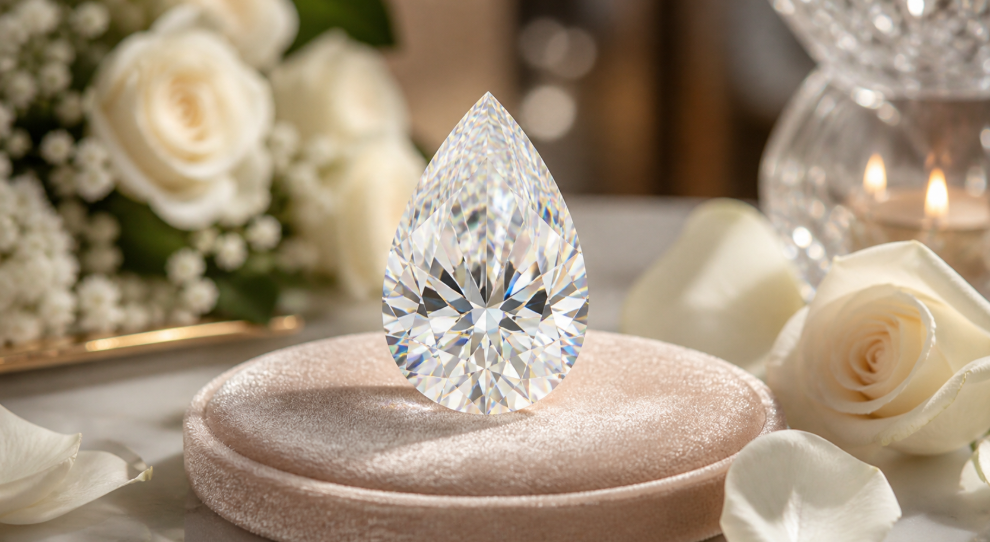
A pear shaped diamond is also known as a teardrop diamond. It is a modified brilliant cut that combines the rounded base of a round brilliant with the tapered point of a marquise. The result is a teardrop silhouette that is wider at one end and pointed at the other, with 58 facets designed to maximize light return.
The shape sits in a sweet spot between classic and statement. It is formal enough for bridal, distinctive enough for bespoke pieces, and flexible enough for pendants, earrings, and rings.
Why Pear Shaped Diamonds Are Popular in Design
The most obvious reason designers keep coming back to the pear is the elongation effect. When set north-to-south on a finger, the shape visually lengthens a feature that sells itself.
Beyond that, the pear sits between round and oval without looking like either. It offers visual differentiation without being niche. That is important when a retailer is building a collection and doesn't want every center stone to look identical on the display case.
There's also a size perception advantage. A pear shape diamond faces up roughly 8% to 30% larger than a round brilliant of the same carat weight, because more of the stone's mass sits at the surface. For buyers comparing price per carat, that's a concrete advantage worth communicating to clients.
Key Specifications of Pear Shaped Diamonds
Understanding the core proportions and visual traits helps you assess both beauty and commercial value at a glance.
1. Length-to-Width Ratio
The length-to-width ratio defines how the stone looks face-up. The standard range sits between 1.45 and 1.75, but what works best depends on the application.
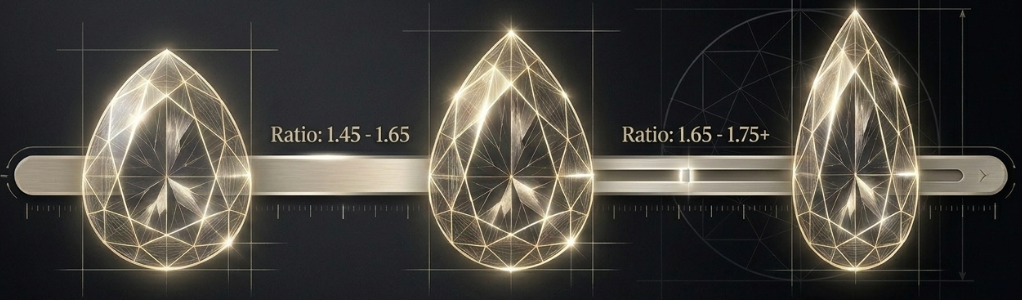
- 1.45–1.55: Wider, softer appearance; works well in solitaire ring settings
- 1.55–1.65: Classic, balanced look; the most commercially versatile range
- 1.65–1.75+: Slim and elongated; ideal for drop earrings and pendants
2. Bow-Tie Effect
The bow-tie is a dark shadow that runs across the center of the stone, caused by light failing to reflect through the table. Every pear cut diamond has some degree of bow-tie. The real question is how visible it is.
A faint bow-tie is acceptable and often unnoticeable in normal wear. A severe one kills the stone's brilliance and makes it significantly harder to sell. The critical point for trade buyers is this: bow-tie severity does not appear on any grading report. You cannot assess it from a GIA or IGI certificate alone.
To evaluate it properly:
- Request a video of the stone under standard lighting
- Look for ASET or Ideal Scope images
- Reject any stone where the bow-tie is visible without close inspection
This step should be non-negotiable in your sourcing checklist, especially for memo approvals.
3. Symmetry
Symmetry is arguably the most important quality factor specific to pear shapes. Draw an imaginary line down the length of the stone; both halves should mirror each other exactly.
What to check:
- Shoulders: the upper curves on each side should be even and arch smoothly
- Wings: the lower curves should match in shape and angle
- Point: must align precisely with the apex of the rounded end
- Belly: the widest part should sit at the center
Poor symmetry causes uneven light return, which translates to patchy brilliance. In a shape where visual balance is the entire appeal, an asymmetric stone looks off even to untrained eyes. Always look for Excellent or Very Good symmetry on the grading report.
Best Cut Quality Considerations for Pear Diamonds
GIA does not issue an overall cut grade for fancy shapes, including pears. For Pear Shaped diamonds, polish and symmetry grades are your proxies for cut quality.
Look for stones graded Excellent or Very Good in both. Avoid Good or below, the drop in light performance is visible and will affect customer satisfaction.
Pear shapes are technically demanding to cut. The pointed tip requires precision, and cutters working with lower-quality rough often sacrifice proportions to retain carat weight. That's why poorly cut pear shapes are disproportionately common in budget inventory.
A few things to watch for beyond the certificate:
- Shallow cuts: the stone looks glassy and flat, lacking depth
- Overly deep cuts: the stone looks smaller face-up than its carat weight suggests
- Flat shoulders: make the stone appear narrow; avoid
- Bulging belly: makes the shape look stubby; reduces setting compatibility
Visual inspection (or video, for remote sourcing) should always accompany the grading report.
Best Jewelry Settings for Pear Shaped Diamonds
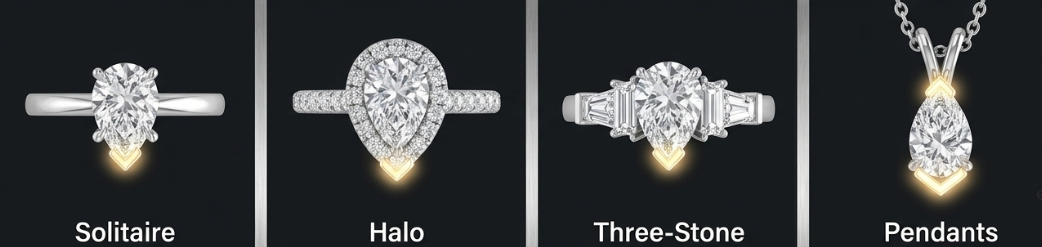
The right setting enhances the pear shape’s elegance while protecting its delicate tip. Different styles influence how the diamond looks, moves, and performs in everyday wear.
1. Solitaire Settings
Solitaire settings let the stone carry the piece on its own. The pear works well here, provided the mounting complements the elongated outline. A four or five-prong setting with a V-prong at the tip is standard.
2. Halo Settings
A halo of smaller stones around the pear amplifies its size and adds visual weight. This setting is popular in bridal retail and photographs particularly well, and is useful for eCommerce listings.
3. Three-Stone Designs
The pear pairs naturally with tapered baguettes or smaller rounds on either side. Three-stone designs are strong sellers for anniversaries and upgrades, not just engagements.
4. Pendants and Earrings
The pear shape is one of the most natural fits for pendants and drop earrings. The pointed tip creates movement when worn, and the elongated silhouette catches light well in motion.
A critical note on tip protection: regardless of setting style, the pointed tip must always be covered by a V-shaped prong. The tip is the most vulnerable point on the stone. It is the last area of the rough to be cut and is most prone to chipping. This applies to every setting, without exception.
Evaluating the 4Cs in Pear Shaped Diamonds
The 4Cs apply differently to pear shapes due to their unique structure and light behavior. A practical understanding of these factors helps balance cost, appearance, and market demand.
1. Cut
There is no official GIA cut grade for fancy shapes. Symmetry and polish grades serve as the practical benchmarks. Look for Excellent or Very Good in both. Pear shapes are more technically demanding to cut than rounds, and poorly proportioned stones appear regularly in lower-price inventory.
2. Color
Pear shaped diamonds retain color more noticeably than round brilliants, particularly at the pointed tip where the stone is thinnest. For stones over 1 carat, consider grading up one color step (for example, G instead of H) so the tip does not telegraph a warmer face.
3. Clarity
The VS2–SI1 eye-clean range is the retail sweet spot for most buyers. It balances grading credibility with pricing that supports healthy margins. Pay close attention to inclusions near the tip. That area is structurally vulnerable and difficult to conceal in most settings.
4. Carat Weight
Pear shapes face up larger than rounds of equal carat weight. Pricing per carat also runs lower than that of round brilliants across most grades. Better visual size, lower cost. That combination gives the trade buyer real room to work with on margin.
Pear Shaped Lab-Grown vs Natural Diamonds
Use this quick breakdown to choose the right option for modern designs, bridal collections, or long-term value.
|
Factor |
Lab-Grown Pear |
Natural Pear |
|
Price per carat |
40–70% lower |
Higher baseline cost |
|
Certification |
GIA, IGI, GCAL |
GIA, IGI, GCAL |
|
Supply consistency |
High, matched sizes available |
Variable, harder to source in matched pairs |
|
Consumer demand trend |
Growing (under 35 demographic) |
Stable but flat |
|
Retail margin |
Stronger at comparable price points |
Tighter margins on comparable grades |
|
Best use case |
Collections, bridal, multi-stone designs |
Investment pieces, heritage jewelry |
Frequently Asked Questions
How do I identify a bow-tie effect when sourcing a pear shaped diamond?
When identifying a bow-tie effect in a pear shaped diamond, remember that it cannot be accessed from the certificate alone. Request a video under standard lighting or an ASET image. A faint bow-tie is acceptable; a dark, prominent shadow across the center is not.
Are lab-grown pear shaped diamonds certified the same way as natural ones?
When it comes to certification, lab-grown pear shaped diamonds are graded the same way as natural diamonds. GIA, IGI, and GCAL all grade lab-grown fancy shapes using the same 4Cs system. The report will note the stone as lab-grown, but the grading methodology and criteria are identical.
Quick recap!
Pear shaped diamonds are gaining ground, and trade buyers who understand them well are better positioned to source profitably and advise clients with authority.
The sourcing checklist comes down to a few non-negotiables:
- Symmetry graded Excellent or Very Good
- Bow-tie evaluated via video or ASET imaging
- Color adjusted upward for stones over 1ct
- V-prong setting to protect the tip
Get those four things right, and the rest of the selection process falls into place.
Lab-grown pear shapes add one more layer to that picture: lower cost per carat, consistent supply, and the same grading documentation your clients expect. For retailers looking to build margin without cutting corners on quality, they're a practical choice across price points.
Ready to source certified lab-grown Pear Shaped Diamonds for your next collection?
Browse Solitaire Lab Diamond's pear shape diamond inventory, available for memo, wholesale, and direct purchase, with GIA, IGI, and GCAL certification across a full range of grades and sizes.
Resources: