The diamond trade runs on decisions. Which shapes to stock, which grades to prioritize, and which cuts will move consistently for your retail partners. If you haven't taken a serious look at princess cut diamonds recently, you're leaving a reliable margin opportunity on the table.
This guide is made for lab-grown diamond wholesalers, retailers, and trade buyers who want a clear breakdown of what the princess cut offers, where it falls short, and how to price it confidently.
What Is a Princess Cut Diamond?
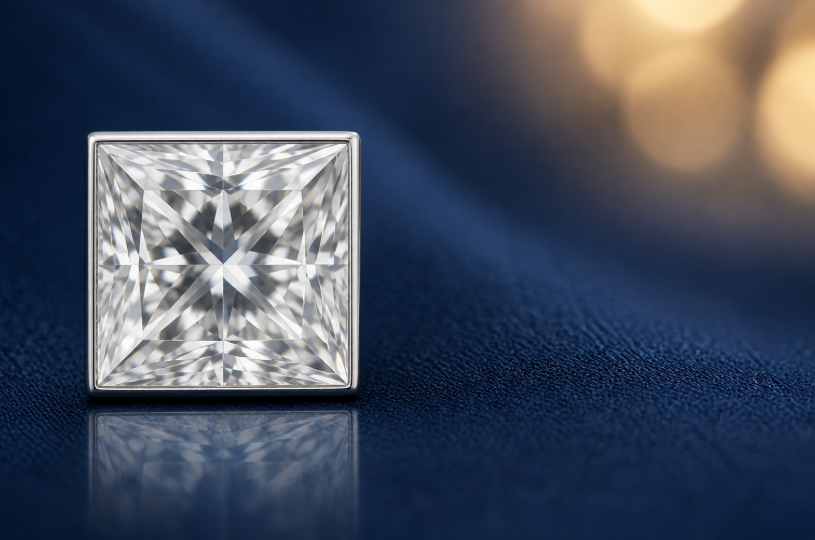
A princess-cut diamond is a square modified brilliant with 50 to 58 facets and four sharp 90-degree corners. It sits behind the round brilliant as the second most popular diamond shape globally, and among fancy shapes, it holds the top position.
The cut originated in the late 1970s as a way to maximize yield from octahedral rough. That origin is still its biggest trade advantage today.
Why Princess Cut Diamonds Remain Popular?
Retailers keep reordering princess cuts for one straightforward reason: they sell on sparkle and price together.
The cut produces strong brilliance and fire. The geometric shape gives it a clean, contemporary look that works for engagement rings, stud earrings, and pendants. That broad application means consistent movement across your retail partners' inventory.
The rough yield factor matters here. A princess cut recovers 80 to 90% of the rough crystal. A round brilliant recovers roughly 40 to 50%. That difference is baked directly into the price, which is why princess cuts cost 20 to 40% less per carat than comparable round brilliants. For lab-grown stones, that gap widens further.
Pros and Cons of Princess Cut Diamonds
Every cut has trade-offs. Here's what actually matters when you're sourcing at volume or advising retail partners.
Pros
- Higher Margins, Lower Cost Per Carat: Princess cuts offer retailers better entry price points without sacrificing visual impact.
- Strong Face-up Appearance: The corner-to-corner diagonal of a princess cut measures roughly 7.7mm on a 1-carat stone, versus 6.5mm diameter for a round brilliant. It reads as larger than it actually is, a selling point that retail staff can use.
- Efficient Inventory Management. Because the cut maps so well to common rough shapes, supply is consistent. You're less likely to face the sourcing gaps that affect more complex cuts.
- Inclusion Tolerance. The high facet count and pavilion structure scatter light in a way that masks minor inclusions well. This opens up the SI clarity range for eye-clean stones, giving you more usable inventory at lower cost.
- Setting Versatility. Princess cuts work in solitaire, halo, channel set, and three-stone configurations. Retail partners don't need to specialize their inventory around this shape.
Cons
- Corner Fragility is a Real Liability: The four 90-degree corners are the most structurally vulnerable points on any diamond shape. Chips at the corners, even minor ones, reduce value significantly. This is important for how you inspect, store, and ship stones.
- Setting Requirements are Non-negotiable: V-prongs on all four corners are not optional. They're the minimum acceptable protection. Retail partners need to understand this before they set the stone.
- Color Shows More Than in Round Brilliants: The face-up view of a princess cut concentrates any body color. G or H is the practical floor for stones that will be set in white gold or platinum. Below that, color becomes visible and affects the sale.
How Princess Cut Diamonds Compare to Other Shapes
Princess cuts offer a sharp, modern look with strong sparkle at a lower price than rounds. They trade a bit of light performance and durability for better value and a geometric style.
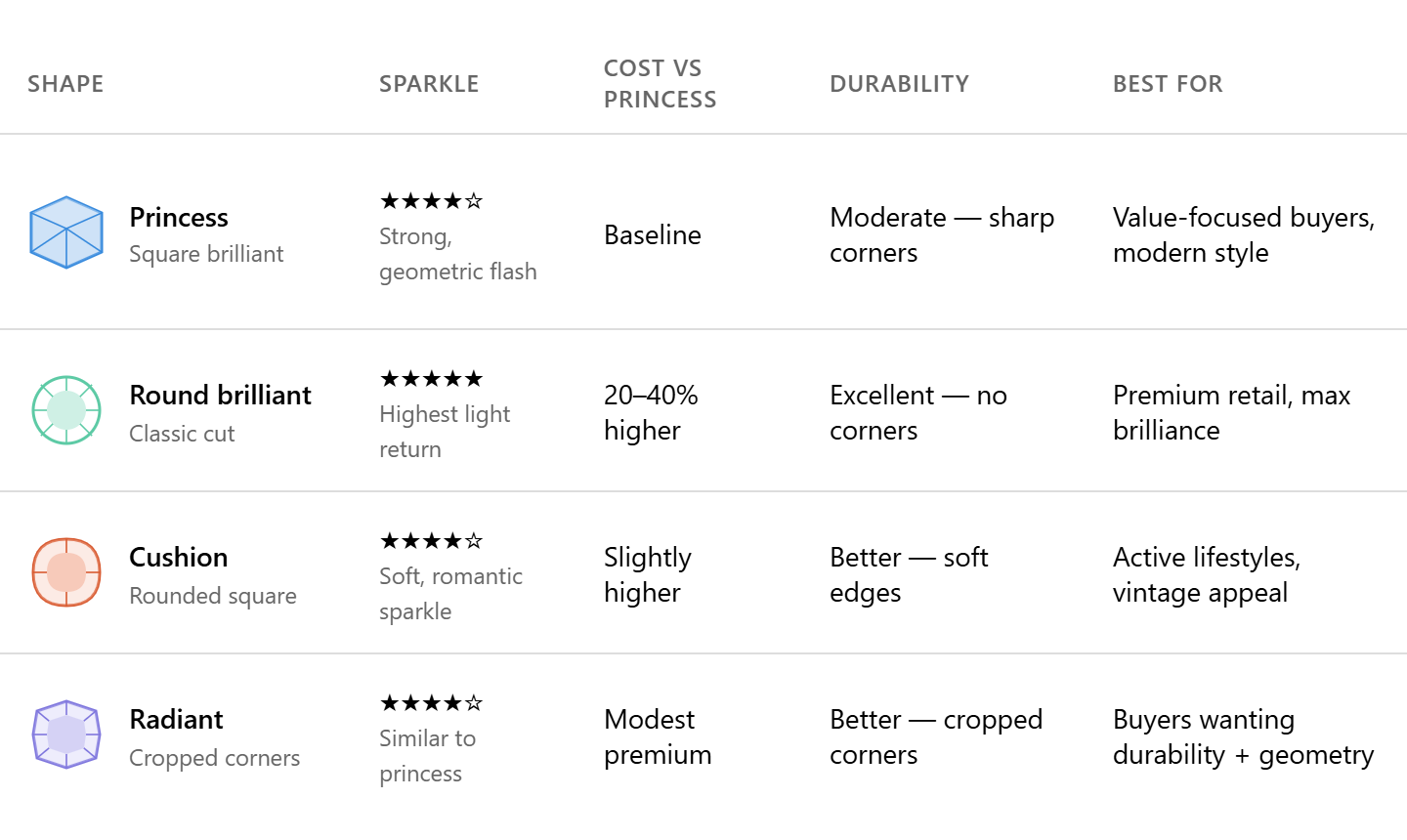
For a more detailed head-to-head comparison, see our princess cut vs cushion cut guide.
Pricing Factors for Princess Cut Diamonds
Princess-cut diamonds' pricing depends on carat, cut proportions, color, clarity, and certification. Small changes in these factors can shift value significantly, especially at key size milestones.
1. Carat Weight
A 1-carat lab-grown princess cut typically runs between $800 and $1,500, depending on grades. Natural equivalents range from $1,600 to $11,000. Price climbs sharply at 1-carat, 1.5-carat, and 2-carat milestones.
2. Cut Quality
The GIA doesn't assign an overall cut grade to fancy shapes. For princess cuts, focus on table percentage (62–72%), depth percentage (64–75%), and symmetry grade (Excellent or Very Good). These numbers tell you more than a single grade label ever could.
3. Color Grade
G to H is the recommended range for white metal settings. I to J works for yellow or rose gold. Avoid going lower; the face-up color visibility will create issues at retail.
4. Clarity Grade
VS2 is the safe choice for premium retail. SI1 is workable if the stone is confirmed eye-clean. Verify each stone individually at SI; don't rely on the grade certificate alone.
5. Certification
IGI is the standard for lab-grown princess cuts and is widely accepted by retail partners. GIA certification is available and carries added prestige, particularly for natural stones or higher-value lab-grown pieces.
Best Settings for Princess Cut Diamonds
Settings should balance visual appeal with protection for the stone’s sharp corners. V-prongs are essential to prevent chipping, regardless of the design style chosen.
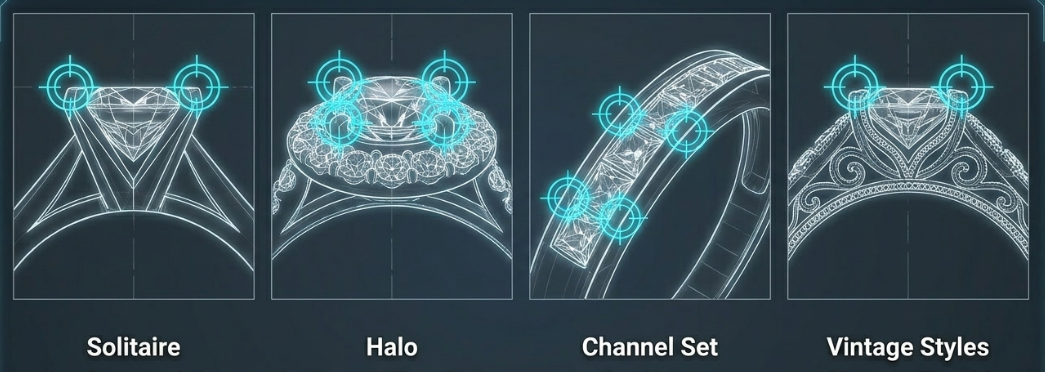
- Solitaire: The clean four-prong solitaire is the most common setting. V-prongs on all four corners are mandatory.
- Halo: A halo of small round brilliants frames the princess cut well and adds visual size. It also provides a buffer that partially protects the corners.
- Channel Set: A channel setting works well when princess cuts are used as side stones. It holds the stones securely without exposed corners.
- Vintage Styles: Princess cuts in milgrain or vintage-style settings are seeing renewed interest. The geometric shape contrasts well against ornate metalwork.
Whatever setting style your retail partner chooses, V-prong corner protection is the baseline requirement.
FAQs
Are princess cut diamonds cheaper than round brilliants?
Yes. Princess cut diamonds typically cost 20 to 40% less per carat than round brilliants of comparable quality. For lab-grown stones, the savings are even more pronounced.
Do princess cuts sparkle more than other fancy shapes?
Yes, princess cut sparkle among other fancy shapes. The 50 to 58 facet count puts princess cut light performance above most other non-round options. Only radiant comes close.
Are princess cuts durable?
Yes. The body of princess cut stone is as durable as any diamond. The corners are the vulnerability. With proper V-prong settings, this is manageable.
Are princess cut lab-grown diamonds GIA or IGI certified?
Yes, princess cut lab-grown diamonds have certificates. IGI is more common for lab-grown stones. GIA certification is available and preferred for certain premium or natural stone buyers.
What L/W ratio works best for princess cuts?
The ideal L/W ratio for princess cuts is 1.00 to 1.05. Above 1.05, the stone reads as slightly rectangular rather than square.
How does princess cut pricing compare to round brilliant for retail margins?
Princess cut pricing gives retail partners a real advantage. The lower cost per carat on princess cuts, combined with strong visual appeal, gives retail partners room to price competitively while maintaining healthy margins.
Is demand for princess cuts still growing?
Demand for princess cuts has stabilized rather than grown, holding around 8% market share as of 2026. It's a reliable core shape, not a growth-stage category.
Final Take: Is Princess Cut Worth It?
Princess cut diamonds deliver what trade buyers consistently need: strong visual impact, cost efficiency, and broad retail applicability. The rough yield advantage that made this cut relevant in the 1970s is even more meaningful today with lab-grown stones.
The cons are real but manageable. Corner fragility is a setting problem, not a sourcing problem. Color visibility is a grading selection problem. Both are solved with the right specifications and retail partner education.
If you started reading this wondering whether princess cuts deserve a consistent place in your catalog, the answer is straightforward: they do.
Explore Solitaire Lab Diamond's princess cut diamond inventory and request specifications that match your retail partners' needs.
The trade buyers who move quickly on well-graded, correctly certified princess cuts are the ones their retail partners call first. Which side of that conversation do you want to be on?
Resources: