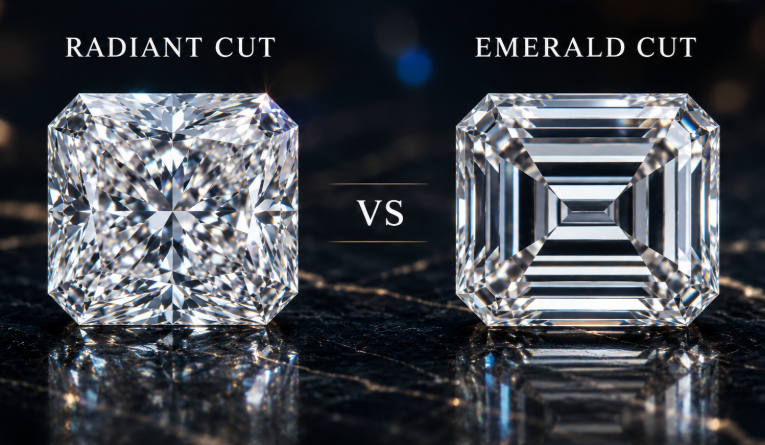
Radiant cut vs emerald cut is one of the more common sourcing questions in rectangular lab-grown diamonds. Both cuts share a similar outline, both have cropped corners, and both are widely available. The radiant cut diamond and emerald cut are easy to confuse in catalog listings and product descriptions.
If you look closer, you’ll notice that they are built completely differently.
The facet structure, light behavior, and grading thresholds for each cut are built around completely different goals. One is engineered for brilliance. The other is built to showcase clarity and depth. Mixing them up in sourcing decisions or product descriptions is an easy mistake, and one that affects how a stone is graded, priced, and positioned.
This breakdown of radiant cut vs emerald cut covers what actually separates the two, from facet architecture and GIA classification to the grading standards that apply to each. If you are building rectangular cut inventory or advising on stone selection, this is where the distinction starts.
What is a Radiant Cut Diamond?
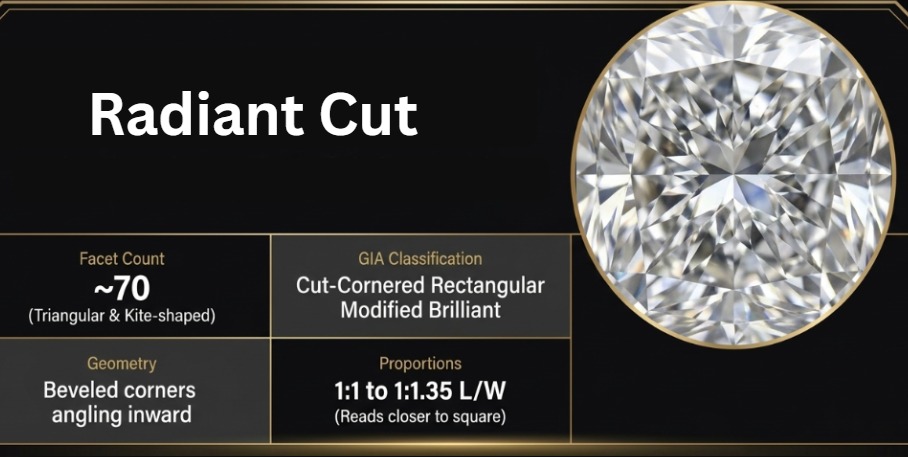
The radiant cut is a modern brilliant-cut diamond with a rectangular or square outline and beveled corners. Henry Grossbard developed it in 1977, making it the first rectangular cut to feature brilliant-cut facets on both the crown and pavilion. Before Grossbard, no rectangular diamond could match the light output of a round brilliant. But the radiant cut changed that.
A standard radiant cut carries approximately 70 triangular and kite-shaped facets. These facets scatter light in multiple directions, producing high brilliance and scintillation. It is classified as a "cut-cornered rectangular (or square) modified brilliant” by GIA.
Within radiant cuts, two facet pattern styles exist: the "crushed ice" look, which produces many small, scattered reflections, and the "chunky" look, which has larger, more defined facets. Both fall under the radiant classification, but they read differently face-up.
What is an Emerald Cut Diamond?
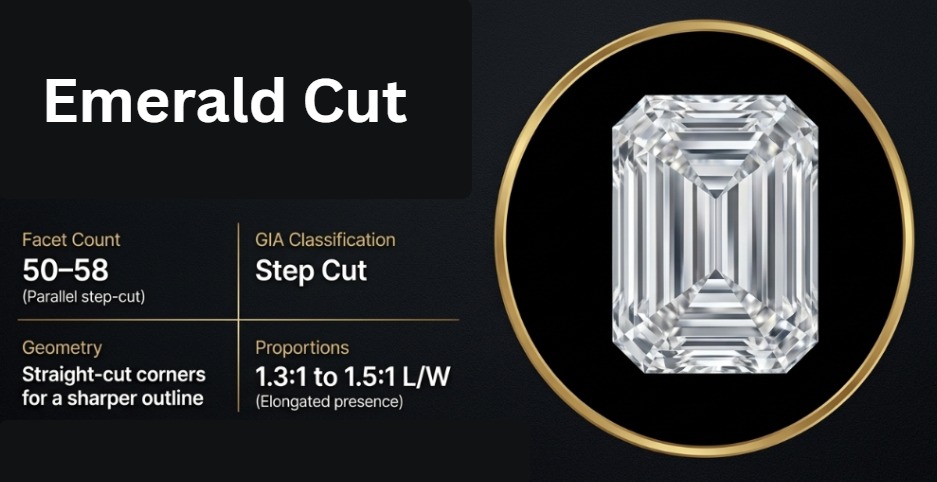
The emerald cut diamond is one of the oldest diamond shapes in use. Its step-cut tradition traces back to the 1500s, and it became widely associated with the Art Deco era of the 1920s because of its clean lines and geometric precision.
An emerald cut features 50 to 58 rectangular, parallel step-cut facets. These wide, flat facets reflect light in long, controlled flashes rather than scattered sparkle. This produces the well-known "hall of mirrors" effect, a calm, deep optical movement inside the stone.
The emerald cut also has a large, open table, which puts the diamond's interior directly on display. The GIA classifies it as a step cut. Unlike the radiant cut, an emerald cut is not trying to dazzle. It is built to show the stone exactly as it is.
Radiant Cut vs Emerald Cut
Both share a rectangular silhouette, but their facet architecture, light performance, and grading priorities are meaningfully different. The table below covers the core distinctions at a glance.
|
Feature |
Radiant Cut |
Emerald Cut |
|
Facet Style |
Brilliant cut |
Step cut |
|
Facet Count |
~70 |
50–58 |
|
Light Performance |
High brilliance, fire, scintillation |
Hall of mirrors, subtle flash |
|
Table Size |
Moderate |
Large, open |
|
Clarity Sensitivity |
Hides inclusions well |
Inclusions more visible |
|
Color Sensitivity |
Masks color tints moderately |
Color more apparent |
|
L/W Ratio (common) |
1:1 to 1:1.35 |
1:1.3 to 1:1.5 |
|
GIA Classification |
Modified brilliant |
Step cut |
|
Origin |
Patent 1977 (developed 1976) |
1500s (popularized 1920s) |
1. Facet structure and light behavior
The main difference between a radiant cut vs emerald cut is how each handles light. Radiant cuts use brilliant facets that scatter light outward in multiple directions, producing fire and scintillation. Emerald cuts use step-cut facets that reflect light in long, parallel planes, creating that controlled hall-of-mirrors movement.
This has a practical implication for sourcing and photography. Radiant cuts hold up well regardless of the light source. Emerald cuts need clean, direct light to show their best. Tradeshow lightboxes and listing photography can flatten an emerald cut in ways the stone doesn't deserve.
If you're evaluating emerald cuts remotely, request a video in natural light.
2. Shape, outline, and proportions
Both cuts have cropped corners, but the geometry is different. Radiant corners angle inward at a bevel. Emerald corners are straight-cut, which keeps the rectangular outline sharper and more defined.
Length-to-width ratios are also different. Emerald cuts typically run between 1.3:1 and 1.5:1, giving them a more elongated presence. Radiant cuts tend to sit between 1:1 and 1:1.35, often appearing closer to square.
3. Clarity and color grading considerations
These two cuts do not grade the same way, and that gap shows up in price. The emerald cut's open table makes inclusions and body color far more visible to the naked eye. For emerald cuts, VS2 clarity is the practical floor for commercially presentable stones, and F–G color is a reliable target.
Radiant cuts are more forgiving. Their brilliant facet pattern masks inclusions effectively, and SI1 or SI2 can appear eye-clean depending on inclusion type and placement. G–H color works well across most radiant cut applications. This grading flexibility directly affects price-point positioning and what your inventory can absorb at each tier.
Which diamond cut is more profitable?
Profitability depends on how each diamond cut fits your inventory model, not on which stone costs more at source.
Does Radiant Cut offer better margin flexibility
Radiant cuts give you more flexibility in margin. Because the brilliant facet pattern masks inclusions effectively, SI1 and SI2 stones remain commercially presentable. You can source at lower clarity grades without the stone reading poorly face-up. That gap between source cost and retail positioning is where the margin sits. The cut also works across a wide range of settings and price points, which makes it easier to move volume.
Is Emerald Cut’s higher sourcing cost worth it
Emerald cuts demand tighter grading but carry stronger positioning at the top tier. The open table means inclusions and color are visible, so VS2 and above is the practical floor for anything you put in front of a buyer. That raises your cost basis. But it also means the stones you do carry read as high-quality, clean, and architecturally precise. For retailers or designers working in the premium segment, that clarity visibility is a feature, not a liability.
Which diamond cut should you stock?
- If you are building across multiple price points, the radiant cut gives you more range to work with.
- If your product line sits at the higher clarity tier and clarity is part of the value story, the emerald cut justifies the sourcing premium.
Neither cut is universally more profitable. The one that matches your existing inventory grade range and customer positioning will always outperform the one that does not.
Final thoughts
The radiant cut vs emerald cut comparison comes down to what each stone is built to do. The radiant maximizes brilliance within a rectangular outline. The emerald showcases transparency, depth, and structural precision. Neither cut wins outright. It comes down to what the stone is grading at, what the design calls for, and what the end product needs to do.
Both started as rectangular cuts with cropped corners. What sits beneath the surface is where they go in completely different directions.
If you are sourcing either cut in lab-grown diamonds, the quality of imagery and grading detail available before purchase makes a genuine difference. A grading report tells you the numbers. It does not tell you how the stone actually looks. That part requires seeing it in person.
Browse radiant and emerald cut lab-grown diamonds at Solitaire Lab Diamond, with detailed stone views and grading information available for every piece. So you can assess structure, light performance, and proportions before making a sourcing decision.
FAQs
What is the main difference between a radiant cut and an emerald cut?
The main difference between radiand and emerald cut is the facet style. Radiant cuts use brilliant-cut facets that produce high sparkle and scintillation. Emerald cuts use step-cut facets that create a hall-of-mirrors reflection effect with a more subdued, elegant glow.
Which diamond cut hides inclusions better?
The radiant cut brilliant facet pattern hides inclusion in a better way. Emerald cuts have an open table that makes inclusions and clarity characteristics more visible.
Does an emerald cut or radiant cut look larger?
Emerald cuts tend to have a larger face-up appearance because of their broad, open table. Radiant cuts can also read large but typically appear slightly smaller face-up compared to an emerald cut of equal carat weight.
Are radiant and emerald cuts available in lab-grown diamonds?
Yes. Both cuts are widely available in lab-grown diamonds and follow the same grading standards as their natural counterparts.