The global vintage ring market was valued at $3.8 billion in 2024 and is projected to reach $6.2 billion by 2030, growing at 8% annually (Deep Market Insights).
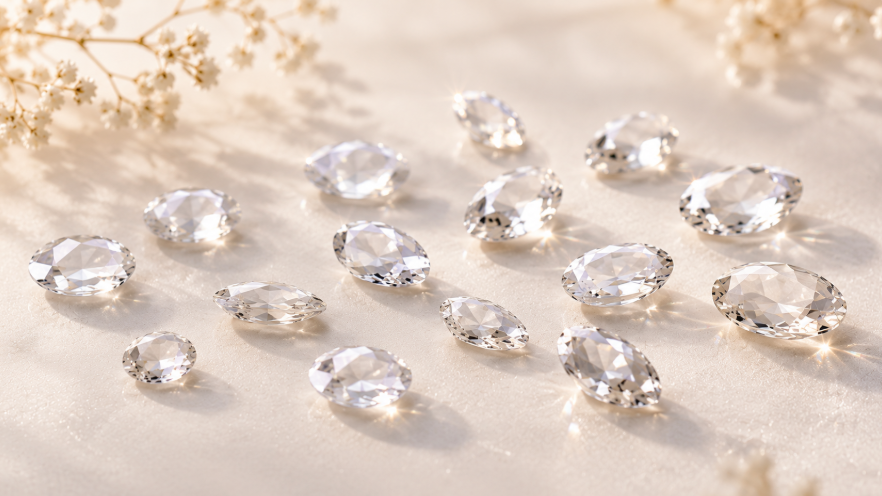
Rose cut diamonds are the defining stone of antique-inspired jewelry. Right now, a consistent lab-grown supply makes them more accessible to trade buyers than ever before. You can already find well-specified stock like this rose cut cushion in E, VVS2, yet most sourcing guidance still applies brilliant-cut logic to a stone that works completely differently.
This blog is written for jewelry retailers, wholesalers, and trade buyers who want a clear, specification-level understanding of rose cuts before making inventory decisions.
What is a rose cut diamond?
A rose cut diamond has a flat base, a domed crown, and triangular facets that converge at a single apex point. There is no pavilion. That single structural difference changes everything about how you source, set, and sell it.
Facet counts range from 3 to 24. For trade purposes, three types matter:
- Single rose cut: 3 to 8 facets, very flat dome, minimal optical depth
- Double rose cut: 48 facets on both sides, rare, primarily of historical interest
- Full rose cut: 18 to 24 facets, fully domed, the standard for retail-grade inventory
The optical output is a soft, diffused glow. It was designed for candlelight, which means it performs differently under LED or fluorescent showroom lighting compared to a brilliant cut. That is the product, not a flaw. Buyers need to know this before building inventory around it.
The cut dates to 16th-century Europe and was the dominant diamond cut through the Georgian and Victorian eras. It essentially disappeared from mainstream production in the 20th century. Today, lab-grown production makes a consistent rose cut supply possible at scale for the first time, which is the real commercial story here.
Key specifications of rose cut diamonds
GIA does not issue a cut grade for rose cuts. It means buyers must evaluate execution directly from proportions, symmetry, and polish. There is no shortcut to it.
1. Crown height-to-diameter ratio
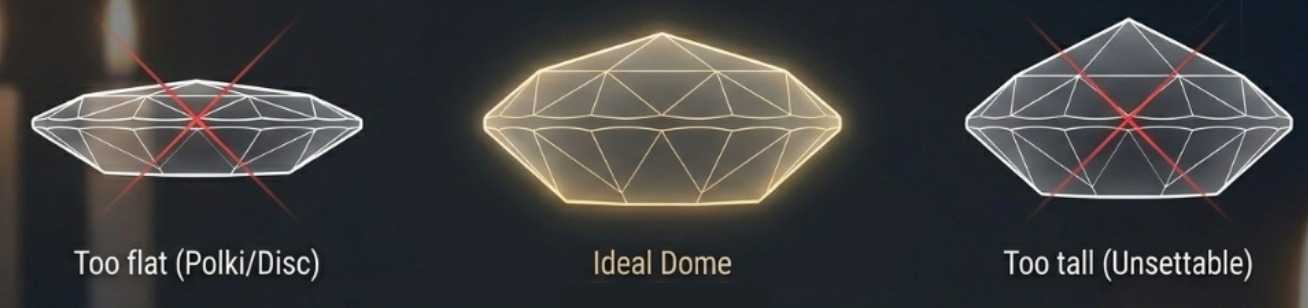
The ideal crown height-to-diameter ratio sits between 1:3 and 1:5. Too flat, and the stone reads as a polki, a disc with no visual depth. Too tall, and it creates a profile that does not sit properly in most settings.
This is the single most important specification to verify. Always request side-profile images or actual measurements before purchasing.
2. Facet count and symmetry
Full rose cuts with 18 to 24 facets are the standard for premium inventory. The central star pattern that makes a rose cut visually distinctive depends entirely on precise facet alignment.
Any misalignment disrupts the pattern immediately. Unlike brilliant cuts, there is no light scatter to compensate for poor execution. Only Excellent or Very Good symmetry grades are acceptable for retail-grade stock.
3. Polish
The domed surface is the entire face-up presentation of a rose cut. Surface haziness or drag marks show up directly under light. Excellent or Very Good polish grades only, without any exceptions.
4. Girdle
A thin to medium girdle is preferred. A thick girdle adds carat weight without contributing to face-up appearance. More importantly, the flat base makes rose cuts vulnerable at the girdle edge, which has direct implications for setting choice. Bezel settings are strongly preferred over prong settings for this reason.
Why clarity matters differently for rose cuts
Clarity standards for rose cuts are stricter than for brilliant cuts, and the reasons are structural. The absence of a pavilion removes the primary mechanism brilliant cuts use to mask inclusions. Every characteristic inside the stone is visible face-up, which makes placement and grade context.
Why rose cuts expose more than other shapes
Without a pavilion, there is no depth to reflect inclusions away from the eye. The dome surface is fully visible face-up, and centrally positioned inclusions sit exactly where the buyer is looking.
Brilliant cuts use sparkle to mask internal characteristics. Rose cuts have no such mechanism. What is inside the stone is what the buyer sees.
Clarity benchmarks for trade sourcing
- VS2 minimum for standard inventory
- VS1 or better for stones above 1.5ct
- SI1 is only viable if the inclusion is positioned at the outer edge of the dome, away from the center
Grade alone is not enough. Always request GIA or IGI clarity plotting maps. A VS2 with a centered feather is a worse stone for retail than an SI1 with an edge crystal; the grade does not tell you that.
Salt-and-pepper rose cuts operate under a completely different logic. Inclusions are the aesthetic in that category, not a defect. That market is discussed below.
Color grading in rose cut lab-grown diamonds
Color behaves differently in a rose cut than in any other common diamond shape. Without a pavilion to break up and reflect light, body color sits directly on the dome surface and concentrates at the center.
1. Why the flat base concentrates body color
Without a pavilion to reflect and disperse light, body color in a rose cut pools directly at the center of the dome. The visual effect is more concentrated than in most other fancy shapes.
G color is the practical floor for standard white rose cut inventory. D to F is the range for premium positioning.
2. HPHT vs. CVD for rose cut color consistency
Production method matters in HPHT vs CVD. HPHT tends to produce Type IIa colorless stones more consistently, making it the better fit for high-color (D-F) rose cuts. CVD output is more variable and requires closer scrutiny at the certification stage.
IGI certification is the accepted standard for lab-grown fancy shapes in the trade. Treat the color grade on the certificate as a starting point, not a substitute for direct visual inspection.
3. Salt-and-pepper and fancy color opportunity
Rose cut is most associated with salt-and-pepper diamonds, heavily included stones where the grey, black, and white patterning is the entire point. This is a separate and growing B2B category, particularly for independent designers and artisan jewelry brands.
Lab-grown fancy color rose cuts in yellow, grey, and black are an emerging niche with limited supply and strong retail positioning. Sourcing logic here shifts entirely: pattern and visual character take priority over traditional clarity benchmarks.
Pros and cons of rose cut diamonds for retailers
Rose cuts are not a substitute for round brilliants. They are a differentiated SKU for a specific retail segment. Before building inventory, trade buyers should weigh both sides clearly.
Pros
- Face-up size advantage: No pavilion means the stone spreads wider face-up relative to carat weight. A 1.5ct rose cut reads visibly larger than a 1.5ct round brilliant. That is a genuine retail selling point.
- Price positioning: Rose cuts typically price below round brilliants of equivalent carat and quality.
- Differentiation: Most lab-grown inventories are round-brilliant heavy. Rose cuts offer a clear point of difference for stores targeting vintage or antique-inspired design.
- Low-profile setting versatility: The flat base suits bezel, flush-mount, and pavé designs. Popular with minimalist and artisan jewelry designers.
- Designer demand alignment: Independent and bespoke jewelry designers actively seek rose cuts for custom work. It is a repeat-order segment that most distributors are not serving well.
- Salt-and-pepper category access: Rose cut is the dominant cut for salt-and-pepper diamonds. One stone type opens access to two distinct retail segments.
Cons
- No official cut grade: Buyers must evaluate execution directly, which increases sourcing complexity.
- Stricter clarity and color floors: Reduces the percentage of viable inventory from any given parcel.
- Smaller resale market: Rose cuts have a more specialized secondary market than round brilliants.
- Setting constraints: Poorly set rose cuts chip at the girdle. Not appropriate for all jewelry types.
- Supply inconsistency: Lab-grown rose cut dimensions and quality vary more across cutters than round brilliants.
Quick reference: Rose cut sourcing specifications
Every rose cut purchase comes down to the same set of parameters. If a stone does not meet these benchmarks, it will be harder to sell and easier to return.
|
Parameter |
Recommended Range |
|
Crown Height Ratio |
1:3 to 1:5 |
|
Facet Count |
18-24 (Full Rose Cut) |
|
Clarity |
VS2 min (VS1+ for 1.5ct+) |
|
Color |
G min (D-F for premium) |
|
Symmetry |
Excellent / Very Good |
|
Polish |
Excellent / Very Good |
|
Girdle |
Thin to Medium |
|
Certification |
IGI or GIA |
Use this as a checklist before confirming any order. A stone that clears every row here is one you can price, position, and move with confidence.
FAQs
What is the difference between a rose cut and a polki diamond?
A polki is an uncut or minimally cut natural diamond with a flat base. A rose cut is a deliberate faceting style with a structured domed crown. They look similar at a glance but are entirely different products.
What carat range moves best for rose cut in retail?
0.50ct to 2.00ct is the most active carat range for rose cut in retail. Stones above 2ct are harder to place, given the niche nature of the cut.
How does rose cut pricing compare to round brilliant?
Rose cuts price below round brilliants of equivalent carat and quality. The exact delta varies, but buyers can generally expect meaningful cost savings, which supports accessible retail price points.
Are salt-and-pepper rose cuts graded differently by labs?
Standard color and clarity grades still apply in salt-and-pepper rose cut, but they carry less weight in purchasing decisions. The visual pattern and character of the stone matter far more than the grade in this category.
Key takeaways!
Rose cut diamonds reward buyers who understand them. The sourcing criteria are well-defined: crown height ratio between 1:3 and 1:5, full rose cut facet count, VS2 clarity minimum, G color floor for standard inventory, and Excellent or Very Good symmetry and polish throughout.
The absence of a GIA cut grade sounds like a complication, but it is manageable once you know what to look for directly in the stone's specifications. Lab-grown production solves the supply consistency problem that historically made rose cuts difficult to stock. You can now source D-F color, VS+ clarity rose cuts reliably in a way that natural rough never allowed.
The round-brilliant-heavy nature of most lab-grown inventories is not going away. That is precisely what makes a well-built rose cut SKU worth having.
Browse certified rose cut lab-grown diamonds on Solitaire Lab Diamond or request a memo to evaluate stones for your specific inventory needs.
Resources: