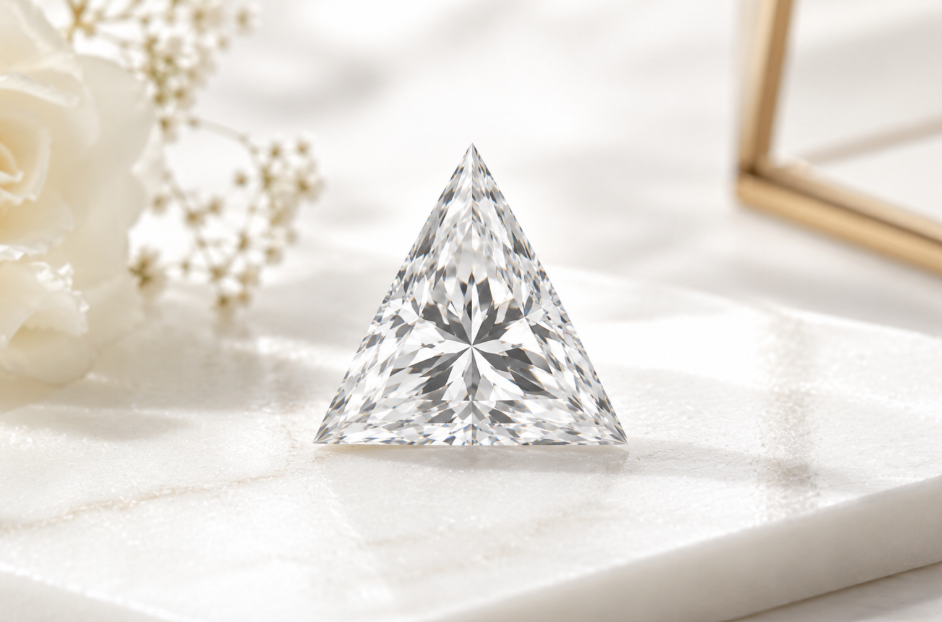
Most naming confusion in the diamond trade is minor. The confusion surrounding triangle, trillion, and trilliant diamonds is not.
All three terms describe triangular diamonds, but they are not always used consistently across the diamond trade. Treating them as interchangeable can lead to ordering mistakes, certificate mismatches, and unnecessary confusion during customer consultations.
Triangle cut diamonds are increasingly used in contemporary jewelry, but inconsistent terminology can create sourcing and communication challenges.
This guide gives jewelers, designers, and trade buyers the practical distinction they need before placing an order.
If you are mapping out where these cuts sit relative to other shapes, the diamond shapes chart is a useful reference to start with.
What is a triangle cut diamond?
A triangle cut diamond is a broad term for diamonds with a triangular outline. Depending on the cutting style, the sides may be straight or slightly curved, and proportions can vary. It is not a proprietary name, not a patented cut, and not a grading term GIA uses on any lab report.
Retailers should review the specific grading report and compare its measurements and facet arrangement with the stone requested.
Although uncommon, triangular diamonds can also be produced with step-cut faceting for specialty or designer applications.
Triangle cut vs. a trillion cut diamond: Key differences and sourcing criteria
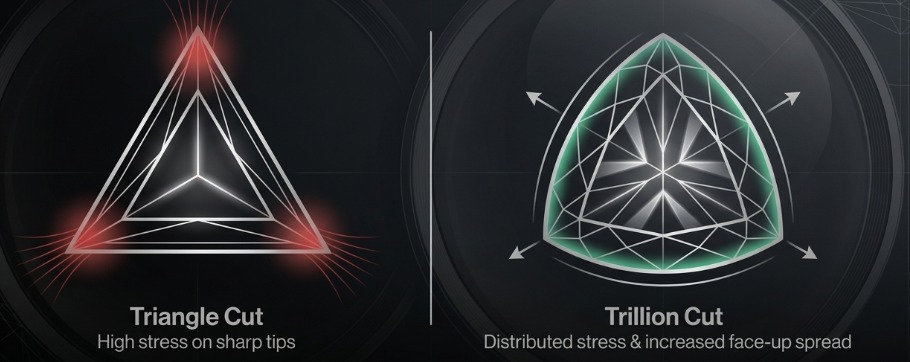
The terms triangle, trillion, and trilliant are not always used consistently across the diamond trade. Rather than relying on the name alone, retailers should confirm the stone's outline before placing an order.
If you want a full breakdown of how trillion cut diamonds are sourced and evaluated, this guide covers it in detail. Here’s what you need to confirm before placing an order.
|
What to confirm |
Why it matters |
|
Exact outline |
Straight, bowed, curved, clipped, or rounded sides affect matching and setting. |
|
Facet arrangement |
Determines the stone's light pattern and overall appearance. |
|
Measurements |
Essential when sourcing matched pairs. |
|
Girdle thickness |
Important near the three vulnerable points. |
|
Symmetry |
Uneven sides and points are visible face-up. |
|
Report description |
Trade names may differ from the Shape and Cutting Style description on the grading report. |
|
Intended use |
Center stones and accent stones may require different proportions and matching tolerances. |
1. Edge profile and structural durability
Triangular diamonds may have straight, slightly curved, or rounded sides depending on the specific design and cutting style. You should evaluate the actual outline rather than relying solely on trade names such as triangle or trillion.
Outline, measurements, and facet arrangement can all affect how a triangular diamond appears and how well it matches another stone.
All triangular diamonds have vulnerable points. Durability should be evaluated by examining the girdle thickness, corner condition, inclusion placement, and intended setting.
V-prongs, protective corner prongs, and bezel settings are commonly recommended for triangular diamonds. The appropriate setting depends on the stone's dimensions, girdle, orientation, and intended wear. Exercise additional caution with inclusions near the points or girdle, particularly surface-reaching feathers or other inclusions that may affect durability.
2. Faceting style and application
Triangular diamonds are available in several brilliant, modified brilliant, and step-style facet arrangements. Some commercial versions have approximately 31 or 50 facets, but facet count alone does not determine whether a stone is suitable as a center stone or an accent stone.
Step-cut triangular diamonds produce broader, mirror-like flashes rather than brilliant-style sparkle. They are often selected for architectural or designer jewelry where a different visual appearance is preferred.
Faceting influences how the diamond reflects light, which also affects where it's best used in jewelry.
3. How GIA describes these stones on grading reports
The trade name used by a supplier may not exactly match the shape and cutting style description on a grading report. Retailers should review the specific grading report and compare its measurements and facet arrangement with the stone.
Depending on the faceting style, triangular diamonds may receive different shape and cutting style descriptions on grading reports. The name a client uses and the name on the grading report are often not the same. So, it is better to cross-reference both before confirming any order.
4. Symmetry
Symmetry is one of the most important quality factors in triangular diamonds, regardless of cut style. Well-cut triangular diamonds should display balanced proportions with evenly matched sides and corners appropriate to their intended design.
Asymmetry in a triangular stone is immediately visible face-up and does not disappear once the stone is set. Look for Very Good or Excellent symmetry when available. Fair symmetry may produce visibly uneven results.
5. Color
Both cuts show color more readily than a round brilliant diamond of the same carat weight due to their shallow, wide profile. The broad table does not scatter light the same way, which means color reads more visibly face-up.
Many retailers prefer G to H color for center stones. While H to I may also work well for some accent stones depending on the design, metal color, and customer preferences. When sourcing matched pairs, prioritize visual consistency in addition to report grades, as stones with the same grade may still appear different face-up.
6. Clarity and proportions
Many retailers source VS2 to eye-clean SI1 diamonds for a balance of appearance and value. But the appropriate clarity depends on the design, stone size, and customer expectations. Eye-clean evaluation remains important because the broad table can make some inclusions more noticeable than the grading report.
Exercise additional caution with inclusions near the points or girdle, particularly surface-reaching feathers or other inclusions that may affect durability.
Some suppliers use these ranges as an initial screening guideline. But the final evaluation should consider symmetry, facet arrangement, girdle thickness, face-up appearance, and light performance.
- Depth percentage: Some suppliers use approximately 32 to 48% depth as an initial screening range.
- Table percentage: 53 to 65% gives balanced brilliance across both cutting styles.
- Face-up size difference: Curved-sided trillions tend to face up slightly larger than straight-sided triangle cuts at the same depth, because the convex edge adds to the face-up diameter.
- Matched pair sourcing: When sourcing accent pairs, you should use the same cutting style for both stones. Mixing a curved-sided trillion with a straight-sided triangle cut can create a noticeable size mismatch, even at the same depth.
Which diamond cut should you stock and for what application?
Now that we've covered the technical differences, the next question is which cut makes the most sense for your inventory.
The answer depends on how your customers plan to use the diamond and the types of jewelry you commonly stock.
Triangle cut, whether step or brilliant faceted, suits architectural and designer pieces, contemporary fine jewelry, and matched earring pairs where clean geometry is the design priority. The straight-sided outline is sharper and more graphic, making it an unconventional shape compared to more traditional shapes like princess cut or round cuts.
Trillion cut is the stronger design application for most jewelers, particularly for side stones in three-stone ring configurations. The curved edge is more forgiving in setting alignment, faces up slightly larger, and works particularly well as an accent stone in three-stone rings. If you carry only one triangular shape, the brilliant-cut trillion in the 31-facet accent stone configuration covers the widest range of retail applications.
Lab-grown trillion diamonds and triangle cuts both make it easier to source matching pairs, which makes natural triangular stones difficult to stock consistently. If you are still weighing the case for lab-grown inventory, understanding why people choose lab-grown diamonds is a good place to start.
Frequently asked questions
Do lab-grown triangle cut diamonds carry GIA or IGI certification?
Yes. IGI issues grading reports for lab-grown triangular diamonds, while GIA provides quality assessments, and their grading formats differ. Since October 2025, GIA has used a Premium or Standard assessment for eligible colorless to near-colorless lab-grown diamonds.
What setting best protects the corners of a triangle cut diamond?
V-prong settings with one prong per corner and bezel settings provide the strongest protection. Standard round prongs do not adequately cover the pointed corners of triangular diamonds, leaving the tips exposed to chipping.
Conclusion
The confusion between the triangle cut and the trillion cut diamond is not a minor terminology issue. It creates real friction at the sourcing stage, at the certificate stage, and in client conversations where the wrong assumption leads to the wrong stone in the setting.
Understanding these distinctions makes it much easier to choose the right stone. Triangle is a broad descriptive term for a triangular diamond, while trillion and trilliant are trade names that suppliers may use differently. You should confirm the outline, facet arrangement, measurements, and grading report before ordering the diamond shape.
Lab-grown diamonds can make it easier to source matched pairs and consistent sizes, depending on the supplier's inventory, cutting consistency, and quality-control standards.
If you are ready to build out your triangular diamond inventory with certified lab-grown stones, browse Solitaire Lab Diamond's triangle and trillion cut selection here.
Resources: