
Diamond type classification shows up on some grading reports and in plenty of supplier specifications, but few jewelers or trade buyers ever get a plain explanation of what it means. This guide breaks down diamond types Ia, Ib, IIa, and IIb for jewelers, retailers, designers, and trade buyers who want to understand a grading report correctly. You can put it alongside other diamond quality factors when evaluating a stone.
Type classification is often treated as a scientific footnote, buried below color and clarity. In practice, it's a useful tool for identification, sourcing, and understanding a diamond's characteristics, and it's worth five minutes of your attention.
What is diamond type classification?
Diamond type classifies diamonds according to certain atomic impurities in the crystal lattice, primarily nitrogen and boron, and how those impurities are arranged. A diamond's crystal structure consists of carbon atoms arranged in a rigid lattice, with chemical impurities, trace elements, and structural defects influencing some of its physical properties.
Some impurity-related defects can influence a diamond's color by changing how the stone absorbs visible light, but diamond type alone does not determine the actual color grade assigned by a laboratory.
There are two broad categories that exist. Type I diamonds show measurable nitrogen-related absorption in infrared spectroscopy. Type II diamonds do not show measurable nitrogen absorption at the levels used for type classification (Rapaport News).
Each category splits further:
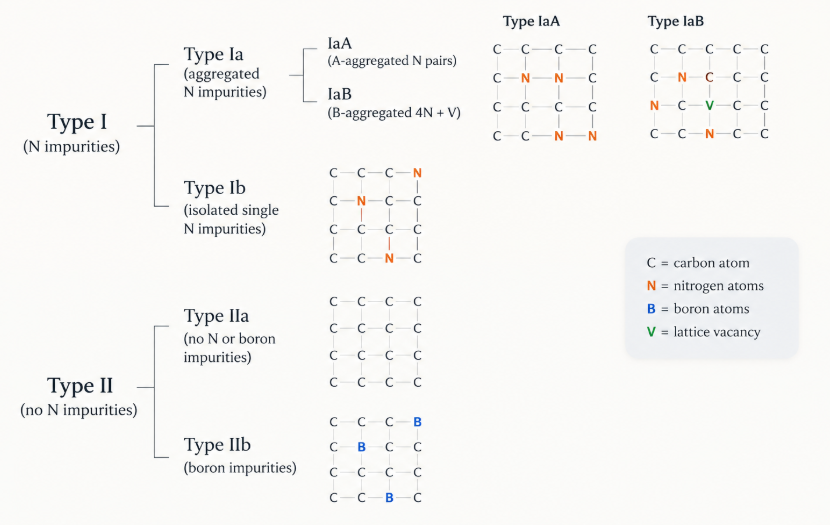
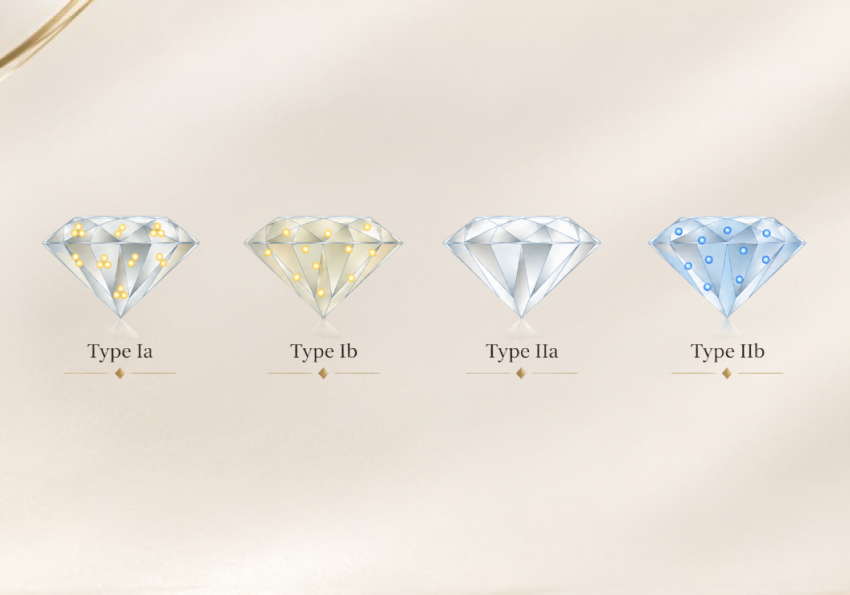
- Type I divides into Type Ia and Type Ib, based on how the nitrogen atoms are arranged. In Type Ia diamonds, nitrogen is typically present in clustered groups, including pairs and groups of four nitrogen atoms around a vacancy, while Type Ib diamonds contain isolated nitrogen atoms.
- Type II divides into Type IIa and Type IIb based on the presence of detectable boron. Type IIa has no detectable nitrogen or boron-related absorption, while Type IIb has detectable boron and no detectable nitrogen-related absorption.
Scientists began classifying diamonds broadly as Type I and Type II in the 1930s. The system was later refined into the Ia, Ib, IIa, and IIb classifications used in modern gemology. GIA uses infrared spectroscopy, including FTIR, as an important tool in diamond type determination and identification.
Diamond types at a glance: Quick reference for trade buyers
For jewelers, retailers, designers, and trade buyers, understanding diamond type can make grading reports and supplier specifications easier to interpret. The table below compares the four main diamond types by their impurity characteristics, typical colors, occurrence, and relevance in the trade.
Use it as a quick reference when evaluating natural or lab-grown diamonds.
|
Type |
Main impurity characteristic |
Typical natural colors |
Natural occurrence |
Lab-grown occurrence |
Trade relevance |
|
Ia |
Aggregated nitrogen |
Colorless, yellow, brown, pink and others |
Very common |
Uncommon |
Dominant type among natural diamonds |
|
Ib |
Isolated nitrogen |
Yellow, orange, brown |
Very rare |
Common in some HPHT material |
Associated particularly with isolated-nitrogen yellow coloration |
|
IIa |
No nitrogen detectable by IR |
Often colorless; can also be pink, brown and other colors |
Rare |
Common in colorless lab-grown diamonds |
Useful identification and sourcing clue |
|
IIb |
Boron; no nitrogen detectable by IR |
Typically blue or gray |
Extremely rare |
Can be produced intentionally |
Associated with electrical conductivity and blue color |
Diamonds can also show mixed-type characteristics when more than one impurity configuration is detected. The Ia, Ib, IIa, and IIb categories are the principal classifications, but not every diamond falls into a single pure type.
These differences can provide useful context when reviewing a diamond's grading report or comparing material from different suppliers. However, diamond type should not be treated as a standalone indicator of origin, quality, or value.
For trade decisions, it is best considered alongside the diamond's 4Cs, growth method, treatment status, and laboratory documentation.
How diamond type appears on grading reports
GIA does not print diamond type as a standard field on every natural-diamond grading report. Diamond Type Analysis is available as an add-on service, with verbal results and an optional letter documenting whether the diamond is Type Ia, Ib, IIa, or IIb.
When ordered as an add-on, the type result is provided separately from the diamond's standard 4Cs grading information. IGI also uses infrared spectroscopy in diamond identification and may report type information on its laboratory documents. Reporting conventions and detection thresholds can vary between laboratories, so type information should be interpreted in the context of the issuing lab's report.
Here's a practical rule worth keeping in your sourcing process: if a supplier claims Type IIa status for a natural diamond without lab documentation, treat that claim as unverified. If a supplier's Type IIa claim materially affects the stone's marketing, sourcing decision, or asking price, verify the classification through appropriate laboratory documentation.
This is also where the Golconda conflation problem shows up. "Golconda" refers to a historic diamond-producing region in India and, in the trade, is also used as a historical designation associated with diamonds from that region.
It is not interchangeable with "Type IIa," even though the two terms get blurred constantly in auction catalogs and trade conversation. A stone can be Type IIa without any connection to Golconda, and plenty of non-Golconda mines have produced Type IIa rough. Keep the two designations separate in your own documentation.
How does diamond type relate to lab-grown diamonds?
Growth method can influence diamond type, but "lab-grown" alone does not determine it. CVD-grown diamonds are commonly Type IIa, particularly when produced as colorless material, because the process can be controlled to minimize nitrogen-related impurities. For a closer look at Type IIa lab-grown diamonds, see our guide to this classification.
However, CVD diamonds can also contain boron impurities or nitrogen and may occur as other diamond types (GIA).
HPHT production works differently. Nitrogen and boron can enter the diamond from the growth environment, including the catalyst, carbon source, or capsule materials. HPHT-grown diamonds can occur as Type Ib, IIa, IIb, or mixed types, depending on the growth conditions and impurities incorporated during growth.
Type Ib is common in some HPHT material, particularly certain yellow-to-green stones, while Type IIa and Type IIb diamonds are also found in colorless and other HPHT-grown diamonds.
Type alone can't confirm whether a stone is natural or lab-grown, since natural Type IIa diamonds exist too, just rarely. Labs combine type data with growth-pattern evidence to make that determination, not type in isolation.
For sourcing purposes, the takeaway is simpler: colorless CVD-grown diamonds are commonly Type IIa, but type should be treated as a documented characteristic rather than a guarantee of growth method or quality.
Conclusion
Diamond type classification is a scientific tool, but it earns its place in a trade conversation because of what it can tell you about a stone's impurity profile, sourcing considerations, and identification. Type Ia is the type you'll encounter most often in natural diamonds.
Type Ib is particularly relevant to isolated-nitrogen yellow coloration, while Type IIb is especially important when evaluating boron-related blue diamonds. Type IIa can be an important identification clue in natural and laboratory-grown diamonds.
It is common among colorless laboratory-grown diamonds and relatively uncommon among natural diamonds, but it does not by itself establish a diamond's origin.
Reading a grading report with this context changes what you notice on it. A type notation stops being a stray technical detail and starts providing useful context about the stone's impurity profile, identification, and, for natural diamonds, the relative occurrence of that type.
If you're sourcing lab-grown diamonds for jewelry production or retail, explore Solitaire Lab Diamond's lab-grown diamond inventory or contact our team to discuss your sourcing requirements.
Frequently asked questions
1. Does diamond type appear on every GIA grading report?
No. Diamond type is not a standard printed field on every GIA grading report. GIA may use spectroscopic type information as part of its identification work, while a documented Diamond Type Analysis result is available as a supplemental service.
2. Why do many colorless lab-grown diamonds test as Type IIa?
Colorless CVD-grown diamonds are commonly Type IIa because the growth process can be controlled to minimize nitrogen-related impurities. HPHT-grown diamonds can be Type Ib, IIa, IIb, or mixed types depending on the growth conditions and impurities present.
3. Is a natural Type IIa diamond more valuable than a Type Ia diamond with the same 4Cs?
There is no automatic Type IIa price premium. Type IIa can add gemological or collector interest in certain notable natural diamonds, but market value still depends on the stone's full quality, size, color, history, treatment status, and demand.
4. Can diamond type be changed through treatment?
Yes, some treatments can alter the defects detected by spectroscopy and may change a diamond's apparent type classification. HPHT treatment, for example, can rearrange nitrogen-related defects. Cutting and polishing alone do not change diamond type. Laboratories therefore interpret type together with other spectroscopic evidence when determining treatment and origin.
5. What is the difference between Type IIa and a Golconda diamond?
Type IIa is a chemical classification. Golconda is a mining region. A diamond can be one, both, or neither, and the two terms shouldn't be used interchangeably in trade documentation.
Resources: