
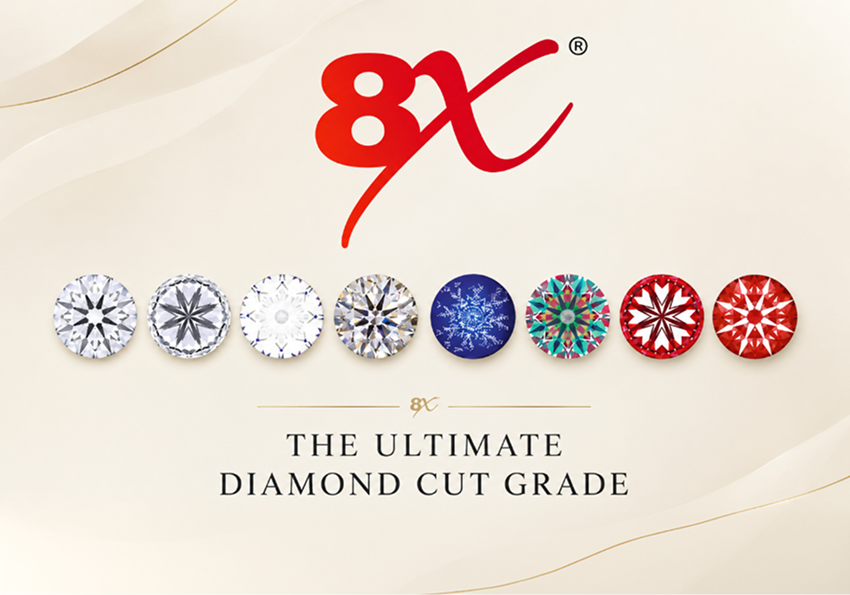
GCAL 8X® is GCAL by Sarine's proprietary diamond cut-grading system. It evaluates eight aspects of cut quality, including physical precision, light performance, optical symmetry, and shape-specific characteristics. A diamond must receive Excellent ratings across all eight criteria to qualify.
This guide explains how GCAL 8X® works, which diamond shapes are eligible, and how its assessment differs from standard cut grades and supplemental light-performance reports. For a broader overview of GCAL's grading services, read our guide to what GCAL certification means for diamonds.
Key takeaways
- Cut quality affects how a diamond handles light in ways the 4Cs alone do not capture, making it a meaningful factor when comparing similarly graded stones.
- GCAL 8X® documents eight cut-quality criteria through direct measurement and optical performance imaging, going beyond what a standard Excellent grade includes.
- The designation does not guarantee a specific price premium, but gives trade buyers verifiable cut documentation for pricing and stocking decisions.
- GCAL 8X® is available for both natural and lab-grown diamonds, including eligible fancy shapes evaluated under Shape Aesthetics.
What is GCAL 8X® cut?
GCAL 8X® is a proprietary cut designation that evaluates eight aspects of diamond cut quality. To qualify, a diamond must receive an Excellent rating in every applicable criterion. GCAL states that fewer than 1% of round brilliant diamonds receiving an Excellent cut grade qualify for its 8X designation.
The designation should not be confused with the 4Cs or with a standard GCAL certificate. A diamond can receive a GCAL grading report without being evaluated for 8X, and receiving a standard Excellent cut grade from another laboratory does not imply 8X qualification.
To understand why these criteria are important when evaluating a diamond's appearance, read our guide on how important GCAL 8X® is for diamond cut and brilliance.
For trade buyers searching for GCAL 8X diamonds in NYC or evaluating precision-cut inventory, verifying the 8X® designation on the specific diamond's certificate helps confirm that the stone carries the designation being claimed.
What are the eight GCAL 8X® cut-grading criteria?
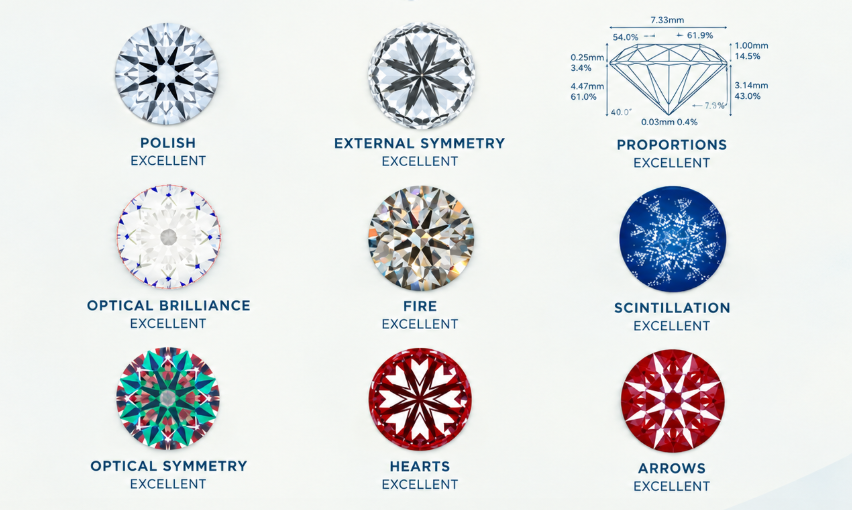
The eight criteria are organized into three groups that cover the physical cutting of the stone, its measured light performance, and its optical precision. A diamond must achieve Excellent in every applicable criterion. A single criterion falling below Excellent disqualifies the stone from the designation.
Physical excellence
- Polish evaluates the quality of a diamond's surface finish. GCAL gemologists examine the facets for polish marks, burns, and scratches.
- External symmetry evaluates the precision and alignment of a diamond's facets, including their shapes, consistency, and meet points. Precise alignment helps maintain consistency in the diamond's facet arrangement. Consistent facet shapes help demonstrate the precision of the cutting process.
- Proportions describe a diamond's measurements and facet angles, including its table size, crown angle, and pavilion angle. GCAL evaluates these measurements against shape-specific requirements.
Light performance excellence
- Optical brilliance measures how effectively a diamond returns white light to the viewer, a characteristic often described as light return. GCAL evaluates this characteristic using optical-performance analysis alongside measurements of the diamond's proportions.
- Fire refers to the flashes of spectral colors produced when a diamond disperses white light. It is one of the light-performance characteristics considered in the GCAL 8X® evaluation.
- Scintillation refers to the flashes of light and changing light-dark patterns visible as a diamond or the viewing position moves. Along with brilliance and fire, it contributes to how a diamond handles light, or its light-handling ability.
Optical excellence
- Optical symmetry evaluates the visual pattern created by the arrangement and alignment of a diamond's facets. It differs from external symmetry, which focuses on the physical precision of the cut.
- Hearts and Arrows is the eighth criterion for round brilliant diamonds, assessing the precision of the hearts and arrows patterns. For eligible fancy shapes, Shape Aesthetics serves as the eighth criterion instead.
How does GCAL 8X® differ for round and fancy-shaped diamonds?
GCAL 8X® uses different eighth criteria for round brilliant and eligible fancy-shaped diamonds to account for their distinct facet patterns and visual characteristics. Hearts and Arrows applies to round brilliants, while Shape Aesthetics evaluates shape-specific features in fancy shapes.
Hearts and Arrows in Round Brilliant Diamonds

For round brilliant diamonds, Hearts and Arrows is the eighth GCAL 8X® criterion. A qualifying diamond must display eight symmetrical hearts when viewed from the pavilion and eight symmetrical arrows when viewed from the crown through a specialized viewer.
GCAL documents Hearts and Arrows through its optical imaging process. Within the 8X® evaluation, this is a specific graded criterion rather than a supplier's standalone marketing claim.
Shape aesthetics in eligible fancy shapes
For eligible fancy shapes, Shape Aesthetics replaces Hearts and Arrows as the eighth criterion. It considers visual characteristics relevant to the diamond's shape rather than applying Hearts and Arrows criteria designed for round brilliant diamonds.
GCAL evaluates shape-specific characteristics within its Shape Aesthetics assessment. For example, an oval diamond is assessed for its outline, symmetry, and bow-tie effect, while a radiant diamond is evaluated for its outline, corner symmetry, and length-to-width ratio.
Which diamond shapes are eligible for GCAL 8X®?
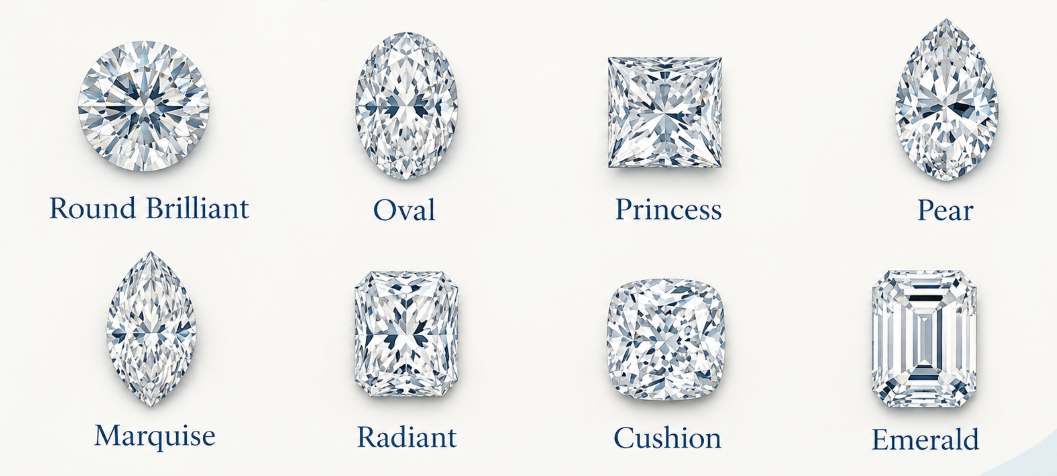
GCAL currently offers 8X grading for the following shapes:
Currently available:
- Round brilliant
- Oval
- Princess
- Pear
- Marquise
- Radiant
- Cushion
Forthcoming:
- Emerald
How is a diamond evaluated for GCAL 8X®?
GCAL gemologists evaluate the diamond against the eight applicable criteria using precision measurements, optical imaging, and shape-specific assessments to evaluate the results of precision diamond cutting.
Before purchasing, buyers should verify the certificate number through GCAL's official verification tool and confirm that the diamond's laser inscription matches the certificate details.
GCAL 8X® vs. a Standard cut grade
The 8X designation and a standard Excellent cut grade from GIA or IGI are not directly comparable because they use different evaluation methodologies.
|
Comparison factor |
GCAL 8X® |
GIA |
IGI |
|
Standard cut grading |
Proprietary eight-criterion 8X® designation |
Standard overall cut grade for round brilliant diamonds |
Cut grading for round brilliant and eligible fancy-shaped diamonds |
|
Supplemental light-performance assessment |
Incorporated into the 8X® evaluation, according to GCAL's methodology |
AGS Ideal® Report available for eligible diamonds as a supplement to a GIA report |
Light Performance Report available for qualifying round diamonds |
|
Hearts and Arrows |
Eighth criterion for round brilliant diamonds |
Not part of the standard cut grade |
Separate Hearts & Arrows report available |
|
Fancy-shape assessment |
8X® available for eligible shapes, subject to GCAL's current eligibility rules |
No standard overall cut grade for fancy shapes; eligible shapes may qualify for the supplemental AGS Ideal® Report |
Cut grading available for eligible fancy shapes |
|
Qualification rate |
GCAL reports that fewer than 1% of round brilliant diamonds qualify. |
Not directly comparable |
Not directly comparable |
These grading systems use different criteria and methodologies, so their results are not interchangeable. Buyers should review each diamond's grading report and any supplemental assessments when comparing stones.
Conclusion
GCAL 8X® provides a detailed assessment of diamond cut quality across eight criteria covering physical precision, light performance, optical symmetry, and shape-specific characteristics. Unlike a standard cut grade, the designation requires an Excellent rating in every applicable criterion.
For trade buyers sourcing natural or lab-grown diamonds, the 8X® designation offers additional information for evaluating cut quality and the results that precision faceting achieves. Buyers should still review the individual diamond's grading report, proportions, and visual appearance when comparing stones.
If you are sourcing lab-grown diamonds for your inventory, explore Solitaire Lab Diamond's lab-grown diamond selection.
Frequently asked questions
1. What does GCAL 8X® stand for?
GCAL 8X® is GCAL's proprietary diamond cut-grading system. It evaluates eight cut-quality criteria, and a diamond must receive an Excellent rating in each applicable criterion to qualify for the designation.
2. Does GCAL 8X® apply to lab-grown diamonds?
Yes. The GCAL 8X cut designation is available for eligible lab-grown diamonds using the same eight criteria applied to natural stones. For lab-grown round brilliants, Hearts and Arrows is the eighth criterion. For eligible fancy shapes, Shape Aesthetics applies.
3. Do fancy-shaped diamonds use Hearts and Arrows?
No. Hearts and Arrows is the eighth criterion for round brilliant diamonds only, because the pattern is structurally specific to the round brilliant facet arrangement. For eligible fancy shaped diamonds, Shape Aesthetics replaces Hearts and Arrows as the shape-specific eighth criterion within the 8X evaluation framework.
Resources: