The kite cut diamond is showing up more frequently in designer collections and bespoke engagement rings. Detailed trade guidance on kite-shaped diamonds remains limited, particularly when comparing cutting styles, grading practices, and sourcing considerations.
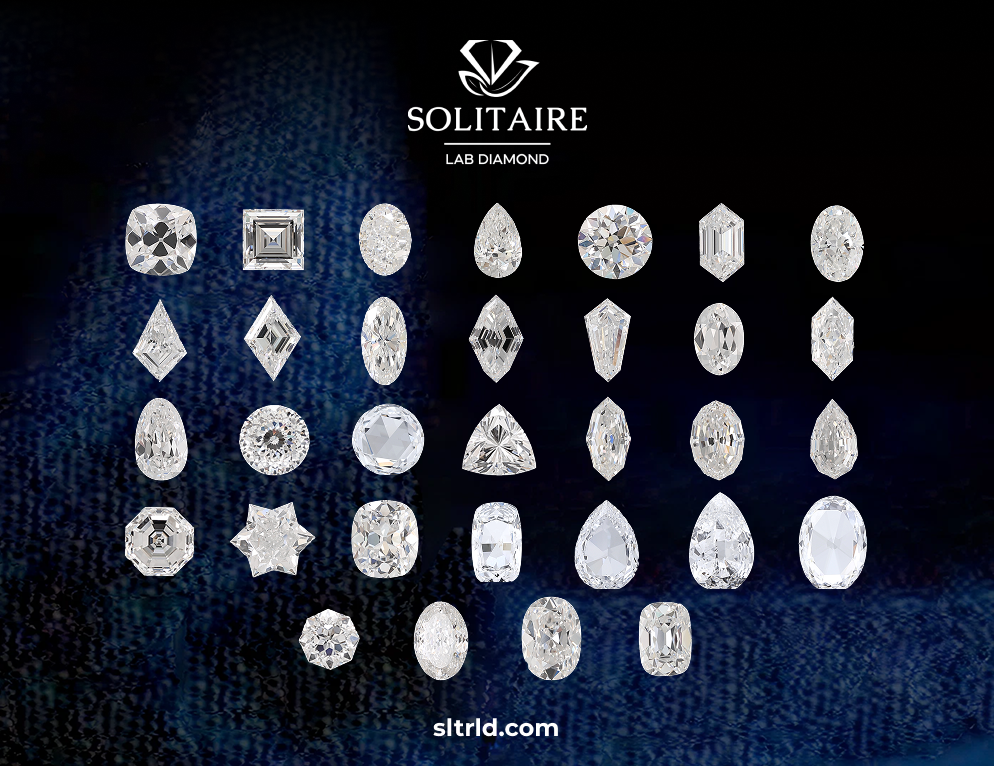
If you are trying to figure out where the kite cut fits relative to the other shapes you already carry, the diamond shapes chart is a useful reference before going further.
This guide is written specifically for jewelers, designers, and trade buyers who need practical sourcing information. Kite-shaped diamonds come in brilliant, step, rose-cut, and modified facet styles.
What is a kite cut diamond?
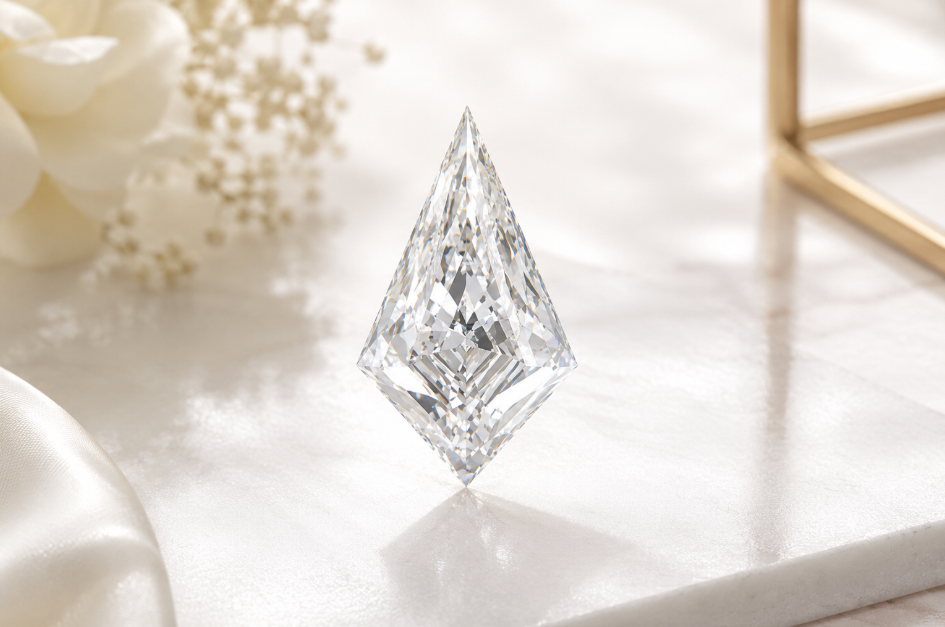
A kite-shaped diamond has a four-sided geometric outline, typically with a long central axis, two side corners, and pointed or sharply angled ends. Exact proportions and facet arrangements vary by cutter and supplier.
Some suppliers may use terms such as "delta cut" for certain geometric or kite-like outlines, but the terminology is not standardized. You should confirm the exact outline, measurements, and facet arrangement before ordering.
The kite's sharp geometric outline pairs naturally with Art Deco-inspired and architectural jewelry designs. GIA classifies kite cut diamonds as fancy shapes, meaning no standardized cut grade is assigned on the certificate.
Not all kite cut diamonds are faceted the same way. So, understanding the three primary cutting styles helps you choose the right option for different jewelry applications.
What are the kite cut diamond variations?
Kite-shaped diamonds are commonly found with brilliant-style, step-style, rose-cut, or modified faceting. Because facet arrangements are not standardized, you should evaluate each stone individually rather than relying only on the cutting-style label.
1. Brilliant cut kite
The brilliant cut kite has triangular and kite-shaped facets radiating from the center, designed to maximize light return. The sparkle is lively and directional, producing angular flashes instead of the even brilliance associated with a round brilliant.
Brilliant-cut kites work best as center stones in bespoke engagement rings and fashion pendants where light performance is the priority. And thanks to its elongated shape, a kite cut diamond often looks larger than its carat weight would suggest.
2. Step cut kite
The step cut kite uses parallel rows of facets running along the length of the stone, similar in character to an emerald cut. It produces quieter, more architectural light return with broad flashes rather than sharp scintillation. This suits designer jewelry where clean geometry matters more than sparkle, and works well as an accent stone in contemporary fine jewelry.
One sourcing note: inclusions are more visible in step-cut versions, which means clarity evaluation needs more attention than it would for the brilliant-cut version.
3. Modified or mixed cut kite
Modified faceting combines elements of both step and brilliant cuts, such as a step-cut crown paired with a brilliant pavilion. This hybrid style offers a middle ground, preserving clean geometric lines while boosting overall light performance and scintillation.
4. Rose cut kite
The rose cut kite has a flat base, a domed top, and facets radiating outward from the center point. It produces a soft, diffused glow rather than sharp brilliance, and it is now popular in vintage-inspired and organic-style pieces.
Rose-cut kites also tend to face up larger relative to their carat weight, making it a strong option for salt-and-pepper diamond settings.
Once you've identified the cutting style, the next step is evaluating the characteristics that affect sourcing and long-term performance. So, let's understand that.
Key specifications of kite cut diamonds
Getting the specification right before sourcing saves time and return conversations. These four areas are where kite cut sourcing tends to go right or wrong.
1. Proportions and length-to-width ratio
Kite cuts have no standardized proportion range, so visual evaluation carries more weight than the certificate alone. A ratio closer to 2:1 appears slimmer and more tapered, and a ratio closer to 1.5:1 reads wider and more balanced.
Depth also varies by cutting style: brilliant cut needs sufficient depth for light return, while step and rose cut run shallower by design. Bilateral symmetry along the kite's central lengthwise axis is especially important. The side corners should align, and the top and bottom points should follow the intended outline without appearing twisted or off-center.
You should also evaluate girdle thickness around the points, facet alignment, light return, windowing, inclusion placement, and the overall outline.
2. Point vulnerability
A kite-cut diamond has two prominent pointed ends, and both are structurally vulnerable to chipping. Pay particular attention to inclusions near the pointed ends and girdle. Surface-reaching feathers or other durability-related inclusions in these areas may increase the risk of damage and should be evaluated carefully.
V-prongs, protective corner prongs, or bezel settings are commonly recommended because they help protect the pointed ends.
3. Grading and certification
GIA does not assign an overall cut grade to fancy-shaped diamonds, so buyers should evaluate symmetry, polish, proportions, and overall appearance. Laboratory-grown kite-shaped diamonds may come with an IGI grading report or a GIA quality assessment, depending on the laboratory.
4. Carat weight and supply reality
Kite-shaped natural diamonds may be less consistently available, particularly when trade buyers require specific sizes or matched pairs.
Lab-grown kite-shaped diamonds may reduce that sourcing challenge, although availability still depends on supplier inventory and production. Kite-shaped diamonds are available in sizes suitable for both accent and center-stone applications. Millimeter dimensions and overall proportions are often more useful than carat weight alone when selecting a stone for a specific design.
Pros and cons of kite shape diamonds
Understanding where this shape works and where it creates challenges is part of making a good stocking decision.
Pros
- Unique visual identity: The geometric outline stands out immediately in a case full of rounds, ovals, and princess cuts, giving your retail staff a clear point of difference from traditional kite engagement ring styles and standard shapes.
- Larger face-up appearance: The elongated outline and typically shallow profile make kite cuts face up larger than their carat weight, a strong value story at the point of sale.
- Versatility across cutting styles: Brilliant, step, and rose cut versions cover a wide range of retail applications from bespoke bridal to designer fashion jewelry.
Cons
- Less traditional brilliance: Buyers accustomed to round brilliant sparkle will notice the difference, particularly in step and rose cut versions. This requires a retail staff that can explain the distinction confidently.
- Point vulnerability: Two exposed tips mean higher chipping risk than shapes with no points, and incorrect settings create a real risk of damage and returns.
- Requires careful setting design: The final setting should be designed around the stone's measurements, girdle condition, orientation, and intended wear.
What are the best settings for kite diamond shape?
Setting selection for a kite cut is not a finishing detail. It is a sourcing consideration that should be part of the conversation before the stone is purchased.
1. Four-prong setting with protected tips
A four-prong setting can leave much of the diamond visible while protecting its corners. V-shaped or specially formed prongs are often used at the sharpest points, while the treatment of the side corners depends on the stone's outline.
2. Bezel settings
A full bezel provides the strongest point protection available for kite cut diamonds and works for both center stone and accent stone applications. For daily-wear pieces, a full bezel is the more practical recommendation over prong settings. A partial bezel with exposed sides is also an option if the client wants greater visibility of the stone while still protecting the tips.
3. Art Deco halos or three-stone settings
Kite cut side stones flanking a round, oval, or emerald center stone are a common design application for this shape. The elongated outline runs parallel to the finger, adding visual length without competing with the center stone. Matched pairs in this configuration must be evaluated for symmetry consistency and color matching within one grade, as any mismatch is visible in the finished piece.
4. East-west orientation
Positioning a kite cut diamond horizontally or at an angle creates a modern, eye-catching look. It works especially well in designer and custom jewelry where the overall design is just as important as the center stone. This orientation pairs well with tapered baguettes or shield cuts flanking the kite, which reinforces the geometric character of the design.
Kite cut lab-grown vs. natural diamonds
Natural and lab-grown kite cuts are not competing products; they serve different retail strategies and come with very different sourcing realities. Here is how the two compare across the factors that actually matter when you are making an inventory decision.
|
Factor |
Natural kite-shaped diamond |
Lab-grown kite-shaped diamond |
|
Availability |
May be inconsistent in uncommon specifications |
May be easier to source repeatedly |
|
Pricing |
Depends on rarity and quality |
Generally lower but varies |
|
Grading documentation |
Available from major laboratories |
Laboratory-specific reports or assessments |
|
Matched pairs |
May require additional sourcing time |
Can be easier to source depending on inventory |
|
Cutting consistency |
Depends on cutter and supplier |
Depends on cutter and supplier |
|
Origin |
Naturally formed |
Laboratory grown |
Lab-grown kite-cut diamonds may be easier to source consistently than natural stones, depending on supplier inventory.
Frequently asked questions
What is the difference between a kite cut and a shield cut diamond?
Kite and shield diamonds are both geometric fancy shapes, but they have different outlines. Kite shapes typically have four prominent corners. Whereas shield cut diamonds usually feature a broader upper edge that tapers to a lower point.
Does GIA issue a cut grade for kite cut diamonds?
No. GIA classifies kite cut diamonds as fancy shapes and assigns no overall cut grade. Symmetry and polish grades are the primary quality proxies on the certificate.
Are lab-grown kite cut diamonds certified the same way as natural ones?
Yes. Lab-grown kite-shaped diamonds may come with an IGI grading report or a GIA quality assessment, depending on the laboratory.
Conclusion
Kite cut diamonds are among the more unique shapes available, offering three cutting styles, a face-up size advantage, and a price per carat that sits below round brilliants. This combination is harder to find in most fancy shapes, and most retailers have not caught on yet.
Before sourcing a kite cut diamond, keep these considerations in mind:
- Confirm cutting style before ordering
- Use symmetry and polish as your primary grading proxies
- Carefully evaluate inclusions near the pointed ends
- Consider protective setting designs such as V-prongs, protective corner prongs, or bezel settings
Lab-grown kite-cut diamonds may be easier to source in larger sizes, although availability still depends on the supplier.
If you are building out your geometric diamond inventory, browse Solitaire Lab Diamond's lab-grown kite cut diamond selection.