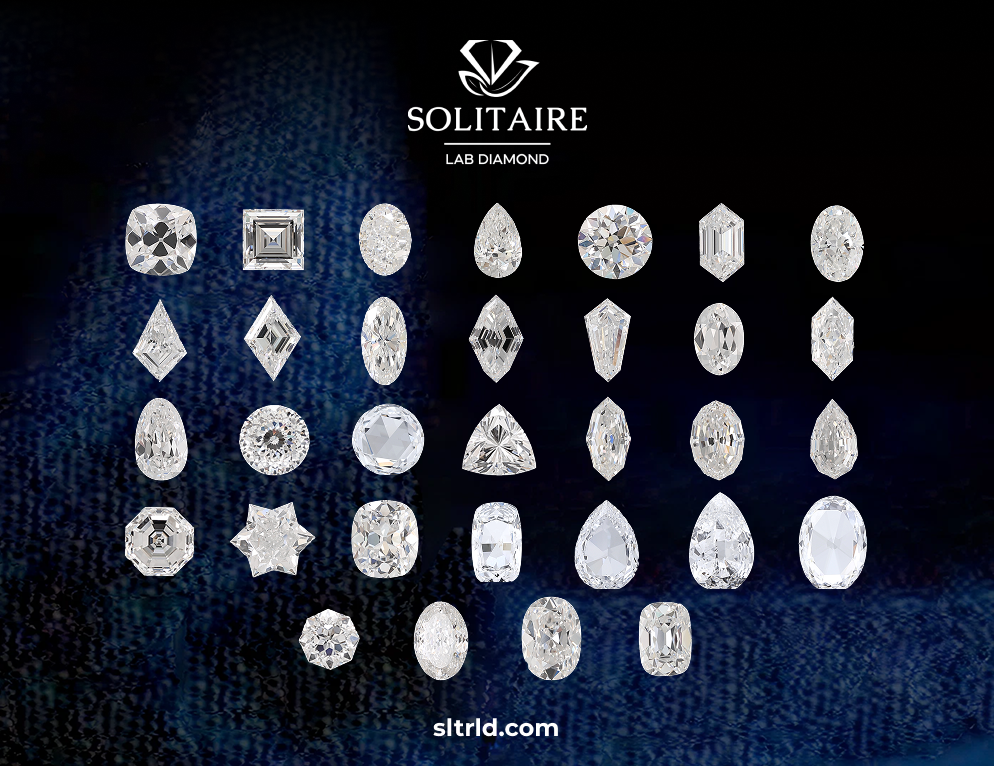
Most fancy-shaped diamonds are associated with one primary jewelry application. The shield cut diamond works as a precision-matched side stone in three-stone engagement rings and as a bold center stone in statement pieces.
This guide is written for jewelers, designers, and trade buyers making inventory decisions. If you are still weighing the sourcing decision between lab-grown and natural diamonds before building out your shield cut inventory, that is worth reading alongside this guide.
What is a shield cut diamond?
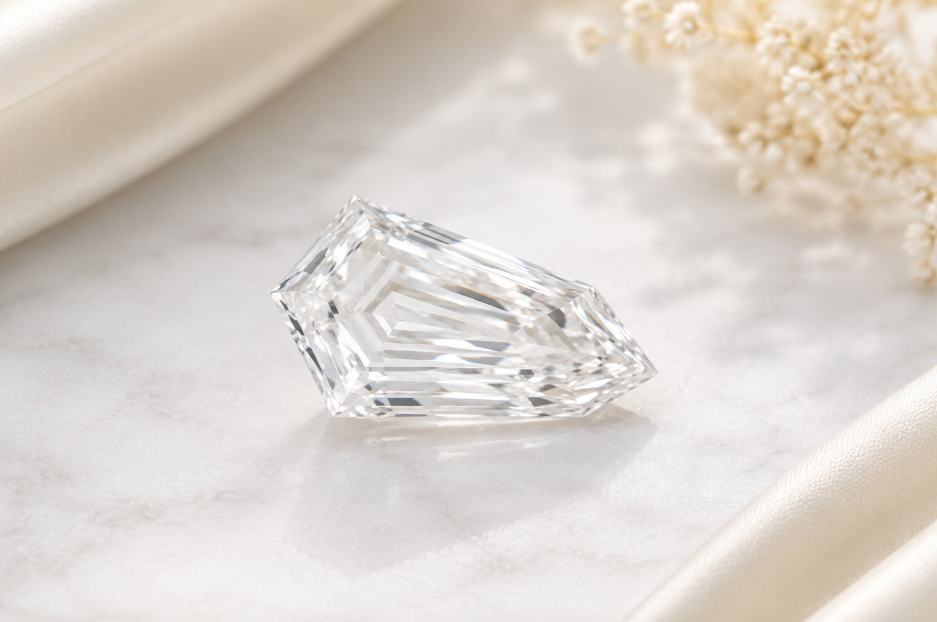
A shield-cut diamond has a five-sided outline with a broad, flat or gently curved upper edge, angled shoulders, and a tapered lower point. Exact proportions and facet arrangements vary by cutter, but the shape is generally distinguished by its broader top and pointed base. This sets it apart from other geometric fancy shapes such as a kite cut diamond.
Shield cuts generally have a broader upper edge that tapers toward the bottom, while kite cuts usually feature four prominent corners arranged around a lengthwise axis. Because terminology is not standardized, you should always confirm the outline, measurements, and facet arrangement before ordering.
The most common commercial application of this diamond is as a side stone in three-stone rings. It also works as a center stone in statement pieces for buyers who want something architectural and non-traditional.
Shield cut vs. kite cut
The shield cut and kite cut are two of the most commonly confused geometric shapes at the trade level, and that confusion can lead to ordering mistakes. Here is how the two actually differ.
|
Factor |
Shield Cut |
Kite Cut |
|
Outline symmetry |
Typically broader across the top and tapering toward the bottom |
Typically symmetrical along its central lengthwise axis |
|
Points |
Single point at bottom only |
Pointed at top and bottom |
|
Top edge |
Flat or gently curved |
Tapered to a point |
|
Widest point |
Across the top edge |
At the center |
|
Setting requirement |
Tip protection at bottom point only |
V-prong at both pointed ends |
|
GIA classification |
Fancy shape |
Fancy shape |
|
Interchangeable when ordering |
No |
No |
The shape description on the certificate is the only differentiator between the two, since both appear under fancy shapes on GIA reports. Confirming the outline with your supplier before placing any order is the one habit that prevents the most common sourcing error with these two shapes.
How shield-shaped diamond styles affect sourcing and setting decisions
Shield-cut diamonds are commonly found with step-cut, brilliant-style, rose-cut, and other modified facet arrangements. Because facet patterns are not standardized, buyers should evaluate the individual stone rather than relying solely on the cutting-style name.
Key diamond styles
- Modified brilliant vs. step-cut: Shield diamonds can feature brilliant-cut facets (for fiery sparkle) or step-cut facets (producing the elegant, watery flash of emerald cuts).
- Straight vs. bullet/kite: While some have rounded sides, elongated "bullet" or "kite" shield cuts feature razor-sharp geometric angles, making them heavily favored for Art Deco or avant-garde rings.
- Toi et Moi: Designers often place two shield-cut diamonds with their flat tops together to form a modern, stylized version of a two-stone ring.
Ideal setting options
- Bezel setting: A metal rim encircles the stone's perimeter. This is one of the most protective setting styles for shielding the pointed tip and corners during daily wear.
- Prong setting: A classic 5-prong or 3-prong setting emphasizes the stone's angular silhouette. Ensure there is a V-shaped prong specifically protecting the bottom point.
- Halo setting: For those who love extra sparkle and a highlight of the shape, a halo is a stunning choice for a shield diamond.
- East-west setting: Setting the flat top parallel to your finger creates a modern, wide-reaching visual silhouette rather than the traditional elongated point.
- Trilogy/three-stone: Because they taper beautifully, shield diamonds are highly prized as accent or side stones to frame round, emerald, or oval center diamonds.
What makes shield cut diamonds effective side stones?
Shield cut side stones are the most common use for this shape, and the sourcing criteria are more specific than they are for most accent stones. Getting this right requires understanding pair matching, orientation, and center stone compatibility as a connected set of decisions, not separate considerations.
1. Pair matching criteria
Shield cut side stones are sourced and priced as matched pairs, not individual stones. Pair total carat weight is the standard sizing convention, ranging from 0.13ctw at the small end to 1.45ctw and above.
The matching criteria cover four areas: outline symmetry between the two stones, color within one grade of each other, consistent clarity, and identical cutting style across both stones. A mismatch in any of these areas is immediately visible in the finished piece and difficult to explain to a retail client after the setting is complete.
2. Orientation and setting alignment
The standard orientation for shield cut side stones is pointed tip running down toward the finger and the wide edge meeting the center stone. This creates a natural taper that draws the eye inward toward the center stone. They can also be set in east-west orientations for a unique look, particularly in center stone applications where a horizontal orientation creates a broader, more architectural reading across the finger.
The wide edge of each shield must align cleanly with the profile of the center stone, because a mismatch in width creates visible gaps in the setting that no amount of metal coverage can fully conceal.
3. Center stone compatibility
Shield side stones pair most naturally with round, oval, and emerald cut center stones where the wide top edge of the shield can align with the center stone's girdle profile. They are generally more challenging to pair with very narrow center stones, such as elongated marquise or pear shapes. This is because achieving clean proportions may require more customized setting work.
What center stone shapes pair best with shield cut side stones?
The answer comes down to the relationship between the shield's wide top edge and the girdle profile of the center stone.
1. Best-fit center stones
Round, oval, and emerald cut center stones are the strongest pairings for shield cut side stones. The wide top edge of the shield aligns naturally with the girdle of these shapes, creating a clean visual connection where the side stone meets the center without gaps or proportion mismatches. The broader the center stone's outline, the more naturally the shield's wide edge sits flush against it.
2. Pairings to avoid
Marquise and elongated pear center stones create a proportion imbalance when paired with shield side stones. The shield's wide top edge is too broad relative to the narrow waist of these shapes, which leaves visible gaps where the side stone meets the center stone. Communicate this to retail clients before the design is finalized because resetting is a costly correction that is entirely avoidable at the sourcing stage.
3. Setting width alignment
The width of the shield pair must be selected to match the diameter of the center stone at the girdle, not the overall length of the center stone. A shield that is too wide or too narrow relative to the center stone will throw off the proportion of the entire ring regardless of how well the individual stones are graded.
Evaluating the 4Cs in shield cut diamonds
The 4Cs apply to shield cut diamonds, but there are a few specifics that change how you source and evaluate this shape compared to more standardized cuts.
1. Cut
GIA does not assign its standard overall cut grade to shield-shaped diamonds. You should evaluate polish, symmetry, proportions, girdle condition, and overall light performance. For laboratory-grown stones, review the accompanying grading report or quality assessment because documentation varies by laboratory.
2. Color
Shield cut diamonds may show color more readily than round brilliants, and the effect is more pronounced in step and rose cut versions due to the broad, shallow profile. H to I is workable in rose gold or yellow gold settings where slight warmth reads as intentional. While D to G is the better range for white gold or platinum settings where color contrast is more visible.
For side stone pairs, both stones must fall within one color grade of each other because a mismatch between them reads as a quality problem.
3. Clarity
Shield cuts can have fewer facets than brilliant cut shapes, making inclusions more visible across all three cutting styles, which is why higher clarity grades are recommended as a starting point for evaluation.
- Step cut: Step-cut shields often reveal inclusions more readily because of their larger, open facets. However, the appropriate clarity depends on the stone's overall appearance and the location of any inclusions.
- Rose cut: VS2 to SI1 is workable because the domed profile scatters light more than a step cut, offering slightly more forgiveness.
- Portrait cut: Evaluate by the stone's overall character rather than standard clarity criteria because inclusion visibility is intentional in many cases.
Pay particular attention to inclusions near the pointed tip and girdle. Surface-reaching feathers or other durability-related inclusions in these areas may increase the risk of damage and should be evaluated carefully.
4. Carat weight
Shield cut diamonds face up larger than their carat weight suggests due to the broad outline and typically shallow depth, which is a useful retail selling point. Side stone pairs are sourced by pair total weight rather than individual stone weight, so factor this into your per-unit cost calculations from the start.
Pricing depends on origin, quality, size, cutting style, availability, and supplier. You should compare millimeter spread, overall cutting quality, and replacement availability before placing an order.
Shield cut lab-grown vs. natural diamonds
Natural and lab-grown diamond shield cuts serve different inventory strategies, and the sourcing experience between the two is quite different in practice. Here is how they compare across the factors that matter most when you are making a stocking decision.
|
Factor |
Natural shield-cut diamond |
Laboratory-grown shield-cut diamond |
|
Availability |
May be less consistent in uncommon specifications |
May be easier to source repeatedly depending on supplier inventory |
|
Pricing |
Influenced by rarity, quality, and availability |
Generally lower, though pricing varies by supplier and market |
|
Grading documentation |
Available from major laboratories |
Available through laboratory-specific grading reports or quality assessments |
|
Matched pairs |
May require additional sourcing time |
Can be easier to source, depending on inventory |
|
Cutting consistency |
Depends on the cutter and supplier |
Depends on the cutter and supplier |
|
Origin |
Formed naturally |
Produced using laboratory growth methods |
Laboratory-grown inventory can make repeat sourcing of matched shield-cut pairs easier, particularly when buyers need consistent specifications. However, availability and cutting consistency still depend on the supplier's production and quality-control process.
Frequently asked questions
Can shield cut diamonds work as center stones?
Yes. Shield-cut diamonds are available in sizes suitable for both side-stone and center-stone applications. The appropriate size depends on the design, millimeter dimensions, proportions, and the desired visual balance rather than carat weight alone.
How are shield cut side stones measured and priced?
Shield cut side stones are sourced and priced as matched pairs by total carat weight, not as individual stones. Pair total weight ranges from 0.13ctw at the small end to 1.45ctw and above.
Do lab-grown shield-cut diamonds have the same grading documentation as natural diamonds?
Lab-grown shield-cut diamonds may come with IGI grading reports or GIA quality assessments. The grading format varies by laboratory.
Conclusion
The shield cut works in two jewelry applications, as a precision-matched side stone and as a bold center stone for buyers who want something outside the standard case.
Before sourcing shield cut diamonds, keep these considerations in mind:
- Confirm cutting style before ordering
- Source matched pairs within one color grade of each other
- Verify outline symmetry between both stones
- Align the shield's width to the center stone's girdle profile
- Carefully evaluate inclusions near the pointed tip and girdle for potential durability concerns.
Laboratory-grown shield-cut diamonds can make repeat sourcing of matched pairs easier, particularly when consistent specifications are required. As with natural diamonds, you should still evaluate each stone's proportions, symmetry, facet arrangement, and grading documentation before ordering.
If you are ready to build out your shield cut inventory, browse Solitaire Lab Diamond's lab-grown shield cut diamond selection.