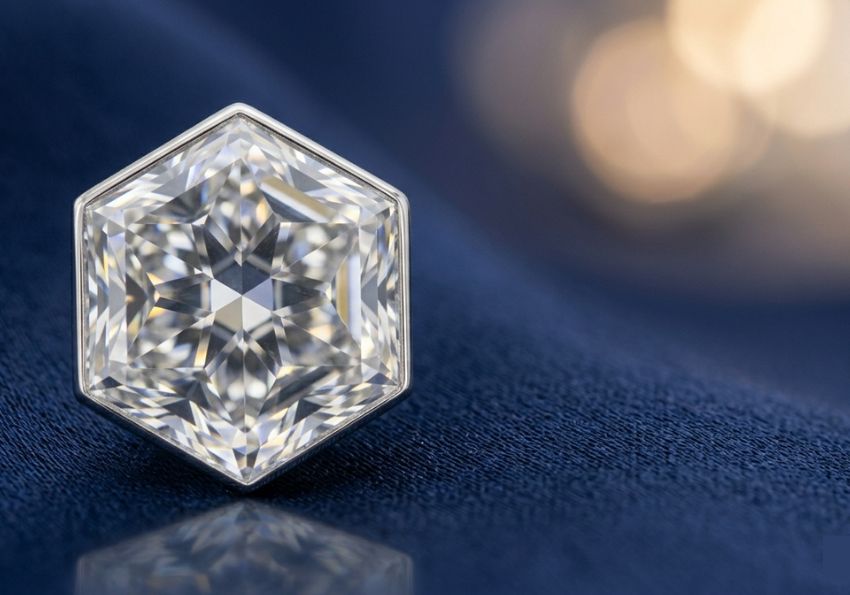
The hexagon cut diamond is a deliberate departure from the round brilliant and princess cuts that have defined the market for decades. Its six equal sides create a geometric outline built on symmetry and architectural precision rather than maximized light return.
Unlike standardized cuts, the hexagon has no GIA cut grade, which means craftsmanship and facet alignment carry more weight than a report number.
The shape draws from Art Deco design principles and has found a strong foothold in custom and designer jewelry, where shape drives the decision as much as the diamond itself.
What Is a Hexagon Cut Diamond?
A hexagon cut diamond is a fancy-cut diamond shaped into a six-sided polygon. Unlike round brilliants or princess cuts engineered around maximizing light return, the hexagon cut is built around geometric symmetry. Each of its six sides is equal in length, producing a flat-table, step-cut, or mixed-cut structure depending on the cutter's approach.
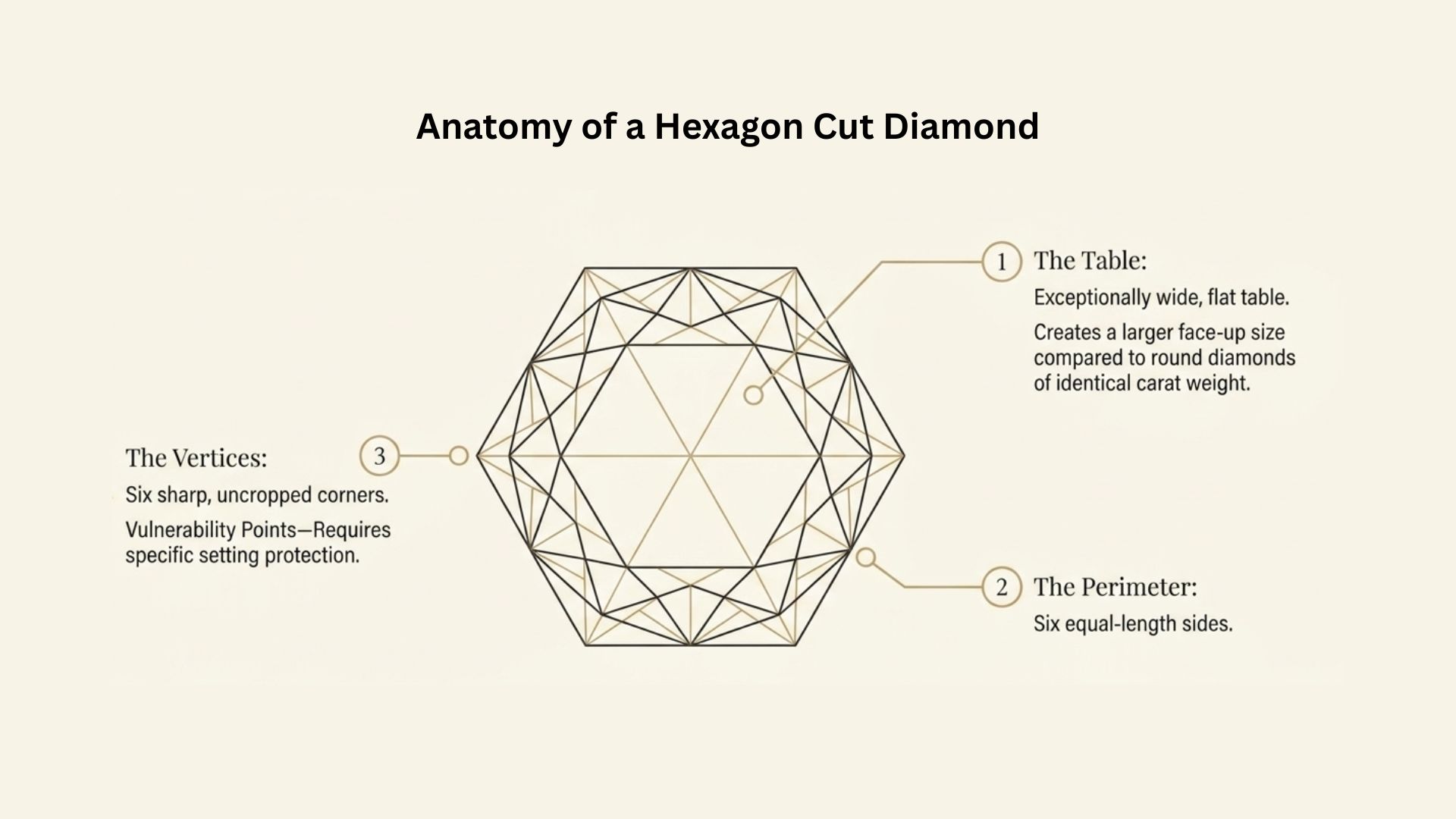
The shape draws directly from Art Deco design sensibility, where geometry took precedence over conventional beauty standards. It produces broader, more deliberate flashes of light rather than the rapid scintillation associated with brilliant cuts.
Because it sits outside the mainstream, the hexagon remains genuinely uncommon in fine jewelry, commanding attention through shape rather than sparkle.
The hexagon cut diamond is a modern specialty cut with roots in early 20th-century design. The Art Deco movement of the 1920s and 1930s introduced geometric layouts into jewelry, and while octagonal cuts like the Asscher cut dominated that era, hexagonal arrangements appeared in halo settings and jewelry suites of the period.
The cut's formal rise as a center diamond shape is largely a 21st-century story. From 2020 to 2023, the elongated and step-cut hexagon gained significant traction through custom jewelers and social media, appealing equally to vintage-inspired and minimalist aesthetics.
Types of Hexagon Cut Diamonds
The hexagon cut is not a single style. The faceting approach determines everything from light performance to overall mood.
Alt: types of hexagonal diamond
1. Brilliant Cut Hexagon
Features triangular facets designed to maximize sparkle and fire. It produces geometric scintillation with star-like reflections, offering light performance closest to a round brilliant diamond while retaining the bold hexagonal silhouette.
2. Step-Cut Hexagon
Uses long, parallel facets that create a hall-of-mirrors effect. Emphasizes architectural lines and clarity over sparkle, with strong roots in Art Deco aesthetics. Similar in feel to an emerald cut, though the open facets demand a higher clarity grade.
3. Elongated Cut Hexagon
Cut thin and flat to produce a near-transparent, window-like appearance. This is the most understated option, prioritizing natural purity and quiet elegance over traditional brilliance.
Each faceting style produces a distinctly different diamond, so the choice comes down to whether you want the hexagon to shine, reflect, or simply exist as a quiet geometric statement.
Shape and Proportions of Hexagon Cut Diamonds
The hexagon cut comes in two primary profiles that significantly influence overall appearance and suitability for different ring styles.
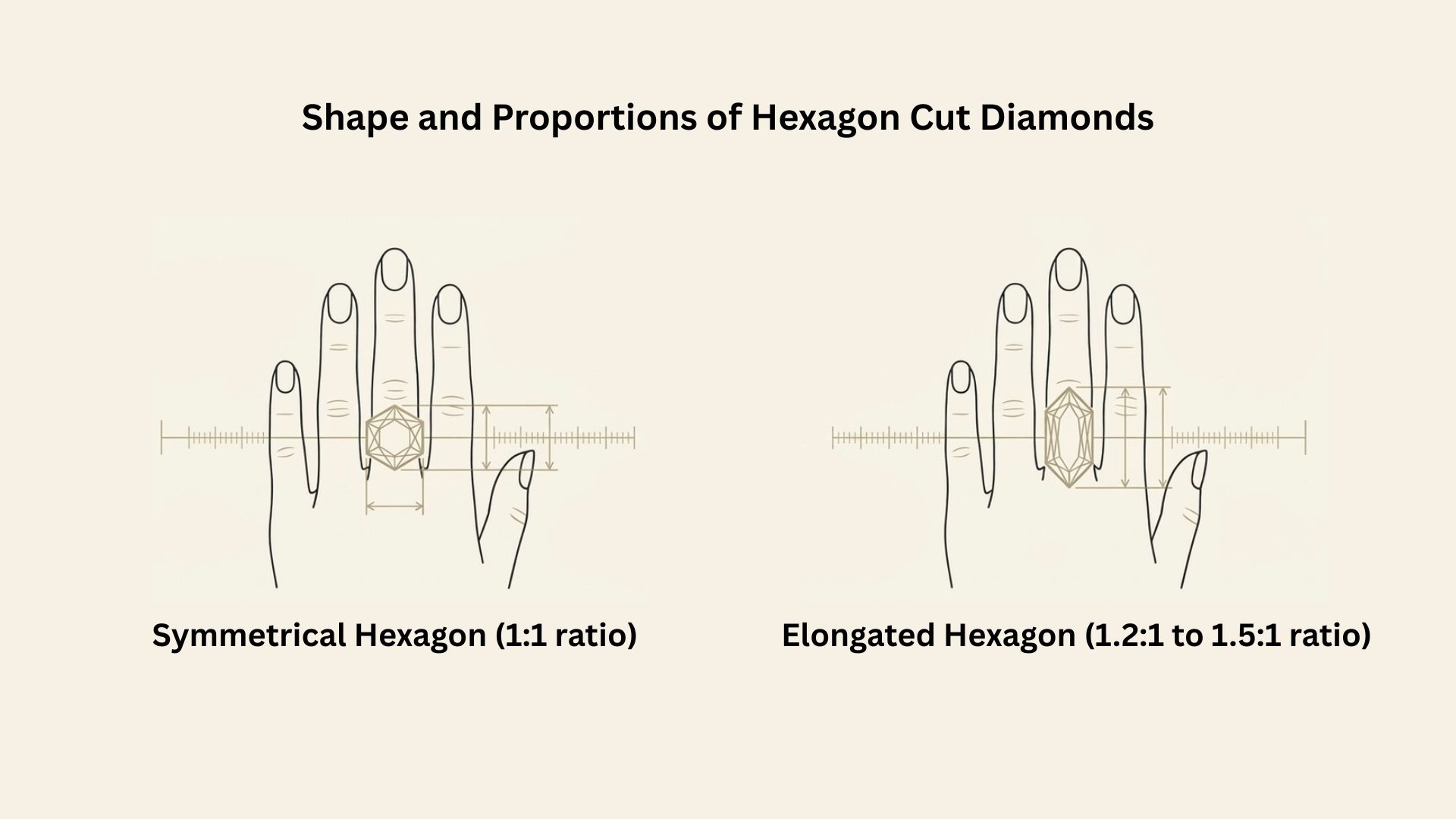
1. Symmetrical Hexagon (1:1 ratio)
Produces a balanced, centered appearance that works well as a standalone center diamond in solitaire or halo settings.
2. Elongated Hexagon (1.2:1 to 1.5:1 ratio)
Creates a slender silhouette that visually lengthens the finger. Especially popular for modern east-west settings. Often compared to the elongated cushion cut in terms of finger coverage, though the straight sides read more architectural.
Symmetry is the most critical quality factor in either profile. Even a slight asymmetry becomes immediately visible in this shape, more so than in round or oval cuts.
How to Evaluate a Hexagon Cut Diamond
Because the hexagon has no standardized grading system, evaluation requires more hands-on assessment than a report alone can provide.
- Check Symmetry and Proportions: Confirm all six sides are equal in length with consistent angles at every corner. A 1:1 length-to-width ratio produces the most balanced face-up appearance. Any asymmetry is immediately visible and cannot be corrected.
- Match the Cut Style: Choose a brilliant cut hexagon diamond if sparkle matters. Triangular facets generate scintillation and mask inclusions and body color more effectively. Choose a step cut hexagon diamond if you want clean architectural lines. Parallel facets create a reflective, hall-of-mirrors effect but demand higher clarity.
- Set the Right Clarity Standard: For step-cut hexagons, VS1 or VS2 is advisable. Brilliant-cut hexagons can work with SI1 if the diamond is eye-clean.
- Check the Color: Step cuts retain body color more visibly. G to H is the recommended range for a white appearance. Brilliant cuts are more forgiving of color.
- Consider Face-Up Size: Hexagon diamonds often appear larger than round diamonds of equivalent carat weight due to their wide, flat table.
- Factor in Corner Protection: The six sharp corners are vulnerable to chipping if left exposed. A bezel or six-prong setting is strongly recommended for everyday wear, not just for aesthetics but for long-term durability.
- Always Request a Grading Report: GIA or IGI certification confirms the 4Cs and verifies the diamond's origin. Without it, there is no reliable baseline for quality or value.
Getting these details right up front saves high cost and disappointment later.
Comparing Hexagon With Other Shapes
Hexagon diamonds offer a unique geometric appeal compared to traditional cuts. Here's how they stack up.
|
Shape |
Light Performance |
Grading Ease |
Visual Style |
|
Round Brilliant |
Benchmark maximum |
Easiest (GIA cut) |
Classic sparkle |
|
Emerald Cut |
Moderate |
Established standards |
Architectural elegance |
|
Hexagon |
Strong, unique |
No standardized benchmarks |
Geometric precision + impact |
The hexagon does not compete with traditional shapes, but carves its own niche.
FAQs
What is a 6-sided diamond called?
A six-sided diamond is called a hexagon cut diamond. It is a fancy-cut diamond defined by six equal straight sides and sharp corners, falling outside GIA's standardized grading system for round brilliants.
What does the elongated hexagon engagement ring mean?
An elongated hexagon engagement ring features a length-to-width ratio between 1.2:1 and 1.5:1. The stretched profile creates a larger face-up surface area, often appearing bigger than a round diamond of identical carat weight.
Are Dutch marquise and elongated hexagon the same?
No. A Dutch marquise has curved sides and pointed ends similar to a traditional marquise. An elongated hexagon has six straight sides and sharp corners. They share a similar outline but are structurally different cuts.
What are the different cuts of hexagon diamonds?
Hexagon diamonds come in three styles. Brilliant-cut uses triangular facets for sparkle, tolerating SI1 clarity if eye-clean. Step-cut uses parallel facets requiring VS1 or better. Portrait-cut is flat and near-transparent, prioritizing geometric form over light performance entirely.
What is the difference between an emerald cut and an elongated hexagon?
An emerald cut has four sides with cropped corners and follows GIA grading standards. An elongated hexagon has six straight unclipped corners, no GIA cut grade, and is almost exclusively custom-cut, making it significantly rarer in retail.
Why Hexagonal Cut Diamonds Stand Out
The hexagon cut diamond holds its ground precisely because it does not follow the rules that define conventional cuts. Its six-sided geometry delivers architectural precision, deliberate symmetry, and a visual presence that round brilliants and standard fancy cuts simply do not offer.
It requires more careful evaluation, a sharper eye for symmetry, and a clearer sense of design intention. But for those who approach a diamond purchase with those priorities, no other shape delivers the same combination of structural elegance and genuine rarity.
Lab-grown hexagon diamonds add another dimension to that decision. Chemically and physically identical to mined diamonds, they offer the same cut quality and certification standards with a significantly lower environmental footprint and greater pricing transparency.
The hexagon cut does not try to compete with tradition. That is exactly what makes it worth considering.