
Two diamonds with the same carat weight, color grade, and clarity grade can look noticeably different in person. The difference usually comes down to cut quality and how the stone handles light. A diamond's cut quality and facet arrangement influence how it returns white light, displays fire, and produces scintillation. Differences in these characteristics can affect the diamond's overall appearance.
For jewelers, retailers, and diamond buyers sourcing inventory, cut quality and optical performance are important factors to evaluate alongside the 4Cs. GCAL 8X® provides an eight-criterion assessment covering physical precision, light performance, and optical symmetry. This documentation can help trade buyers compare eligible diamonds and assess whether the designation fits their inventory needs and customer demand.
To understand how this assessment works, explore our guide to the GCAL 8X® cut and its eight evaluation criteria.
Although the designation does not guarantee that every buyer will prefer an 8X® diamond, it provides additional assessment details that may not be included in a standard grading report.
Key takeaways
- Two diamonds with identical 4Cs grades can look noticeably different, and cut quality is often the factor that explains the gap.
- GCAL 8X® documents eight cut-quality criteria covering physical precision, light performance, and optical symmetry, providing more detail than a standard overall cut grade.
- The designation is not a requirement for every buyer and does not guarantee a specific price premium or visual result, but offers useful documentation when cut is a priority.
Why does diamond cut quality matter?
Cut quality is important because it directly affects how a diamond interacts with light, which is the primary reason a faceted diamond looks the way it does. Two stones with identical color and clarity grades will perform very differently if one is cut with greater precision than the other.
1. Cut quality and light return
A diamond's cut characteristics determine how much light enters the stone, how it travels through the interior, and how much returns through the table to the viewer's eye. Stones with shallow or deep proportions allow more light to escape through the sides or base rather than reflecting back upward.
The amount and distribution of light returned to the viewer contribute to a diamond’s face-up brightness. Brilliance, fire, and scintillation also influence its overall appearance.
Facet alignment also affects light return in ways that proportion measurements alone do not fully capture. A stone with acceptable proportions but poor facet alignment can still show dark areas or uneven brightness across the face-up surface. This is one reason GCAL 8X® assesses optical symmetry separately from proportions, using imaging to evaluate the uniformity of the diamond's optical pattern.
2. Brilliance, fire, and scintillation
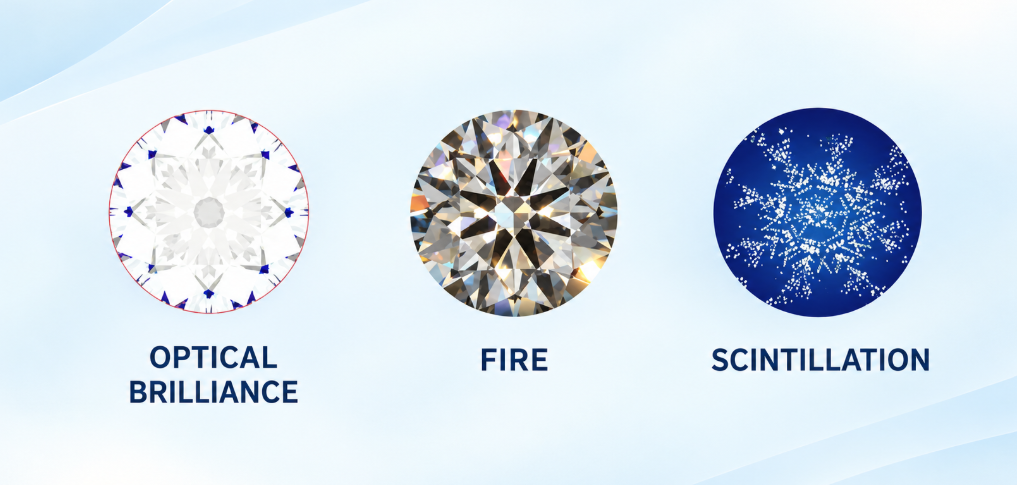
Brilliance refers to the return of white light through the diamond's crown and table. Fire refers to the dispersion of white light into spectral colors as it bends through the stone's facets. Scintillation refers to the flashes of light and the changing pattern of bright and dark areas visible as the diamond, the viewer, or the light source moves.
These three visual qualities are related but distinct. A diamond can show strong brilliance with relatively modest fire, or strong fire with moderate white light return, depending on its proportions and facet arrangement. Evaluating all three gives a more complete picture of how a stone performs than any single measurement provides.
3. Proportions and facet alignment
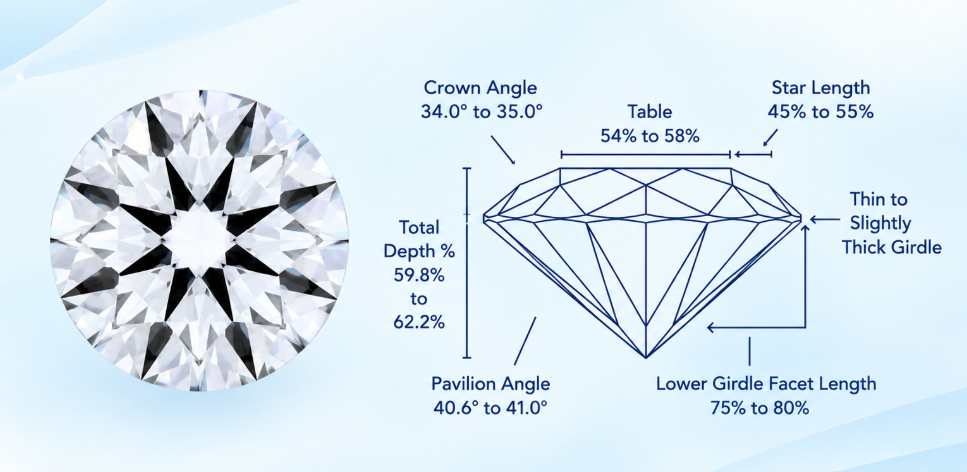
Crown angle, pavilion angle, table percentage, and depth percentage all influence how a diamond distributes light. Proportions that are poorly suited to a diamond’s facet arrangement can contribute to light leakage, reduced brightness, or uneven areas of light and dark. However, proportions should be evaluated together rather than judged individually.
Facet alignment and symmetry work alongside proportions to determine how precisely the stone converts incoming light into brilliance, fire, and scintillation. A diamond can have acceptable proportions and still show optical irregularities if the facets are not aligned with sufficient precision. These are the factors that precision diamond cutting addresses, and that GCAL 8X® documents across eight specific criteria.
How important is GCAL 8X®?
For trade buyers sourcing GCAL 8X®-graded diamonds, the designation provides documented information about cut quality and optical performance beyond a single overall cut grade.
1. Prioritizing cut quality
Buyers who place cut quality and light performance at the top of their criteria will find the GCAL 8X® designation particularly useful. The assessment covers polish, external symmetry, proportions, optical brilliance, fire, scintillation, and optical symmetry.
Hearts and Arrows is the eighth criterion for round brilliant diamonds, while Shape Aesthetics is the eighth criterion for eligible fancy shapes. This provides buyers with more information than a single overall cut grade.
Rather than treating the GCAL 8X ultimate cut grade as a standalone ranking, buyers should consider the individual assessment criteria and supporting report details. The specific information available depends on the laboratory and the report or supplemental service.
2. Comparing diamonds with similar specifications
When comparing round brilliant cut diamonds with similar carat weight, color, and clarity specifications at comparable price points, cut quality becomes one of the most meaningful differentiating factors.
Unlike a comparison based solely on excellent cut grades, a GCAL 8X® designation indicates that the diamond has received an Excellent assessment in all eight applicable criteria.
Buyers should still review the diamond's actual appearance, available images and videos, and the supplier's terms alongside any cut designation. The GCAL 8X® provides additional information, not a substitute for examining the stone.
3. Evaluating fancy-shaped diamonds
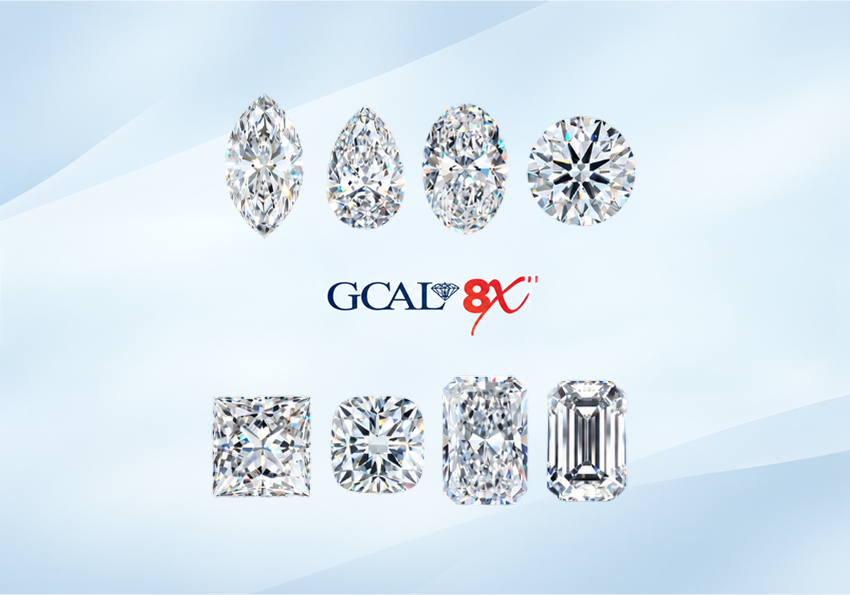
GCAL 8X® is available for eligible fancy shapes, including oval, princess, pear, marquise, radiant, and cushion cuts. For trade buyers comparing fancy-shaped inventory, reviewing the applicable shape-specific assessment criteria helps clarify what the designation documents. See our guide to GCAL 8X® cut for a closer look at the assessment framework.
4. Balancing budget and other diamond characteristics
GCAL 8X® is not essential for every inventory strategy and does not guarantee a specific price premium or resale value. Trade buyers should assess the designation alongside stocking costs, target price points, and customer demand for cut quality, colour, clarity, and carat weight.
Depending on the target market, stocking well-cut diamonds with different colour and clarity grades may offer more flexibility than focusing exclusively on stones with a premium cut designation. The right balance depends on the retailer's positioning, available budget, and the specifications customers are actively seeking.
GCAL 8X® is most useful when documented cut quality and optical performance align with the needs of the intended customer base and justify the cost of stocking those stones.
How does GCAL 8X® compare with other cut grades?
Different laboratories use different assessment methods, and grades from one system should not be treated as directly equivalent to grades from another.
|
Comparison point |
What buyers should understand |
|
Assessment scope |
GCAL 8X® evaluates eight criteria related to diamond cut quality and optical performance. |
|
Light performance |
GIA's supplemental AGS Ideal® Report provides additional information about light performance for eligible diamonds. |
|
Fancy-shaped diamonds |
GCAL 8X® provides shape-specific assessment details for eligible fancy shapes. |
|
Comparing grades |
Different laboratories use different methods, so their grades should not be treated as directly equivalent. |
The table reflects what each system documents rather than ranking laboratories against one another. Each laboratory uses its own methodology, and buyers evaluating specific report types should refer to official laboratory sources for current information on what each assessment covers.
What should you check before buying a GCAL 8X® diamond?
Before purchasing, use these checks to review the diamond's gem certification details and supporting cut assessment. If you want to understand how diamond grading reports work, read our GCAL diamond certification guide.
- Verify the report: Check that the diamond's GCAL report identifies it as 8X® and confirm the report details through GCAL's official certificate verification tool.
- Review the cut assessment: Review the eight-criterion results and supporting images or videos, including optical-performance imagery where available.
- Consider the complete diamond: Review the 4Cs, measurements, inclusion placement, and actual appearance rather than relying on the cut designation alone.
- Compare prices: Compare the stone against diamonds with similar characteristics and evaluate whether the additional assessment documentation represents value for your specific priorities and budget.
Conclusion
Cut quality affects how a diamond looks in ways that carat weight, color, and clarity grades alone do not capture.
GCAL 8X® provides a documented assessment of diamond cut quality across eight criteria covering physical precision, light performance, and optical symmetry. For trade buyers evaluating inventory, it offers additional information beyond a single overall cut grade and can help compare stones based on their documented cut characteristics. Its value depends on whether the assessment aligns with target price points and customer demand.
For trade buyers sourcing lab-grown diamonds with documented cut quality, explore Solitaire Lab Diamond’s certified selection to find stones suited to your inventory needs.
Frequently asked questions
1. Is GCAL 8X® worth it?
GCAL 8X® can be valuable for trade buyers whose customers prioritize cut quality and optical performance. Its usefulness depends on target price points, inventory costs, and customer demand. Buyers should assess whether the additional cut-quality documentation justifies the cost of stocking these diamonds.
2. Does GCAL 8X® guarantee maximum diamond brilliance?
No. GCAL 8X® documents that a diamond has achieved Excellent across eight specified cut-quality criteria, including direct measurements of optical brilliance, fire, and scintillation. It does not guarantee that every viewer will perceive the same level of brilliance, as visual perception varies with lighting conditions, viewing angle, and personal preference.
3. Does GCAL 8X® affect diamond pricing?
A GCAL 8X® designation may influence how a diamond is priced, but it does not guarantee a specific price premium. Prices also depend on factors such as carat weight, color, clarity, shape, and seller pricing. Compare diamonds with similar characteristics to determine whether the price fits your budget and priorities.
4. Is GCAL 8X® available for fancy-shaped and lab-grown diamonds?
Yes. GCAL 8X® is available for eligible fancy-shaped and lab-grown diamonds. Eligible fancy shapes include oval, princess, pear, marquise, radiant, and cushion. Shape Aesthetics serves as the eighth criterion for eligible fancy shapes, while Hearts and Arrows applies to round brilliant diamonds. Eligibility depends on the applicable shape and assessment criteria.
Resources: