Type IIa diamonds have no detectable nitrogen at the levels used for diamond-type classification and are generally regarded as the most chemically pure diamond type. This classification describes the diamond's impurity profile, not its quality or visual appearance.
For trade buyers sourcing colorless lab-grown diamonds, understanding what Type IIa actually means at the grading and production level is worth more than the marketing language that often surrounds it.
This guide explains what Type IIa classification means in practice, how it connects to the 4Cs, how CVD and HPHT growth methods relate to diamond type, and how to verify it before placing an order.
What does Type IIa mean in a diamond?
A Type IIa diamond is one in which nitrogen is not detectable by the infrared spectroscopy used for diamond-type classification (Rapaport News). Nitrogen is the most common impurity found in natural diamonds. The presence, concentration, and configuration of nitrogen, along with boron in Type IIb diamonds, determine the diamond's type classification.
Because Type IIa diamonds have no detectable nitrogen at the levels used for type classification, they are generally regarded as having very high chemical purity.
This classification is determined through infrared spectroscopy (FTIR analysis), not by visual inspection or standard grading criteria. Diamond type cannot be reliably determined from appearance or standard 4Cs information alone; spectroscopic analysis is required.
Several things Type IIa does not mean are worth stating clearly:
- It is not a quality grade: Type IIa describes chemical composition, not cut, color, clarity, or carat weight.
- It is not equivalent to flawless: A Type IIa diamond can have inclusions, color tint, or proportional issues just like any other diamond.
- It is not visually identifiable: No trade buyer can determine diamond type without spectroscopic testing.
- It is not a substitute for the 4Cs: The classification is a structural designation, not a performance indicator on its own.
Other diamond types: Type IIb, Ia, and Ib
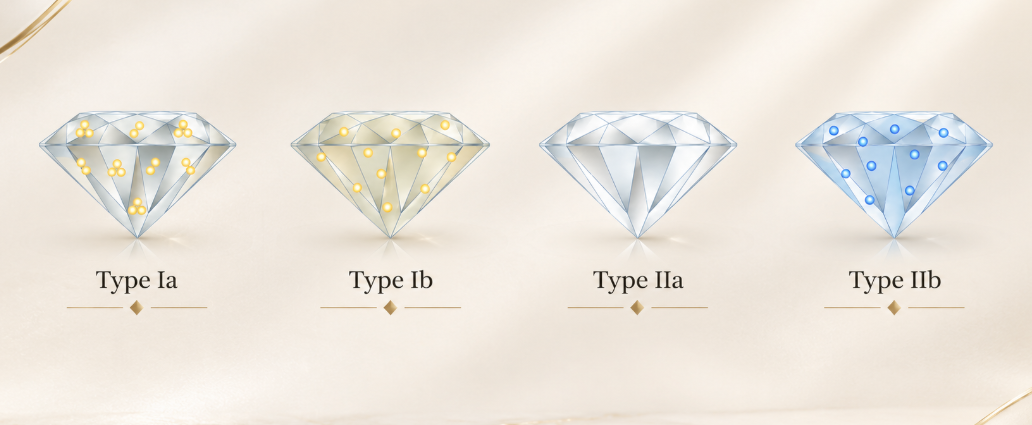
Type II diamonds are one of two broad categories in the diamond type system, with Type IIa and Type IIb as the two subtypes. If you want to read it in detail, you can go through our blog on diamond types. Here is where the four classifications sit:
- Type Ia: Contains aggregated nitrogen and accounts for the vast majority of natural gem diamonds. Its color varies depending on nitrogen concentration, defect structure, and other color-causing mechanisms.
- Type Ib: Contains isolated nitrogen atoms rather than aggregated nitrogen; rare in natural diamonds and commonly associated with yellow to orange coloration. Type Ib is not synonymous with 'canary,' which is a trade term used more broadly for strongly colored yellow diamonds.
- Type IIa: No detectable nitrogen at the levels used for type classification; commonly colorless or near-colorless. Type IIa diamonds can also occur in pink, brown, gray, and other colors because of other defects or impurities.
- Type IIb: Contains boron impurities and can conduct electricity; boron is the primary cause of color in many natural blue Type IIb diamonds.
How are lab-grown diamonds made?
Lab-grown diamonds are produced using two main methods: Chemical Vapor Deposition (CVD) and High Pressure High Temperature (HPHT).
Both methods grow genuine diamond crystals from a carbon source, producing stones with the same fundamental crystal structure and essential physical and chemical properties as natural diamonds.
The difference lies in the growth environment and the process of creating each diamond, which can influence the characteristics that result.
CVD vs. HPHT: How do they differ?
Both methods produce genuine lab-grown diamonds, but there are key differences in how the crystal grows and in the diamond characteristics that can result from each process. Here is a quick comparison for lab-grown diamond sourcing.
|
Factor |
CVD |
HPHT |
|
Growth environment |
Controlled chamber with carbon-rich gases |
High pressure and high temperature |
|
Typical diamond type |
Commonly Type IIa |
Can be Type IIa or other types |
|
Type IIa occurrence |
Common in colorless CVD diamonds |
Depends on growth conditions |
|
Color |
Can range from colorless to fancy colors |
Can range from colorless to fancy colors |
|
Growth characteristics |
Can vary with the CVD process |
Can vary with the HPHT process |
Neither method is inherently better. The individual diamond's quality, appearance, and laboratory documentation matter more than the growth method alone.
Type IIa vs. the 4Cs: What actually determines value?
Type IIa classification is not a value driver on its own. For trade buyers, color, clarity, cut, and carat weight (4Cs) remain important factors in evaluating a diamond's quality and marketability. Actual pricing also depends on factors such as shape, growth method, treatments, supply, and market demand.
1. Type IIa vs. Cut
Cut determines how well a diamond reflects light and how it performs face-up. A Type IIa diamond with a poorly executed cut will not outperform a well-cut Type Ia stone.
Under GIA's current Laboratory-Grown Diamond Quality Assessment, eligible colorless-to-near-colorless stones are classified as Premium or Standard based on defined thresholds for color, clarity, polish, and symmetry. Cut-grade criteria apply only to round brilliant diamonds.
2. Type IIa vs. Color
The absence of detectable nitrogen is one reason Type IIa diamonds are commonly colorless or near-colorless, but Type IIa classification does not guarantee a particular color grade.
Type IIa diamonds can still display brown, pink, gray, or other colors because color may result from structural defects, deformation, treatments, or other color-causing mechanisms unrelated to measurable nitrogen. The laboratory's reported diamond color assessment is the reliable measure, not type classification alone.
3. Type IIa vs. Clarity
Type IIa says nothing about a diamond's inclusions. IGI reports lab-grown diamond clarity using the traditional clarity scale. GIA's current Laboratory-Grown Diamond Quality Assessment instead uses the descriptive Premium and Standard classifications for qualifying colorless-to-near-colorless lab-grown diamonds.
Type IIa classification itself says nothing about clarity, so a Type IIa diamond can contain inclusions or other clarity characteristics.
4. Type IIa vs. Carat Weight
Carat weight simply measures the diamond's weight. The final polished weight depends on the size of the grown rough and how it is cut, not on whether the diamond is classified as Type IIa. Type IIa does not influence face-up size, depth percentage, or any other dimensional characteristic. A heavier carat weight does not become more valuable simply because the stone is Type IIa.
5. Type IIa and diamond appearance
Type IIa does not predict visible sparkle, fire, or brilliance. Those depend far more on cut, proportions, facet arrangement, and the individual stone's optical behavior. However, type classification alone does not predict a diamond's visible sparkle, brilliance, fire, or fluorescence. Those characteristics depend on multiple factors, including cut, proportions, defects, and the diamond's specific optical properties.
How can buyers verify Type IIa?
Verification of Type IIa status requires documentation rather than visual assessment. Here is the process for confirming classification before committing to an order.
1. Look for spectroscopic documentation
A Type IIa claim should be supported by laboratory documentation or spectroscopic analysis from a qualified gemological laboratory. GIA currently offers Diamond Type Analysis as an add-on to its natural-diamond services.
For a lab-grown diamond marketed specifically as Type IIa, request laboratory documentation that explicitly states the type classification or separate FTIR/spectroscopic analysis from a qualified gemological laboratory.
Other laboratories may also provide diamond-type information or spectroscopic documentation. Confirm exactly what testing was performed and what the issued report states. A supplier claiming Type IIa status without any supporting documentation should be treated as unverified.
2. Verify the report on the lab's official website
Major grading laboratories such as GIA and IGI provide online report verification tools. Enter the report number and confirm that the grading information on the physical or digital report matches what the laboratory has on file.
Any discrepancy between the supplier's documentation and the laboratory's database is a red flag worth investigating before the purchase.
3. Match the report to the diamond's laser inscription
Current GIA-assessed lab-grown diamonds are laser-inscribed with “Laboratory-Grown” and the assessment number, while IGI also laser-inscribes laboratory-grown origin and its report number. Confirm that the inscription corresponds to the documentation being presented.
When present, verify that the inscription matches the report or assessment number. This helps confirm that the physical stone corresponds to the laboratory documentation being presented.
4. Confirm the Type IIa classification
Not every grading report includes type classification by default. Confirm explicitly whether the type analysis is included on the report or whether it was performed separately.
Because Type IIa diamonds are uncommon in natural production, a Type IIa result can be useful as part of a broader laboratory examination of a natural diamond's origin and treatment history. Type IIa classification by itself does not establish whether a diamond is natural, laboratory-grown, or treated.
5. Consider independent verification for high-value purchases
For high-value purchases where Type IIa classification is central to the stone's positioning or pricing, independent verification can provide additional assurance.
Conclusion
Type IIa lab-grown diamond classification describes a diamond's impurity characteristics at the spectroscopic level, not its visual performance, quality grade, or market value. The absence of detectable nitrogen at the levels used for type classification is what defines Type IIa, which is why the classification is common among colorless CVD lab-grown diamonds.
As the introduction established, the term carries real technical meaning but gets treated as a marketing designation more often than it deserves. The 4Cs remain important quality and merchandising factors, while actual market pricing also depends on shape, growth method, treatment history, supplier, availability, and demand.
For retailers building lab-grown inventory, understanding this distinction helps you communicate the classification accurately to clients without overselling it, and helps you verify it correctly before placing sourcing orders.
If you are sourcing lab-grown diamonds with documented Type IIa classification and grading or quality-assessment information, browse Solitaire Lab Diamond's lab-grown diamond selection.
FAQs
1. Are Type IIa diamonds more expensive?
In natural diamonds, the rarity of Type IIa stones can contribute to a premium, depending on their overall quality, color, provenance, and market demand. For lab-grown diamonds, Type IIa is common enough that the classification should not be treated as an automatic quality or price premium.
2. Can natural diamonds be Type IIa?
Yes, although natural Type IIa diamonds are extremely rare (GIA). Type IIa classification can occur in both natural and laboratory-grown diamonds, so the classification alone does not establish a diamond's origin or treatment history. When origin or treatment matters to a transaction, appropriate laboratory testing should be used.
3. Does Type IIa affect diamond sparkle?
Not directly. Sparkle is determined by cut quality, proportions, and facet alignment, none of which are influenced by diamond type classification. However, this does not mean a Type IIa diamond will visibly outperform another diamond with an equivalent cut and color.
Resources: