
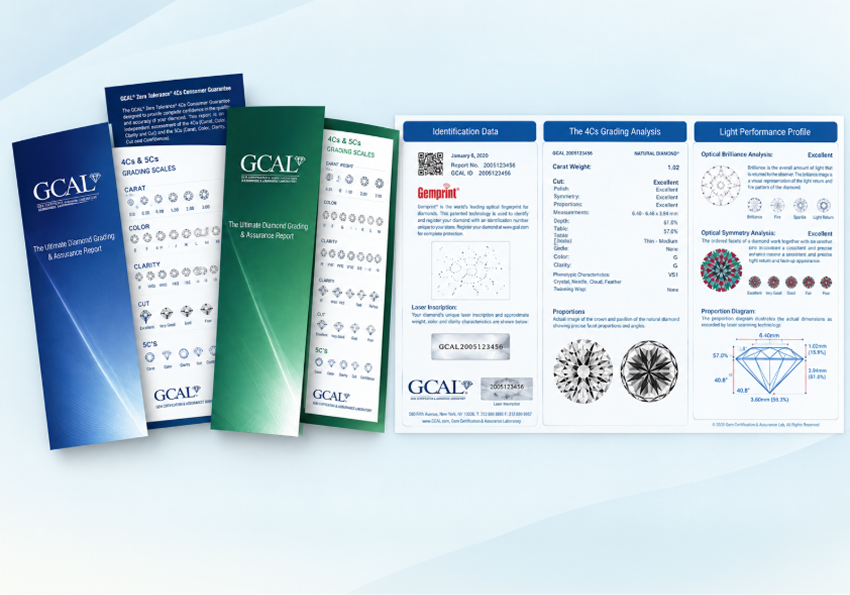
GCAL (Gem Certification & Assurance Lab), now GCAL by Sarine, provides independent grading services for natural and laboratory-grown diamonds. Its reports document diamond characteristics, with additional cut and optical-performance information available for certain certificate types.
For a closer look at the trade considerations behind GCAL certification, explore our guide to why GCAL certification matters for diamonds.
Here, you’ll get information related to what a GCAL certificate includes, how to verify it, and how GCAL compares with GIA and IGI.
Key takeaways
- A GCAL certificate documents a diamond's 4Cs, with additional features such as optical-performance imagery and Gemprint identification available on applicable certificates. The two-year consumer grading guarantee applies to qualifying 4Cs Grading Certificates, subject to GCAL's published terms.
- GCAL 8X is a separate, highly selective cut designation that requires Excellent ratings across all eight applicable criteria and is not awarded to every GCAL-certified diamond.
- GCAL differs from GIA and IGI in its optical performance documentation, Gemprint identification, fancy shape cut grading, and consumer grading guarantee.
- Before accepting any GCAL-certified diamond, verify the certificate number, match it to the laser inscription, and review the 4Cs, cut grade, and available optical performance imagery.
What is GCAL certification?
GCAL (Gem Certification & Assurance Lab) is a gemological laboratory based in New York City that provides diamond grading and verification services. A GCAL certificate documents a diamond’s key characteristics, including the 4Cs: Cut, Color, Clarity, and Carat Weight.
Depending on the certificate type, it may also include photography, cut-quality assessments, optical-performance information, and identifying details. Specialized options include GCAL 8X® Ultimate Cut Grade and Hearts & Arrows (H&A) analysis.
For trade buyers in New York, a GCAL certificate provides documented characteristics for evaluating natural and lab-grown diamonds. Verify the certificate through GCAL’s verification service, then assess the report alongside the diamond’s appearance, asking price, and supplier terms before sourcing the stone.
What information appears on a GCAL certificate?
Depending on the GCAL certificate type, report features can include:
- 4Cs assessment: Color, clarity, cut, and carat weight documented using standard gemological grading language.
- Proportion diagram: Specific measurements including table percentage, depth percentage, crown angle, and pavilion angle.
- Photomicrograph: A magnified photograph of the actual diamond, included on GCAL Guaranteed Certificates.
- Cut grade: Including the 8X designation where the diamond qualifies.
- Optical performance documentation: Fire, scintillation, optical brilliance, and optical symmetry imaging for 8X-graded stones.
- Laser inscription: Included with almost all GCAL Guaranteed Grading Certificates, with the corresponding certificate number. Lab-grown diamonds may also carry a laboratory-grown designation.
- Gemprint: An optical fingerprint that records the diamond's unique light-reflection pattern for identification.
- Consumer grading guarantee: Eligible GCAL 4Cs Grading Certificates include a two-year consumer guarantee, excluding trade purchases. Claims incur submission and return-shipping fees. Damage, treatment, re-polishing, or re-cutting voids the guarantee. Any payout equals the price paid minus the current fair market value, as determined solely by GCAL.
Does GCAL certify natural and lab-grown diamonds?
Yes. GCAL grades both natural and laboratory-grown diamonds. The report's origin designation helps buyers distinguish between them and compare the documented characteristics.
Confirm that the certificate matches the diamond being offered, as grading details and supporting documentation vary by report type. Trade buyers in New York can use GCAL’s verification service to check the recorded information before accepting a stone.
How to read and verify a GCAL certificate
Checking a GCAL certificate involves more than reviewing the 4Cs. Trade buyers should verify the certificate record, match the physical diamond to its documentation, and review the available cut and optical-performance information before purchasing.
1. Verify the GCAL certificate number
Enter the certificate number into GCAL's official online verification tool and confirm that all information on the physical or digital report matches what GCAL has on file. Any discrepancy between the certificate and the database record is a red flag worth investigating before accepting the stone.
2. Match the laser inscription
Confirm that the certificate number inscribed on the diamond's girdle matches the number on the report or certificate record. For a laboratory-grown stone, confirm that the girdle inscription matches the inscription information shown on the GCAL certificate or digital record, including the laboratory-grown identification where applicable.
3. Review the 4Cs
Check color, clarity, cut, and carat weight against your sourcing requirements. For step-cut diamonds, review inclusion location as well as the clarity grade because inclusions beneath the open table may be more noticeable depending on their size, type, and position.
4. Check the cut grade and GCAL 8X® designation
Confirm whether the diamond qualifies for GCAL 8X®, which requires Excellent ratings across all eight applicable criteria. The designation is not included with every GCAL grading certificate. For a detailed explanation of its cut criteria, read our guide to what is a GCAL 8X® cut.
5. Review optical performance imagery
GCAL's digital verification materials for applicable certificates can include 360° video, Fire video, and Scintillation video, along with still images. Reviewing available videos alongside still images can help buyers assess the diamond's appearance and documented optical performance before placing an order.
6. Check Gemprint and identification information
Confirm that the Gemprint record is included, if applicable to that certificate type, and that the identification information on the certificate matches the physical stone. For high-value purchases, Gemprint provides an additional identification method beyond the laser inscription.
GCAL vs. GIA vs. IGI: What should buyers know?
GCAL, GIA, and IGI are established diamond-grading laboratories, but their reports emphasize different aspects of diamond evaluation and documentation. For trade buyers, the differences are most relevant when comparing cut assessment, optical-performance information, identification features, and the type of assurance provided with a grading report.
|
Feature |
GCAL |
GIA |
IGI |
|
Lab-grown diamond grading |
Yes, including 8X for eligible diamonds. |
Premium/Standard Quality Assessment for eligible colorless-to-near-colorless lab-grown diamonds. |
Yes, with service-specific report options. |
|
Fancy-shape cut assessment |
8X available for eligible shapes. |
No standard overall cut grade for fancy shapes. Eligible diamonds may qualify for the AGS Ideal® Report. |
Fancy-shape cut grades from Excellent to Poor. |
|
Optical-performance documentation |
Optical assessment and imaging under 8X. |
Optical assessment through the AGS Ideal® Report for eligible diamonds. |
Light Performance Report available for qualifying round diamonds; separate cut-grading options are available for eligible fancy shapes. |
|
Hearts and Arrows documentation |
Separate 8X criterion for qualifying round brilliants. |
Not standard on grading reports. |
Dedicated Hearts & Arrows Report available; not standard on every grading report. |
|
Gemprint identification |
Available on applicable certificates. |
No comparable standard report feature. |
No comparable standard report feature. |
|
Laser inscription |
Available on applicable certificates. |
Available on applicable diamonds and reports. |
Available on applicable diamonds and reports. |
|
Consumer grading guarantee |
Financially backed guarantee on qualifying 4Cs certificates, subject to terms. |
No comparable GCAL-style consumer guarantee identified in the standard report framework. |
No comparable GCAL-style consumer guarantee identified in the standard report framework. |
The right laboratory depends on the documentation required for sourcing. GCAL emphasizes its 8X® assessment and optical-performance documentation, while GIA and IGI offer their own grading and reporting services.
What should trade buyers check before sourcing a GCAL-certified diamond?
A GCAL certificate provides documented information about a diamond, but it should not be the sole basis for a sourcing decision. Trade buyers should review the grading details, assess the stone's appearance, and compare its price and supplier terms before accepting the stone.
- Review the full grading details: Check the 4Cs and confirm that the documented characteristics match your requirements. The report can help you assess the diamond's quality, but it does not replace examining the stone itself.
- Assess the diamond cut: Review the available cut grade, proportions, and optical-performance data, if provided. For eligible stones, GCAL 8X® offers additional information about cut and optical performance.
- Evaluate the diamond's appearance: Consider its shape, light return, visible inclusions, and suitability for your intended design. Available images and videos can help you assess its appearance before purchasing.
- Compare the complete offering: Compare diamonds with similar specifications and consider the price, return policy, warranty, and other supplier terms. This helps you evaluate the overall value rather than relying on the grading report alone.
- Distinguish grading from valuation: A GCAL certificate is not an appraisal or a valuation. Review the grading information separately from any valuation needed for your business.
Conclusion
GCAL certification provides trade buyers with documented information about a diamond’s characteristics, grading, and, where applicable, optical performance. Specialized assessments such as GCAL 8X® can provide additional information for evaluating eligible diamonds.
Before sourcing a stone, verify its grading report, compare its documented specifications with its appearance, and review the supplier’s terms. Explore lab-grown diamonds at Solitaire Lab Diamond to compare available options for your inventory.
Frequently asked questions
1. Is GCAL a diamond grading laboratory?
Yes. GCAL (Gem Certification & Assurance Lab), now GCAL by Sarine, is a gemological laboratory that provides diamond grading and verification services.
2. Can lab-grown diamonds receive GCAL certificates?
Yes. GCAL grades both natural and laboratory-grown diamonds. The report identifies the diamond’s origin and documents its characteristics, with available features depending on the certificate type.
3. How can I verify a GCAL certificate?
Enter the certificate number into GCAL’s official online verification tool. Compare the online record with the report and, where applicable, check the diamond’s laser inscription to confirm that the identification details match.
4. Does every GCAL-certified diamond qualify for GCAL 8X®?
No. GCAL 8X® is a specific cut-grading designation available to eligible diamonds that achieve Excellent ratings across all eight applicable criteria. A GCAL grading certificate does not automatically mean the diamond qualifies for 8X®.
Resources: