
Diamond grading reports give jewelers, retailers, designers, and other trade buyers an independent record of a stone’s key characteristics, including cut, color, clarity, and carat weight. This documentation supports consistent comparisons, although appearance, pricing, and suitability for a particular customer or inventory requirement must be assessed separately.
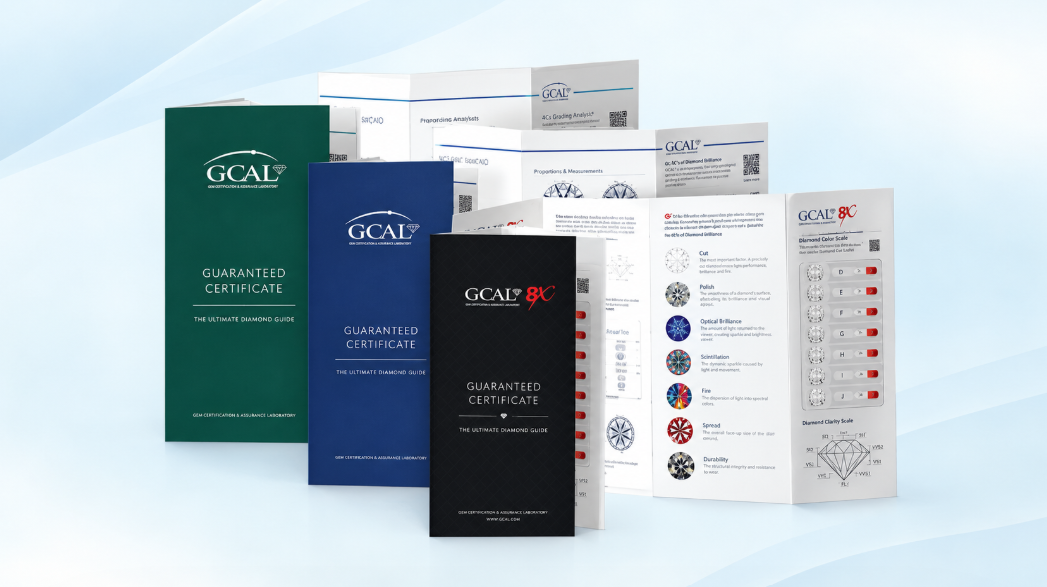
GCAL (Gem Certification and Assurance Lab), now operating as GCAL by Sarine, provides grading services for natural and lab-grown diamonds. Understanding its certificate types, 8X® cut assessment, and grading guarantee helps trade buyers evaluate documentation when sourcing diamonds for inventory or client requirements.
For a broader overview of the laboratory's documentation and grading process, read our guide to GCAL certification.
Key takeaways
- GCAL certification provides independently documented grading information buyers can verify, but does not replace assessing the diamond's appearance, price, and suitability.
- For eligible diamonds, the 8X designation documents eight cut-quality criteria, including optical performance, beyond what a standard color and clarity grade covers.
- GCAL offers a two-year consumer grading guarantee on qualifying 4Cs certificates, covering grading accuracy and natural or lab-grown identification, subject to published terms.
- A standard GCAL certificate and a GCAL 8X designation are not the same; features included depend on the certificate type and whether the stone qualifies for 8X.
Why is GCAL certification important to diamond buyers?
GCAL certification is important for diamonds because it provides independently documented grading information that buyers can reference, verify, and compare. That documentation supports more informed purchasing decisions without replacing the need to assess the stone and evaluate the seller's terms separately.
1. Confidence in documented diamond grading
Independent grading gives trade buyers a third-party record of a diamond’s documented characteristics. This helps jewelers and retailers compare stones against specifications rather than relying on a supplier’s description alone.
A certificate reflects the diamond as evaluated by the laboratory. It does not determine the stone’s visual appeal, suitability for a particular setting, or value at a given price. For details on certificate contents and how to verify them, read our guide to GCAL certification.
2. Additional cut and optical performance information
GCAL 8X® evaluates eight cut-quality criteria, including polish, proportions, external symmetry, light performance, and optical symmetry. The assessment also considers optical brilliance, fire, and scintillation. Round brilliant diamonds are assessed for Hearts and Arrows, while eligible fancy shapes are assessed for Shape Aesthetics. A diamond must receive an Excellent rating in all eight applicable criteria to qualify for the 8X® designation.
For a detailed explanation of the assessment and its criteria, read our guide to the GCAL 8X® cut grade.
Not every GCAL certificate includes this level of detail. The availability of cut grading, optical performance imagery, and Hearts and Arrows documentation depends on the certificate type and whether the stone qualifies for the 8X designation. Buyers should confirm what is included on the specific certificate rather than assuming all GCAL reports carry the same documentation.
3. Diamond identification and verification
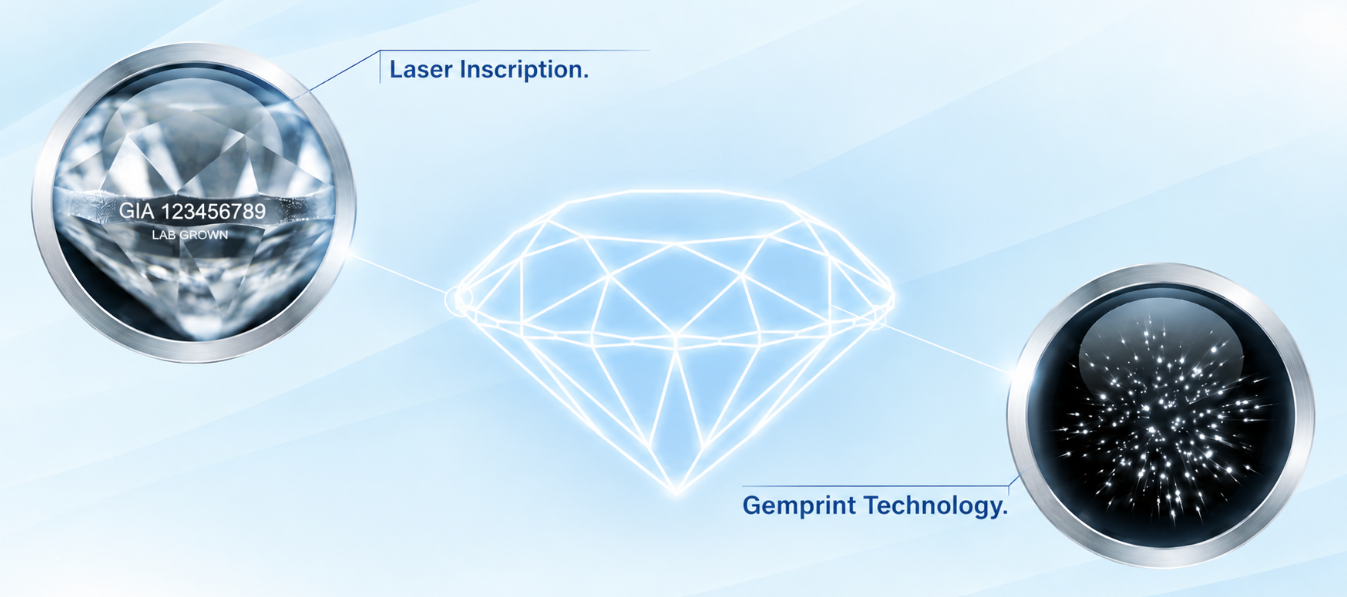
Depending on the certificate and identification services provided, a GCAL-graded diamond may have a laser inscription and Gemprint identification. A laser inscription on the diamond's girdle can help match the stone to its certificate number.
When researching GCAL lab-grown diamonds, buyers should check whether the specific certificate includes an inscription identifying the stone as laboratory-grown.
Gemprint uses the pattern of light reflections from a diamond to create an optical fingerprint that can support identity verification. If these features are included with the diamond, buyers can use them alongside the certificate's identifying details to help confirm that the stone matches its documentation.
4. Grading guarantee for eligible certificates
GCAL offers a two-year consumer grading guarantee on eligible 4Cs Grading Certificates, starting from the certificate date. It covers carat weight, cut, color, and clarity within recognized gemological tolerances, as well as the diamond’s identification as natural or lab-grown, subject to the published terms.
If GCAL confirms a qualifying grading or identification error, reimbursement is based on the difference between the original purchase price and the current fair market value of an equivalent diamond at the corrected grade or weight, as determined by GCAL.
Claims require an unmounted diamond, the original retail receipt, and the original certificate. Submission and return shipping fees apply. The guarantee is non-transferable, applies only to eligible consumer purchases, and may be affected by damage, treatment, recutting, repolishing, or other alterations. Trade buyers should confirm their contractual protections separately.
What is GCAL's connection to New York?
GCAL was founded in New York City in 2001 by Donald and Pamela Palmieri. Its founding principles included independent diamond grading and consumer protection, with a focus on standing behind its grading conclusions through a written guarantee. These principles have remained central to GCAL's approach to diamond grading.
Sarine announced its plan to acquire a majority stake in GCAL in January 2023 and completed the acquisition in May 2023. GCAL subsequently operated under the GCAL by Sarine brand, combining GCAL’s diamond grading and consumer guarantee with Sarine’s grading technology. In January 2024, GCAL by Sarine opened a grading laboratory in Surat, India, while maintaining its New York presence (National Jeweler).
GCAL's New York origins place its history within the US diamond trade. However, buyers should assess the grading documentation, applicable guarantee terms, and the diamond itself rather than treating its location as a measure of quality.
How can GCAL certification help buyers compare diamonds?
A GCAL grading certificate helps trade buyers assess a diamond against specifications, compare prices across similar stones, and review available cut and optical performance information. Use these details alongside the stone’s appearance and the supplier’s terms when making sourcing decisions.
- Check the documented grades: Confirm that the 4Cs align with your specifications and inventory requirements.
- Review additional cut data: For eligible 8X® stones, use the available optical performance information to assess cut quality beyond the basic grades.
- Compare like-for-like pricing: Evaluate diamonds with comparable characteristics rather than comparing prices in isolation.
- Assess the stone and supplier: Review available images or videos, examine the diamond where possible, and check return policies and other purchasing terms.
Is GCAL certification enough to choose a diamond?
No. A GCAL grading certificate provides important information about a diamond, but it does not determine whether the stone is the right choice for a particular buyer. Inclusion placement, face-up appearance, proportions, and visual performance can all influence how a diamond looks.
Review the available images and videos, and examine the stone in person when possible. Consider its price, the intended setting, and the supplier's return policy before making a final decision.
It is also worth distinguishing general GCAL certification from the GCAL 8X designation specifically. A standard GCAL certificate documents the diamond's grading characteristics, but it does not automatically include the full eight-criterion evaluation associated with the GCAL 8X designation. The specific optical performance data and identification features available depend on the certificate type.
Conclusion
GCAL by Sarine provides independent diamond grading and, for eligible stones, the 8X® cut assessment, backed by a two-year consumer grading guarantee on qualifying 4Cs certificates.
For jewelers, retailers, designers, and other trade buyers, understanding the certificate’s scope and guarantee limitations helps when comparing stones for inventory or client requirements. The diamond’s appearance, price, and supplier terms remain important parts of the sourcing decision.
Explore Solitaire Lab Diamond’s lab-grown diamond selection to compare stones for your sourcing needs.
Frequently asked questions
1. Does GCAL certification guarantee a diamond's beauty?
No. GCAL certification documents a diamond's grading characteristics, including cut, color, clarity, and carat weight. How a stone looks in person, how it performs under different lighting conditions, and whether it suits a buyer's preferences are separate considerations that the certificate does not determine.
2. Is GCAL 8X the same as GCAL certification?
No. GCAL 8X is a specific cut-grading designation for eligible diamonds that meet all eight applicable criteria at the Excellent level. A standard GCAL certificate documents the diamond's grading characteristics but does not automatically include the 8X designation.
3. Does GCAL offer grading services for lab-grown diamonds?
Yes. GCAL grades both natural and lab-grown diamonds. Its qualifying 4Cs certificates document carat weight, color, clarity, and cut, while eligible stones may also receive the GCAL 8X cut designation. Check the specific certificate to confirm which grading details and identification features are included.
Resources: