Elongated radiant cut diamonds can be challenging to source consistently because stones with similar carat weights may differ noticeably in outline, proportions, and face-up appearance.
Two stones described as "elongated radiant" at a similar carat weight can look noticeably different face-up depending on ratio, depth, facet arrangement, and the resulting contrast pattern. For jewelers and trade buyers, that variability is the sourcing problem this guide addresses.
For context on how the radiant cut compares to a similar step cut shape, the radiant cut vs emerald cut guide covers the structural differences in detail.
What is an Elongated Radiant cut diamond?
There is no industry-standard length-to-width ratio that defines an elongated radiant. For this guide, we use approximately 1.20 and above as a practical working range for noticeably elongated stones.
The radiant cut is a mixed cut that combines step-cut and brilliant-style faceting, with its brilliant-style facets contributing much of its characteristic sparkle. For a broader overview of the shape's structure and characteristics, see our radiant cut diamond guide.
The rectangular diamond has cropped, rounded corners, which distinguishes it from a princess cut diamond (which has pointed corners) and from an emerald cut (which uses step-cut facets instead of brilliant-cut facets). The cropped corners remove the exposed points found on shapes such as princess cuts, which can reduce the vulnerability of the corners to accidental impact.
For natural diamonds, GIA does not assign its standard overall cut grade to radiant or other fancy shapes. Under GIA's current laboratory-grown diamond system, eligible stones receive a Premium or Standard Quality Assessment, but radiant cuts still do not receive a separate overall cut grade. As a result, proportions, symmetry, polish, and individual visual evaluation are especially important when assessing the stone.
The distinction between square radiant, rectangular radiant, and elongated radiant is a matter of ratio rather than a formal grading category. There is no universal definition of where "rectangular" ends and "elongated" begins, which is one of the core sourcing challenges covered in this guide.
Natural vs. Lab-grown Elongated Radiant cut diamonds
Both options are viable, but they serve different sourcing realities and inventory strategies.
|
Factor |
Natural Elongated Radiant |
Lab-grown Elongated Radiant |
|
Availability |
Can vary by size, ratio, and supplier inventory |
May offer broader availability depending on supplier inventory |
|
Price |
Generally higher at comparable specifications |
Generally lower at comparable specifications |
|
Grading documentation |
GIA, IGI, and other recognized laboratories, depending on the service |
GIA, IGI, and other recognized laboratories, depending on the service |
|
Matched pairs |
May require more searching across inventory |
May be easier when calibrated or closely matched inventory is available |
|
Ratio consistency |
Depends on available inventory |
Repeatable ratios may be easier to source when a supplier cuts or stocks to defined specifications |
|
Replenishment |
Depends on future inventory availability |
Replenishment may be easier when comparable specifications remain available |
Lab-grown elongated radiant cut diamonds may make it easier to source consistent ratios across a collection or replenish similar specifications when a supplier offers repeatable inventory.
How to evaluate an Elongated Radiant cut diamond
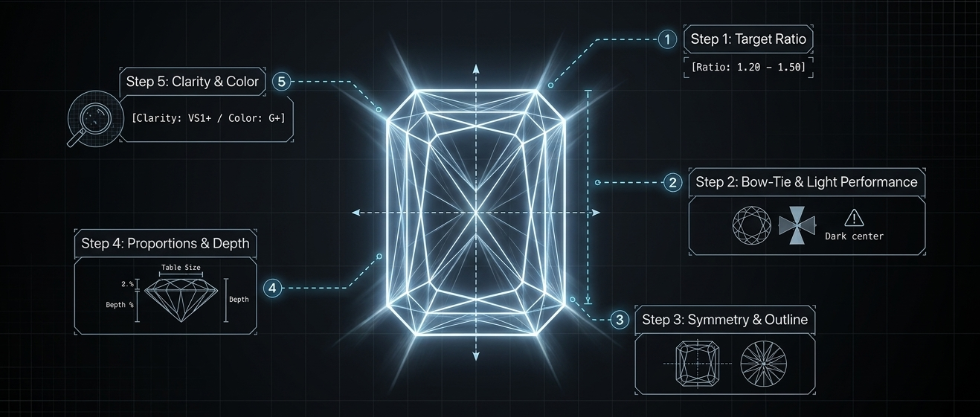
Evaluating an elongated radiant cut diamond requires looking at several variables together rather than relying on any single metric.
1. Length-to-width ratio
The length-to-width ratio is the first number to define before sourcing, because it determines how an elongated diamond reads face-up. A ratio around 1.20 to 1.50 can cover a useful range of elongated radiant styles, although there is no universally accepted cutoff for an "elongated" radiant. Around 1.30 to 1.40 can be a useful starting range for retailers seeking a clearly elongated but not extremely narrow appearance.
Ratios below about 1.20 generally read less elongated and may appear closer to a square or softly rectangular radiant, depending on the stone's outline. Ratios above 1.50 create a more elongated look and may be better suited to buyers or designers specifically seeking a more strongly elongated outline.
Decide in advance which ratio range you want to stock rather than accepting whatever comes from the cutter.
2. Bow-tie and light performance
Elongated radiant cut diamonds can show a bow-tie effect, a darker band across the center caused by the interaction of the stone's faceting and viewing light. Its visibility varies with the stone's proportions, facet arrangement, and length-to-width ratio.
A mild bow-tie may be acceptable depending on the intended look, but its visibility should still be evaluated in the actual stone. Radiant diamonds can display darker central contrast patterns. If that contrast is broad, dark, or persistent enough to distract from the stone's overall appearance, it may be a reason to reject the stone for a particular assortment.
Request stone-specific video from multiple angles and, where possible, more than one lighting environment to evaluate contrast, bow-tie visibility, and overall face-up appearance.
3. Symmetry and outline
Symmetry in an elongated radiant affects how the stone reads in the setting. The outline should be even on both long sides, with no visible bulging or pinching along the rectangular shape. Cropped corners should be consistent in size and angle on all four corners.
For natural diamonds with GIA grading reports, Very Good or Excellent symmetry can be used as a sourcing preference, but the grade should still be confirmed visually. For IGI-graded fancy shapes, review the symmetry and overall cut assessment together rather than treating symmetry alone as a proxy for visual performance.
4. Table, depth, and proportions
As an initial screening tool, some buyers use table and depth percentages to narrow a radiant-cut search, but there is no universally accepted set of ideal proportions that guarantees strong light performance. Use these numbers alongside the stone's actual appearance and elongated proportions rather than as pass/fail criteria.
Depth percentage affects how the stone faces up relative to its carat weight. Elongated radiant cuts often appear larger than round diamonds of similar carat weight. At the same carat weight, a deeper radiant may have less face-up spread than a shallower stone, although actual millimeter dimensions depend on the stone's full set of proportions.
It is worth communicating clearly to retail clients who are comparing stones by carat rather than by face-up dimensions.
5. Clarity and color
For many retail assortments, VS2 to SI1 can be a practical starting range for elongated radiant cut diamonds. However, clarity should be evaluated stone by stone because brilliant-style faceting can help mask some inclusions compared with open step cuts such as emerald cuts. “Eye-clean” is a visual trade description, not an official laboratory clarity grade.
For many white-metal assortments, G to H can be a useful starting point, while H to I may work well in yellow or rose gold depending on the stone and the intended look. Radiant cuts can show color differently from round diamonds, so evaluate the actual stone rather than automatically moving up a color grade.
Sourcing elongated Radiant Cut diamonds
Sourcing elongated radiant cut diamonds requires a closer look at proportions, dimensions, and visual performance than carat weight alone can provide. A consistent evaluation process helps retailers select stones that meet their design requirements and maintain a cohesive inventory.
What to check before ordering
Radiants generally require more stone-specific visual evaluation than standard round brilliants because fancy-shape proportions and facet arrangements vary more widely, and GIA does not provide its standard overall cut grade for them.
- Confirm exact measurements in millimeters, not just carat weight and ratio.
- Define your target ratio before reviewing stones, not after.
- Request video in multiple lighting conditions to assess bow-tie, contrast, and overall face-up appearance.
- Compare stones with similar ratios and dimensions side by side before committing.
- Review outline shape and corner consistency visually.
- For collection building, maintain consistent ratio ranges across pieces to keep the assortment visually coherent.
Sourcing matched pairs
Matched pairs for earrings, three-stone designs, or multi-stone layouts require additional evaluation criteria beyond individual stone selection.
Matching criteria for elongated radiant pairs should cover actual millimeter dimensions, ratio, outline shape, similar color and clarity characteristics, and overall face-up appearance. The same ratio does not guarantee identical visual appearance because depth and facet pattern differences between two stones at the same ratio can produce noticeably different face-up sizes and light behavior.
Lab-grown elongated radiant cut diamonds can make matched-pair sourcing more manageable when a supplier can provide stones produced or sourced to consistent dimensions and ratios.
Setting options for elongated Radiant-Cut diamonds
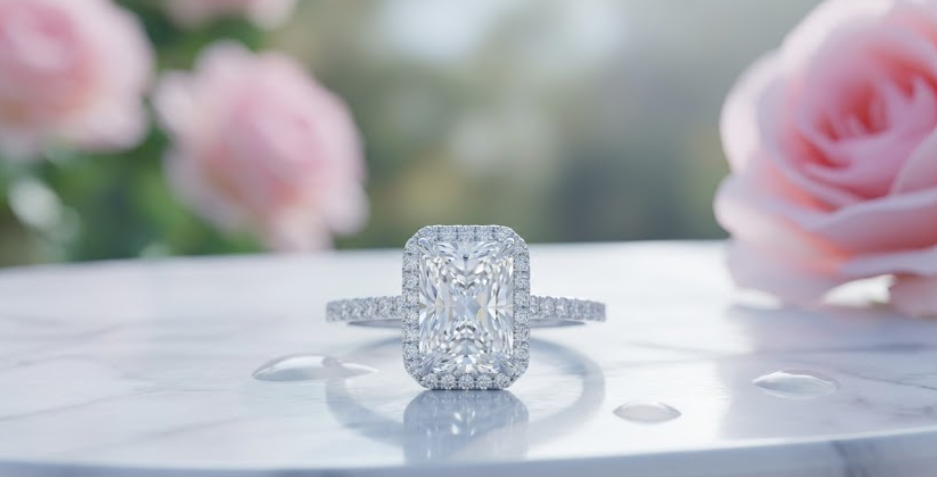
The right setting can enhance an elongated radiant cut diamond while balancing its proportions, visibility, and everyday wearability. From minimalist solitaires to bezels and hidden halos, the setting should complement the stone's elongated shape without overwhelming it.
1. Solitaire with minimal prongs
A four-prong solitaire with minimal metal coverage suits the elongated radiant's brilliant sparkle and keeps the rectangular outline visible from above. The cropped corners generally make standard prong or bezel approaches practical, although the exact placement should be determined by the stone's corner geometry and the setting design.
Setting height should be chosen based on the desired side profile, wedding-band compatibility, security, and everyday wear preferences.
2. Three-stone setting
An elongated radiant center with side stones is a popular choice for radiant-cut engagement rings and works well with this shape. Tapered baguettes, shield-cut diamonds, or half-moon side stones complement the rectangular silhouette without competing with the center stone's sparkle.
Choose side-stone dimensions based on the desired overall proportions of the finished ring, considering the center stone's width, outline, setting geometry, and visual balance.
3. Bezel setting
A full or partial bezel can suit an elongated radiant well, with the bezel providing coverage around the cropped corners. The exact fit should be determined by the stone's measurements and corner geometry.
A bezel can provide substantial protection around the stone's perimeter, including the cropped corners, which can be useful for daily-wear designs. A partial bezel with exposed long sides retains more face-up visibility while still providing corner protection.
4. Hidden Halo
A hidden halo places small accent diamonds beneath the center stone, typically around the gallery or just below the girdle. It adds sparkle from side and angled views while usually preserving the center stone's outline when viewed face-up.
Square vs. Rectangular vs. Elongated Radiants
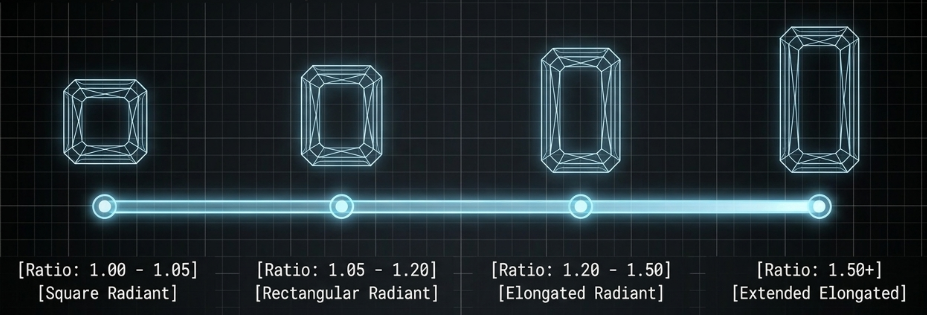
The distinction between these descriptions is ratio-based rather than formally defined by any grading organization. The ranges below are practical working ranges for sourcing, not industry-standard classifications.
|
Description |
Typical L/W Ratio |
Visual Character |
Outline Description |
|
Square radiant |
1.00 to 1.05 |
Balanced, near-square face-up |
Solitaires, classic bridal |
|
Rectangular radiant |
1.05 to 1.20 |
Slightly elongated, still reads squarish |
Three-stone, bezel settings |
|
Elongated radiant |
1.20 to 1.50 |
Clearly elongated, visually lengthening effect |
Solitaires, three-stone, contemporary bridal |
|
Very elongated |
Above 1.50 |
Very long, dramatic silhouette |
Custom design, statement pieces |
Understanding where a stone sits within this range before sourcing prevents the mismatch between what a retail client expects and what arrives.
Conclusion
Elongated radiant cuts vary considerably from stone to stone, even when carat weight and length-to-width ratio are similar. The term "elongated" is a useful description of this unique shape, not a standardized ratio. And two stones with identical descriptions can look very different face-up depending on depth, bow-tie, and facet arrangement, proportions, and central contrast pattern.
The practical sourcing framework is straightforward:
- Use 1.20 to 1.50 as a practical working range for sourcing.
- For retailers that want a moderately elongated look, 1.30 to 1.40 can be one practical starting range.
- Evaluate bow-tie through actual stone imagery or video rather than relying on the grading document.
- Confirm millimeter dimensions before ordering.
Lab-grown elongated radiant cut diamonds can make consistent sourcing and matched-pair replenishment more manageable when suppliers can provide repeatable dimensions and inventory. Pricing and laboratory documentation still depend on the individual stones and supplier.
If you are ready to build out your elongated radiant cut inventory with lab-grown diamonds at consistent ratios, browse Solitaire Lab Diamond's radiant cut selection.
Frequently asked questions
1. Is a 1.30 ratio good for an elongated radiant cut diamond?
A 1.30 ratio can be a useful starting point if you want a clearly rectangular shape without an extremely elongated outline. It is not a quality benchmark, and the preferred ratio ultimately depends on design and customer preference.
2. Does ratio affect the sparkle of an elongated radiant cut diamond?
Ratio changes the diamond's outline, but it does not determine sparkle on its own. Light performance and central contrast depend on the stone's complete facet arrangement, proportions, and viewing conditions. Two radiants with the same length-to-width ratio can look very different face-up.
3. Are elongated radiant diamonds more expensive than square radiants?
Price per carat is not consistently higher for elongated radiants than square radiants. The price relationship depends on market demand, availability at specific ratios, and individual stone characteristics. In the lab-grown category, elongated radiants may be available at competitive price points, but pricing depends on size, quality, availability, and supplier inventory.
4. Does GIA give elongated radiant diamonds a cut grade?
For natural diamonds, GIA does not assign its standard overall cut grade to radiant or other fancy-shaped diamonds. Under GIA's current laboratory-grown service, eligible radiants can receive an overall Premium or Standard Quality Assessment, but they do not receive a separate overall radiant cut grade. For natural GIA reports, polish, symmetry, measurements, and other report data should be considered alongside direct visual evaluation.
Resources: